
General Tso's Chicken
Crispy General Tso's Chicken features deep-fried chicken thighs tossed in a sticky, savory glaze.
Contents (5 sections)▾
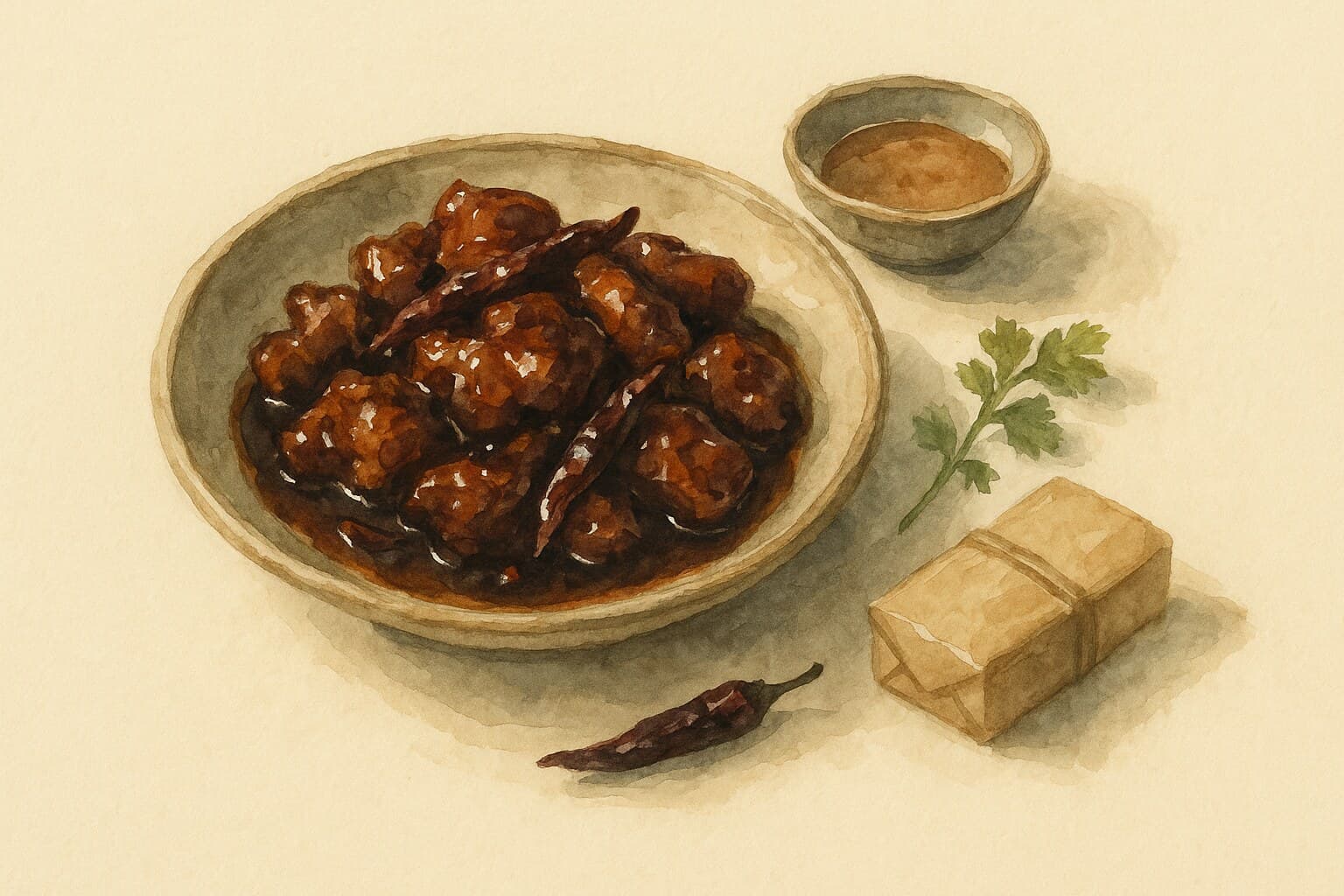
Ingredients
- 500 g chicken thighs, boneless and skinless
- 100 g cornstarch
- 2-3 dried chilies, to taste
- 3 cloves garlic, minced
- 1 inch ginger, grated
- 60 ml soy sauce
- 50 g sugar
- 30 ml rice vinegar
- oil for deep frying, enough to submerge chicken
Steps
Cut the chicken thighs into bite-sized pieces and marinate with soy sauce, garlic, and ginger for at least 15 minutes.
Heat oil in a deep fryer or a heavy pot to 175°C (350°F).
Dredge each marinated chicken piece in cornstarch, shaking off excess before carefully adding to the hot oil.
Fry the chicken in batches for about 5-7 minutes until golden brown and the internal temperature reaches 74°C (165°F).
Remove the chicken and drain on paper towels. Allow to rest while preparing the glaze.
In a separate pan, combine soy sauce, sugar, rice vinegar, and dried chilies. Simmer on medium heat until thick and sticky.
Toss the deep-fried chicken in the glaze just before serving to maintain its crispiness.
Tools you'll want
- · Cast-iron skillet (Lodge, 6.5–10in)
Why this works
The key to achieving that perfect crispy texture in General Tso's Chicken lies in the cornstarch (a fine white starch from corn that fries up light and crisp) batter and the correct frying temperature. The cornstarch creates a light, crispy crust when deep-fried (cooked fully submerged in hot oil, so it crisps all over) at 175°C, while the chicken cooks to a safe 74°C internally. The quick frying helps prevent the chicken from absorbing too much oil, keeping it juicy. Additionally, by tossing the chicken in the glaze (the thick, glossy sauce that coats each piece) at the end, you ensure the crispy texture is preserved, as the glaze does not have time to soak into the crust. If the chicken pieces seem too wet before frying, pat them dry with a paper towel to enhance crispiness. If the glaze is too thick, a splash of water can be added to reach the desired consistency.
Common mistakes
Dropping too much chicken into the oil at once.
Target: Oil back at 175°C before each batch, and never more than a single loose layer of pieces.
Why it matters: Cold chicken pulls heat out of the oil. If the temperature falls below about 150°C the coating soaks up oil instead of crisping, and you get pale, heavy, greasy pieces. Frying in batches is what keeps the crust light.
What to do: Use a thermometer clipped to the pot. Fry 6–8 pieces at a time and wait for the reading to climb back to 175°C between batches.
Dredging chicken that is still wet with marinade.
Target: Surface just tacky, not dripping, before it goes into the cornstarch.
Why it matters: Soy sauce clinging to the pieces turns the cornstarch into a paste. Paste slides off in the oil, leaving bare patches and cloudy oil instead of a dry, shattering crust.
What to do: Lift the chicken from the marinade with tongs, let it drip, then blot lightly with paper towel. Toss in cornstarch, press it on, and shake off every loose bit before frying.
Judging doneness by color alone.
Target: 74°C (165°F) in the middle of the thickest piece, measured with an instant-read thermometer.
Why it matters: Golden-brown is a surface event; it can happen a minute or two before the middle of a chunky piece is cooked. Chicken needs to reach 74°C to be safe, and thigh meat stays juicy at that temperature rather than drying out.
What to do: Cut the thighs into even bite-sized pieces so they finish together, and check the biggest one. Anything undercooked can go straight back into the oil.
Cooking the glaze too far.
Target: A syrup that coats the back of a spoon and falls in a slow ribbon — thick, but still pourable.
Why it matters: The glaze is mostly sugar with soy sauce and vinegar. Past the syrup stage the sugar keeps concentrating, and it sets to a hard, bitter candy on the chicken as it cools.
What to do: Keep the heat moderate and stir. If it goes too thick, take it off the heat and stir in a tablespoon of water at a time until it flows again.
Saucing the chicken too early.
Target: Toss in the last 20–30 seconds before it reaches the table.
Why it matters: The crust is a dry, porous shell. The moment it meets liquid it starts drinking it up, and within a few minutes the crunch is gone for good.
What to do: Have plates, rice, and everyone at the table ready first. Then toss and serve. Leftovers will never be crisp again — reheat them in a hot oven rather than a microwave.
What to look for
- Oil at frying temperature: a pinch of dry cornstarch dropped in fizzes at once and floats; a wooden chopstick held upright grows a steady stream of small bubbles. Slow, lazy bubbles mean it is too cool.
- Coated chicken ready to fry: matte and chalky-dry all over, with no shiny or damp patches and no clumps of loose powder.
- During the fry: a loud rolling boil of a sizzle for the first minutes — that is water leaving the coating — settling into a finer, quieter crackle as the pieces finish. The sound dropping is your first hint they are nearly done.
- Cooked chicken: deep even golden brown, and each piece feels light and rigid when you lift it with a spider or tongs. Confirm with the thermometer: 74°C.
- The glaze: glossy and dark, bubbling in slow thick bubbles rather than fast thin ones. Draw a spatula across the pan — the trail should hold for a second before filling in. The vinegar's sharp smell will have softened into something rounder.
- Finished dish: every piece wearing a thin shiny coat, with no sauce pooling in the bottom of the bowl; you can still hear a crunch when you bite.
A note on history
Despite the name, this dish has no connection to the nineteenth-century Qing general Zuo Zongtang beyond the borrowing of his name. It was created by the Hunanese chef Peng Chang-kuei, who cooked it in Taiwan in the 1950s after fleeing the Chinese Civil War, and brought it with him when he opened a restaurant in New York in 1973 — where other cooks made it sweeter and crisper for American tastes, producing the version most people now recognize. (Sources: General Tso's chicken — Wikipedia, TIME: the creator of General Tso's chicken)
Get the essays in your inbox — free
Weekly notes on flavor, fermentation, and food history — the writing behind the Atlas of Flavor. No spam; unsubscribe anytime.