
Cantonese Congee (Jook)
Cantonese congee is a creamy rice porridge that showcases the art of starch breakdown through gentle cooking.
Contents (5 sections)▾
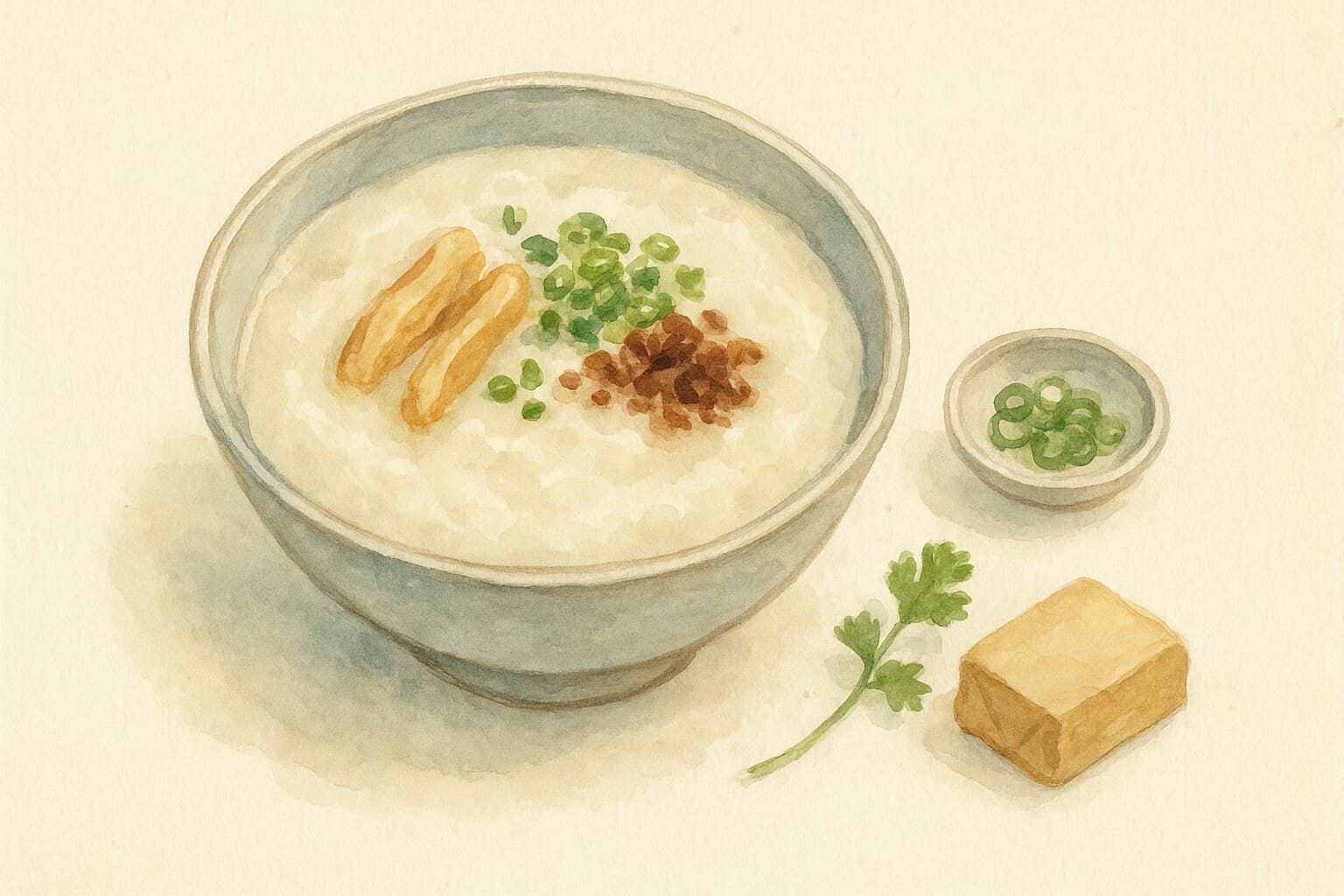
Ingredients
- 1 cup jasmine rice
- 8 cups water or chicken broth
- 1 inch ginger, sliced
- 2 scallions, chopped
- 2 tablespoons sesame oil
- Salt to taste
- Toppings of choice (e.g., century egg, chicken, or mushrooms)
Steps
Rinse the jasmine rice under cold water until the water runs clear, about 2-3 minutes, to remove excess starch.
In a large pot, combine the rinsed rice and 8 cups of water or chicken broth. Bring to a boil over high heat.
Once boiling, reduce the heat to low. Add the sliced ginger to enhance the congee's flavor. Cover and simmer for about 1 hour, stirring occasionally to break the grains.
After 1 hour, the rice should have broken down into a smooth consistency. If the congee is too thick, add more water or broth to reach your desired consistency.
Season with salt to taste. Stir in chopped scallions and drizzle with sesame oil before serving.
Serve hot with your choice of toppings, such as century egg or cooked chicken.
Why this works
Cantonese congee, or jook, relies on the technique of cooking rice in a large volume of liquid over gentle heat. This process encourages starch breakdown, transforming the rice grains into a creamy porridge. The long cooking time allows the grains to release their starches, creating a smooth texture that is almost drinkable. Stirring is crucial as it helps break down the grains further, ensuring an even consistency. If the congee seems too thick during cooking, simply add more liquid to reach your desired consistency. Conversely, if it appears too watery, continue to simmer with the lid off to evaporate some liquid. The addition of toppings near the end enhances the dish's flavor, allowing for personal customization without compromising the congee's foundational smoothness.
Common mistakes
Too little liquid, or too high a ratio of rice.
Target: Roughly 1 part rice to 8 parts water or broth for a classic silky jook.
Why it matters: Congee is not thick rice — it is rice cooked until the grains collapse and release their starch into the surrounding water (the starch granules swell and burst, a process called gelatinization, which is what thickens the bowl). Too little water and the grains soak it all up before they can break down, leaving you with wet rice instead of porridge.
What to do: Measure the ratio. If it thickens too far, just stir in more hot water or broth — congee is forgiving that way.
Cooking it too hard, or never stirring.
Target: A low, lazy simmer with an occasional stir, lid mostly on, for about an hour.
Why it matters: A violent boil can boil dry and scorch the bottom (scorch = burn onto the pan, which taints the whole pot), while leaving it completely still lets grains settle and stick. Gentle heat plus the odd stir is what coaxes the grains apart into that drinkable smoothness.
What to do: Keep the heat low. Every 10–15 minutes, stir from the bottom — you will feel the grains breaking down under the spoon.
Adding raw toppings and assuming the congee will cook them.
Target: Toppings cooked through to a safe temperature, not just warmed by the porridge.
Why it matters: Once you cut the heat the congee cools steadily, so raw chicken or fish stirred in at the end may never reach a safe temperature. Thin raw slices can be poached in the simmering congee while it is still hot; anything thicker should be cooked first. (Century egg is already cured and ready to eat — it just needs slicing on top.)
What to do: Poach thin raw protein in the active simmer until fully opaque and cooked through, or cook it separately and fold it in. Don't rely on residual heat alone.
Skipping the rinse, or drowning the bowl in salt instead of finishing it.
Target: Rice rinsed until the water runs nearly clear; seasoning built at the end with salt, ginger, scallion, and a thread of sesame oil.
Why it matters: Rinsing removes loose surface starch so the congee is clean-tasting rather than gluey. And a plain rice base is quiet by design — its character comes from the finish, not from salt alone. The sesame oil in particular carries aroma the way only fat can.
What to do: Rinse 2–3 minutes until the water clears. At the end, salt to taste, then add scallion and a drizzle of sesame oil off the heat so the aroma stays.
What to look for
- Rinse water: running from cloudy-white to nearly clear. That is the loose starch washing away.
- Halfway through cooking: grains visibly swollen and starting to splay open, the liquid turning milky. The starch is releasing.
- Finished texture: smooth, pourable, almost drinkable — it falls off the spoon in a soft ribbon. If grains are still distinct and chewy, it needs more time and liquid.
- The seasoned bowl: glossy, pale, fragrant with sesame and ginger. It should taste gently savory, not sharp or salty.
A note on history
Congee — jook in Cantonese — is one of the oldest dishes in the Chinese repertoire: the cookbook author Eileen Yin-Fei Lo dates it to around 1000 BC in the Zhou dynasty, and it is referenced in the Record of Rites of that period (Wikipedia). In the rice-growing south it has long been made with rice, while the thicker grain gruels of the wheat-and-millet north used whatever grew locally (Wikipedia). Eaten for millennia, it has been both everyday comfort food and a food of survival — prized for being cheap, gentle on the stomach, and able to stretch a little grain through hard times (Slurrp). The English word "congee" itself traces back to the Tamil kanji, the water rice is cooked in (Wikipedia).
Get the essays in your inbox — free
Weekly notes on flavor, fermentation, and food history — the writing behind the Atlas of Flavor. No spam; unsubscribe anytime.