
Food is a 5,000-year record of human desire.
Food history, cooking science, and the quiet logic behind taste.
What happens when a Roman eats ramen? A Heian aristocrat tastes modern shortcake? I write the books that decode the answer — one bite, one civilization at a time.
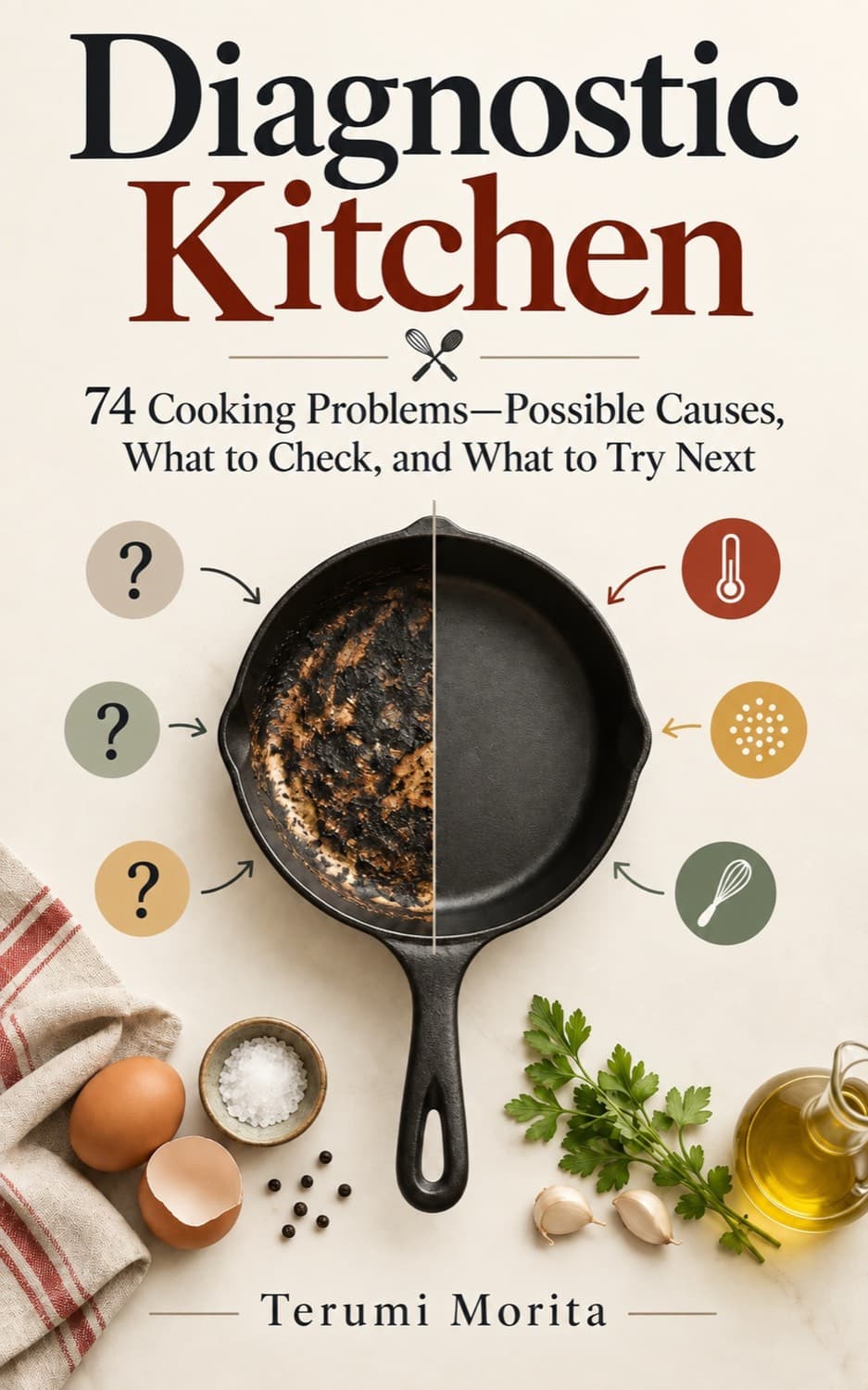
Diagnostic Kitchen
The way this site reads cooking — symptom, likely cause, what to check, what to try next — gathered into one book.
The Fermentation Notebook
Salt, time, temperature, and the safety rules of home fermentation — a decision manual, not a recipe collection. PDF · EN + JA · ¥1,480.
Food History Essays
Why we eat what we eat. From Mesopotamian beer-brewers to the modern snack aisle, traced as one continuous chain.
Japanese Cooking Logic
Decoding Japanese cuisine into principles that work in any kitchen, anywhere in the world.
Food Travel & Taste
How geography, history, and a single bite become inseparable. Why street food is unforgettable and airplane food is awful.
Learn cooking fundamentals
Six clusters every cook eventually rebuilds from first principles — written as a guided reading order, not an undifferentiated archive.
Diagnostic Kitchen
74 Cooking Problems—Possible Causes, What to Check, and What to Try Next
5,000 years of flavor in one map
From fire and salt to fermentation, sauce, refrigeration, and AI — explore how humans learned to turn time into flavor.
- c. 10,000 BCEHeatFire as the first cooking technology
Heat changed texture, aroma, safety, and digestibility, making cooking the first transformation of nature into cuisine.
- c. 6,000–4,000 BCEFermentationFermentation as managed time
Fermentation turned spoilage risk into flavor, preservation, acidity, aroma, and cultural identity.
- c. 500 BCE – 500 CESauceGarum and the Roman sauce economy
Roman garum shows sauce not as decoration, but as industry, trade, and everyday flavor infrastructure.
- 1908ScienceIkeda Kikunae and umami
The naming of umami gave scientific language to a taste long recognized in broths, seaweed, fermented foods, and meat.
- 2020sScienceAI, recommendation, and the future of taste
AI may help connect ingredients, history, technique, and personal context, but taste still depends on the human body and memory.
The pieces built for repeated use — companion notebooks and audio editions that go deeper than the free site.
The Complete Collection
All four guides — Sauce, Fermentation, and the Atlas in PDF and audio — in one purchase.
The Sauce Notebook, The Fermentation Notebook, the full World Cooking Systems Atlas as a bound PDF, and the Atlas Audio Edition — the whole library in one bundle. Bought separately at launch prices they come to ¥6,460; together, ¥4,980. EN and JA editions of every title are included.
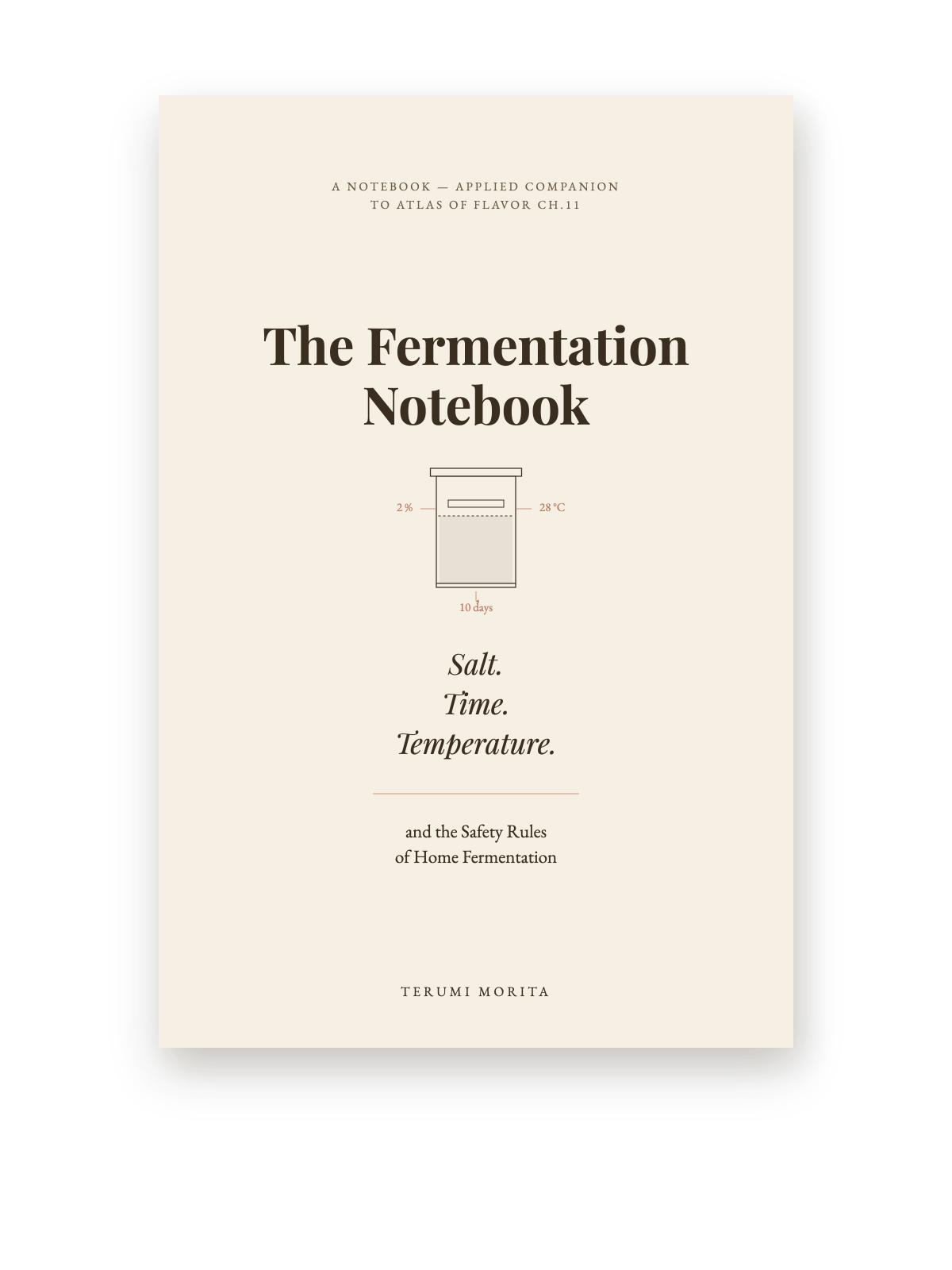
The Fermentation Notebook
The failure-decision manual for home fermentation.
Salt in grams, temperature in °C, and the discard rules that make years of home fermentation safe. Sauerkraut, shio-koji, miso, vinegar pickle, kombucha, nukazuke — each with the cues that decide wait / adjust / refrigerate / discard, and the §SD-1 through §SD-8 doctrine that Chapter 5's failure catalog cites by label.
The World Cooking Systems Atlas — Full Edition
All eleven Atlas chapters in one bound PDF — the artifact version.
All 11 chapters bound into a single A4 PDF (~180 pages EN / ~260 pages JA). Title page, table of contents, every chapter in sequence. Same content as the free chapters at /free — bound into one file you can keep, gift, or print.
Atlas Audio Edition
All eleven Atlas chapters, narrated end to end — in English and Japanese.
Twenty-two mp3 files. About 13 hours 45 minutes of bilingual listening. Every Atlas chapter from Flavor and Seasoning through Fermentation and Preservation — narrated in full so you can listen while you cook.
The Sauce Notebook
The companion to 5,000 Years of Sauce — for the pan, not the desk.
Six foundation sauces. Twenty-four failure patterns with structural causes and concrete fixes. Temperature windows, ratios in grams, what to do when the emulsion breaks.
The Atlas of Flavor
After this chapter, you won't need to be told a dish is "missing something." You'll be able to name what is missing, in which direction, and from which moment in the cooking. The seven axes of flavor, eight worked examples from the catalog.
Read the free chapter →Listen to the library
112 narrated essays, recipes, Atlas chapters, and cooking-system guides. Bilingual EN+JA, paired track-for-track. Made for listening while the dashi simmers, the reduction tightens, or the kettle boils.
Open the audio library →Get the essays in your inbox — free
Weekly notes on flavor, fermentation, and food history — the writing behind the Atlas of Flavor. No spam; unsubscribe anytime.
Terumi Morita is a chef and author writing about food history, cooking science, fermentation, French cuisine, Japanese cooking, and the hidden structures behind taste.
Trained in Lyon and Paris. Based in Ho Chi Minh City.
Read the full bio →