
Curry Udon
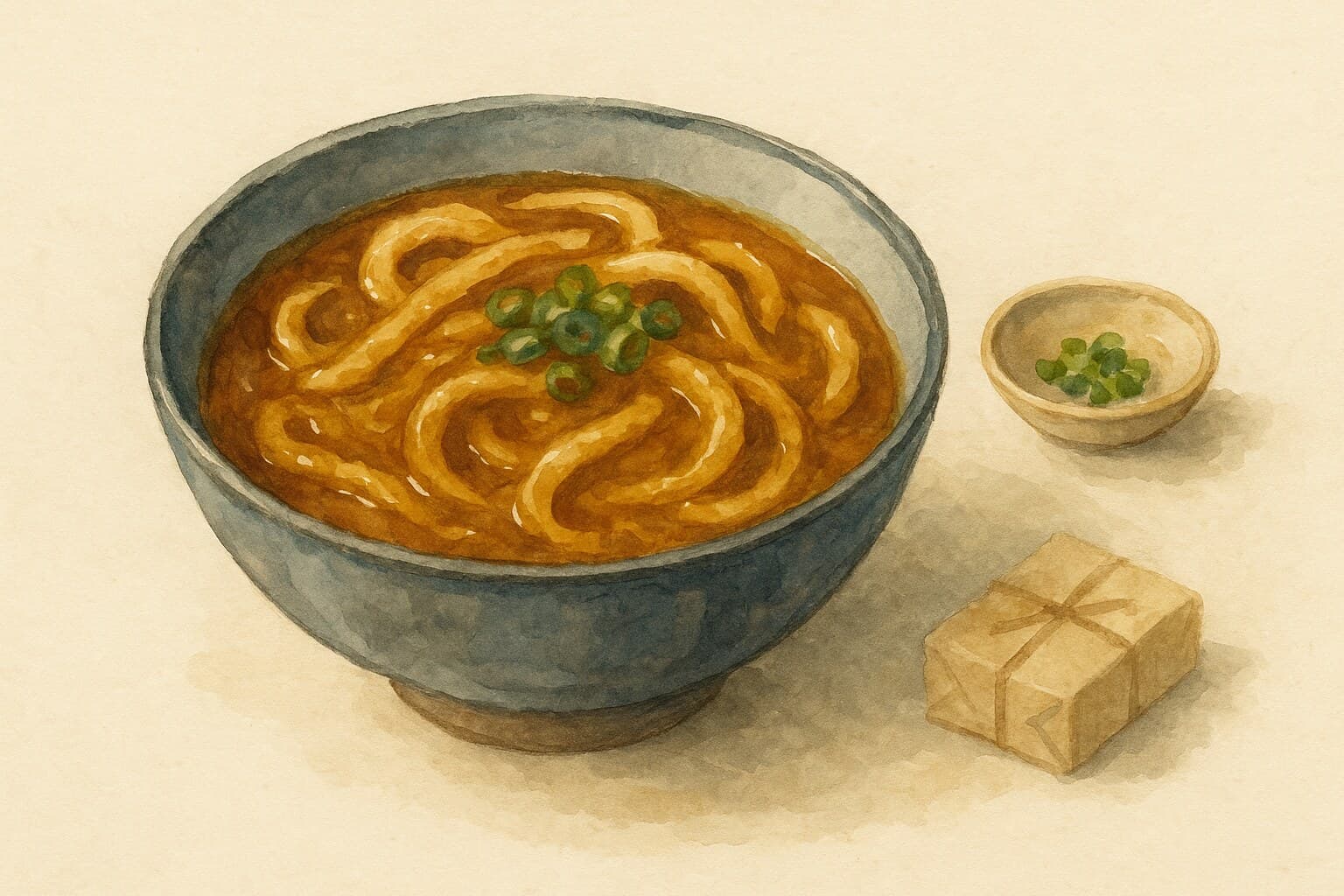
A savory and comforting bowl of curry udon featuring a thick, clingy broth enhanced with dashi.
Contents (5 sections)▾
Ingredients
- 200 g udon noodles
- 100 g Japanese curry roux
- 500 ml dashi
- 100 g thin-sliced pork or 100 g aburaage
- 2 scallions, thinly sliced
- 2 tbsp starch slurry (cornstarch mixed with water)
Steps
Cook the udon noodles according to package instructions until al dente, then drain and set aside.
In a saucepan, bring 500 ml of dashi to a gentle simmer over medium heat.
Add the thin-sliced pork or aburaage to the dashi and cook for about 3-4 minutes until the meat is tender.
Gradually add the Japanese curry roux to the dashi, stirring until fully dissolved. This creates the curry base.
Simmer the curry mixture for 5–8 minutes, allowing it to thicken while stirring occasionally. If it seems too thick, add a little more dashi.
Stir in the starch slurry and continue to simmer for an additional minute until the broth is pourable and clings to the noodles.
Ladle the curry broth over the cooked udon noodles and garnish with sliced scallions before serving.
Tools you'll want
Why this works
Using dashi (a light Japanese stock made from kombu seaweed and dried fish flakes) instead of water as the base for your curry udon broth elevates the dish by infusing it with umami (the deep savory taste you notice in stock, mushrooms or aged cheese) flavor, differentiating it from standard curry-rice with noodles. The combination of dashi and curry roux (the blocks of cooked flour, fat and curry spice that melt into the broth) creates a rich, flavorful sauce that clings to the noodles, making each bite satisfying. Simmering (cooking just below a boil, with only small lazy bubbles) the broth allows it to reduce and thicken, which is crucial for achieving that perfect clingy texture. If the broth becomes too thick, you can adjust by adding more dashi gradually; this keeps the flavor balanced without compromising the consistency. The starch slurry (cornstarch stirred smooth into a little cold water before it goes in) thickens the broth further, ensuring it coats the udon without becoming overly watery. This technique is key to a successful curry udon, providing a comforting dish that feels both hearty and refined.
Common mistakes
Melting the roux into hard-boiling dashi.
Target: A gentle simmer — small bubbles rising at the edge of the pan, no rolling churn — with the roux broken into small pieces and added a few at a time.
Why it matters: Japanese curry roux is flour and fat pressed into a solid block. Dropped whole into violently boiling liquid, the outside gels instantly and seals the dry flour inside, so you get rubbery lumps that never dissolve no matter how long you stir.
What to do: Turn the heat down first. Break the 100 g of roux into small pieces, add a few, stir until they vanish, then add the next few. If lumps still appear, press them against the side of the pan with the back of a ladle.
Pouring in the starch slurry without stirring it again.
Target: A slurry (cornstarch stirred smooth into cold water — see slurrying) with no white sediment sitting on the bottom of the cup, poured in a thin stream while you stir the broth.
Why it matters: Cornstarch sinks within about a minute of mixing. Pour off the top and you add mostly water, so the broth stays thin; pour the settled bottom and you drop in a paste that seizes into a gluey knot the instant it meets hot liquid.
What to do: Re-stir the slurry right before it goes in, scraping the bottom. Add it in a thin stream with the broth at a simmer and your other hand stirring, then let it simmer the extra minute the recipe calls for — starch only reaches full thickening power once it is properly hot, and that minute also cooks off the chalky raw-starch taste.
Letting the drained udon sit in the broth while you finish other things.
Target: Noodles well drained and shaken, broth ladled over them at the last moment, bowl served straight away.
Why it matters: Cooked udon keeps drinking liquid. Left standing, the noodles go soft and pasty and the broth you worked to thicken turns thin and pale — the exact opposite of the clingy texture that defines this dish.
What to do: Cook the noodles first, drain them properly (shake the strainer a few times so no water clings), and leave them dry in the serving bowls. Ladle the hot curry broth over only when you are ready to eat.
Boiling the broth down to fix the thickness.
Target: Adjust consistency with more dashi, never by reducing.
Why it matters: Curry roux carries a lot of salt. Every minute you boil the broth down concentrates that salt while the texture barely improves, and an over-salty curry broth cannot be rescued later without watering down all the flavor at once.
What to do: If it is too thin, use a touch more slurry. If it is too thick, loosen it with warm dashi a splash at a time. Taste after every adjustment.
Trusting the clock for the pork.
Target: Thin-sliced pork simmered until no pink remains anywhere and the slices have turned opaque and curled — usually the 3–4 minutes in the recipe, but check, don't assume.
Why it matters: Pork slices vary in thickness, and a cold pan or a crowded one slows cooking. Undercooked pork is a real food-safety risk, not just a texture problem.
What to do: Separate the slices as you drop them in so they don't stick together in a raw clump. Lift one out and look at the thickest part — it should be pale grey-brown all the way through. (Using aburaage instead? It only needs to warm through and soften.)
What to look for
- Dashi ready for the roux: steam rising steadily, a ring of small bubbles around the edge, the surface barely moving. If the middle is churning, it is too hot — pull it back before the roux goes in.
- Roux fully dissolved: the broth is one uniform colour with no pale streaks or grainy specks. Draw the ladle across the bottom of the pan; nothing should drag or stick.
- Pork cooked through: slices opaque and lightly curled, no pink or translucent grey at the centre of the thickest piece.
- After the slurry, the broth is right: it coats the back of a spoon, and a line drawn through it with your finger holds for a second before closing. It should still pour freely from the ladle — thick like pouring cream, not like gravy.
- The finished bowl: lift a noodle with chopsticks and the broth rides up with it in a visible coat rather than sliding straight back into the bowl. That clinging film is the whole point of the dish.
A note on history
Curry udon belongs to the late-Meiji moment when Japan absorbed Western-style curry and immediately made it its own. It is usually credited to Sanchoan (三朝庵), a soba shop near Waseda University in Tokyo, around 1904 — the story goes that the owner, watching students desert noodle shops for the new curry-rice restaurants, dissolved curry into a katsuobushi-and-soy broth and thickened it with potato starch so it would cling to noodles. That thickening step, invented to solve a business problem, is still the technique that makes the dish work.
Source: Curry Udon — Food in Japan
Get the essays in your inbox — free
Weekly notes on flavor, fermentation, and food history — the writing behind the Atlas of Flavor. No spam; unsubscribe anytime.