
Uttapam (South Indian Savory Pancake)
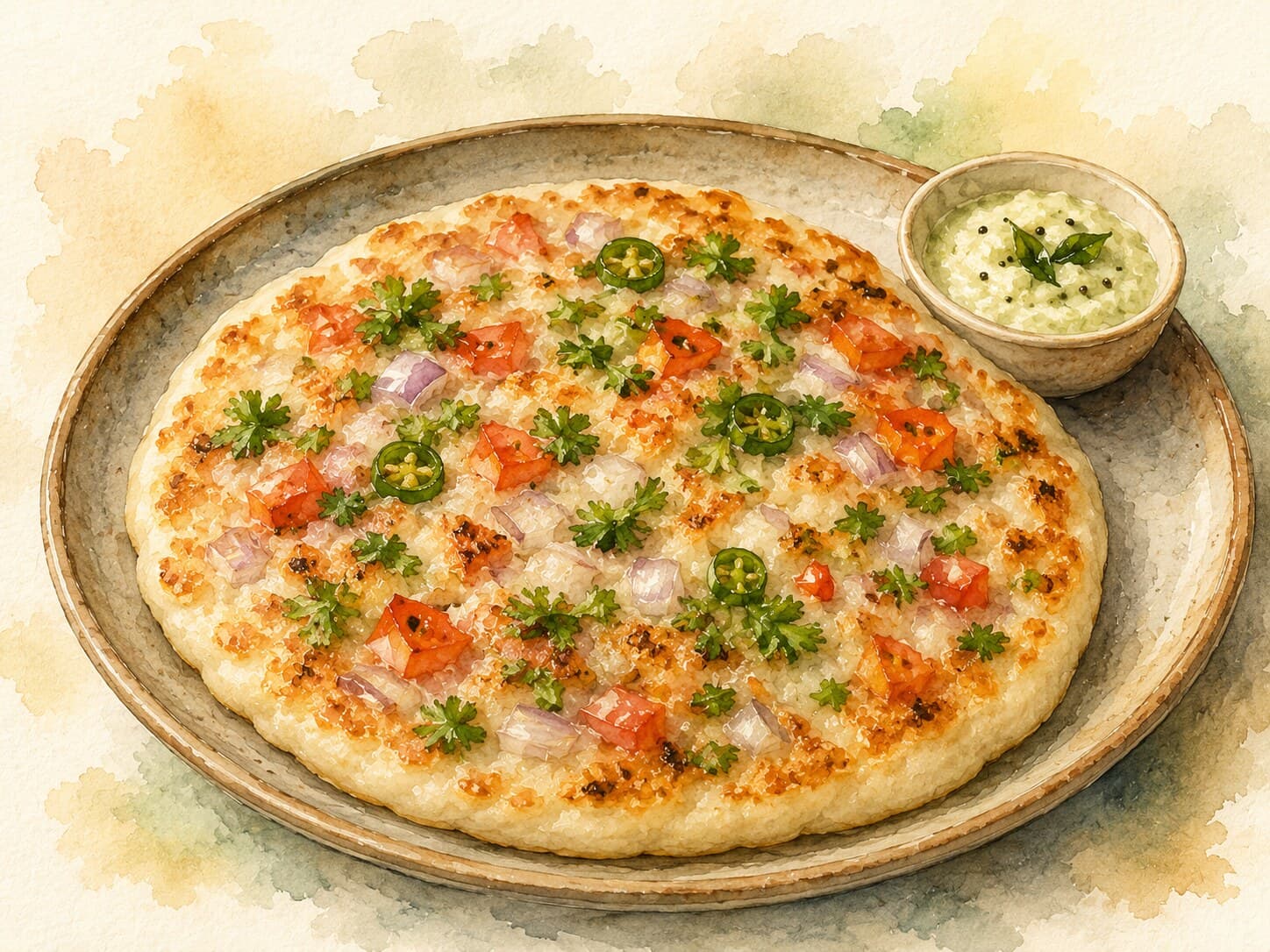
Uttapam is a thick, savory South Indian pancake made from fermented rice-lentil batter, topped with vegetables for added flavor.
Contents (5 sections)▾
Ingredients
- 1 cup fermented rice-lentil batter
- 1/4 cup finely chopped onions
- 1/4 cup finely chopped tomatoes
- 1/4 cup finely chopped bell peppers
- 1/4 cup chopped cilantro
- 1/2 tsp salt
- 1 tbsp oil (for cooking)
- optional toppings (e.g., sliced green chilies, grated carrots) to taste
Steps
Preheat a non-stick griddle or skillet over medium heat for about 5 minutes.
Lower the heat to medium-low and lightly grease the surface with a tablespoon of oil.
Pour a ladleful of fermented rice-lentil batter onto the griddle, spreading it to form a thick pancake.
Immediately press the chopped vegetables into the wet surface of the batter, ensuring they adhere well.
Cook for about 5-7 minutes, or until the bottom is golden brown and crispy.
Carefully flip the Uttapam and cook for an additional 3-5 minutes to ensure the top is steamed and cooked through.
Remove from the griddle and serve hot with chutney or sambar.
Why this works
The technique of pouring thick fermented rice-lentil batter onto the griddle allows for the creation of a pancake that is both crispy on the bottom and soft on the top. The fermentation imparts a tangy flavor, while the thickness of the batter ensures a substantial texture. Pressing toppings into the wet surface enhances the visual appeal and allows the flavors to meld during cooking. If the Uttapam seems too thick and doesn't cook through, you can cover the griddle with a lid to trap steam, helping to cook the top faster. Conversely, if the batter is too thin and spreads too much, use less batter next time and adjust the cooking temperature to avoid burning. This technique makes Uttapam a forgiving and versatile dish, transforming leftover batter into a delicious meal.
Common mistakes
-
Using underfermented batter. Fresh batter that hasn't fermented properly gives a dense, sour-without-depth pancake.
- Target: Batter that has roughly doubled in volume, smells pleasantly tangy, and has a visible bubbled surface — usually 8-12 hours at warm room temperature.
- Why it matters: Fermentation is what gives uttapam its airy crumb and complex flavour. Skipping it leaves a flat, gummy disc.
- What to do: Plan ahead. If the kitchen is cool, set the bowl over a low pilot light or in a turned-off oven with the light on. Wait for the bubbles before you cook.
-
Pan too hot when the batter goes in. A screaming hot tawa sets the bottom before the toppings can sink in or the top can rise.
- Target: Medium heat — a drop of water should sizzle and dance for a few seconds before evaporating, not vanish instantly.
- Why it matters: Uttapam needs time to puff and steam through. Too hot, and you get a burned crust with a raw, doughy centre.
- What to do: Heat the pan, then lower the flame to medium-low before pouring. If the first pancake burns, wipe the pan, let it cool a moment, and try again.
-
Spreading the batter thin like a dosa. Uttapam is meant to be thick.
- Target: A 1-1.5 cm thick disc, about 12-15 cm across — twice the thickness of a dosa.
- Why it matters: Thinness defeats the dish. The whole point is a soft, fluffy crumb under a vegetable-studded top, with a crisp golden bottom.
- What to do: Pour the batter in one steady ladleful and spread only enough to even the surface. Resist the urge to circle outward with the back of the ladle.
-
Flipping too early. Turning before the top has set sloughs the vegetables off.
- Target: Wait until the edges look dry, the surface loses its wet sheen, and the visible holes from bubbles stay open — 5-7 minutes on the first side.
- Why it matters: The toppings need time to bond with the cooking batter. Flip too soon and they fall away when the spatula goes under.
- What to do: Cover the pan with a lid for the first few minutes to steam the top, then uncover, watch for the dry surface, and flip with confidence in one move.
What to look for
- Batter that bubbles steadily on the surface as it pours from the ladle — a sign fermentation (the slow microbial process that gives the batter rise and tang) has built the structure.
- A pancake top that goes from glossy to matte as the bubbles set — the moment to consider flipping.
- A bottom crust that lifts off in one piece when nudged with the spatula, deeply golden and crisp around the rim.
- Toppings that stay embedded after the flip, no loose pieces left on the pan — the press-in step worked.
A note on history
Uttapam (a thick South Indian pancake made from fermented rice-and-lentil batter) belongs to the rice-and-lentil-batter family of South Indian dishes that includes dosa and idli, and the Tamil word "uttapam" is often glossed as "poured cake" — uttu (poured) + appam (a small cake or pancake). The dish is widely treated as a creative use of leftover dosa batter that has fermented an extra night, giving the thicker, tangier body uttapam wants. Tamil-language references to fermented rice-and-lentil preparations go back to the early Sangam-era texts, and uttapam itself is documented as part of the everyday South Indian repertoire from at least the medieval period onward.
Get the essays in your inbox — free
Weekly notes on flavor, fermentation, and food history — the writing behind the Atlas of Flavor. No spam; unsubscribe anytime.