
Idli (Steamed Rice Cakes)
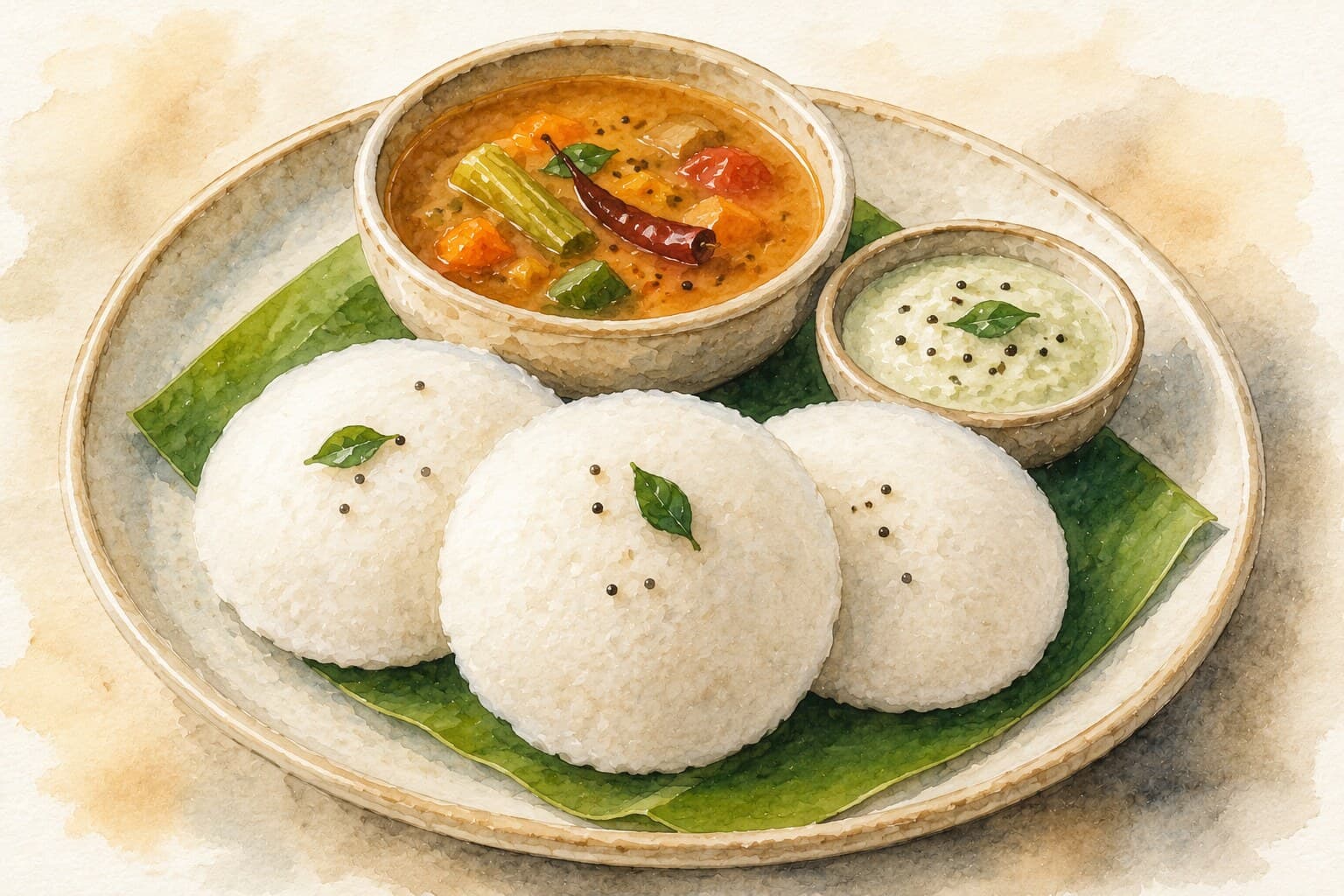
Idli are soft, steamed rice cakes made from a fermented rice-lentil batter, perfect for breakfast.
Contents (5 sections)▾
Ingredients
- 250 g rice
- 100 g urad dal (split black gram)
- 1 tsp fenugreek seeds
- 1 tsp salt
- 650 ml water
- oil for greasing molds
Steps
Soak the rice and urad dal with fenugreek seeds in 650 ml water for at least 6 hours or overnight. This helps in the fermentation process.
Drain and blend the soaked mixture into a thick batter, adding water as needed to achieve a smooth consistency. The batter should hold its shape but be pourable.
Transfer the batter to a large bowl, cover, and let it ferment in a warm place for 8 hours or until it has doubled in size and shows bubbles.
Once fermented, gently stir in salt. Prepare your steamer by boiling water and greasing the idli molds with oil.
Fill the molds with the batter, leaving space for expansion, and steam them for 10-15 minutes until a toothpick inserted comes out clean.
Remove the idlis from the molds and serve them warm with chutney or sambar.
Why this works
The fermentation process is crucial for developing the idli's characteristic flavor and texture. The natural bacteria break down the starches in the rice and lentils, creating a light, spongy cake with a faint sourness. If the batter seems too thick after blending, add a little more water to ensure it is pourable but still holds shape. The steaming method ensures even cooking, allowing the idli to rise and become fluffy. If they break apart when you remove them from the molds, it may indicate they were not steamed long enough or were too tightly packed in the molds. Ensure you leave enough space for the batter to expand during cooking, as this will create the ideal texture.
Common mistakes
Under-fermenting the batter and ending with dense, flat cakes.
Target: A batter that has roughly doubled in volume, is visibly bubbly on top, and smells distinctly tangy — usually 8–12 hours in a warm room (around 28–32 °C).
Why it matters: Idli is leavened by wild fermentation (lactic-acid bacteria and natural yeasts from the lentils and the air; they produce both gas, which lifts the cake, and acid, which gives it its faint sourness). Without enough fermentation, there is no gas to expand during steaming, and the texture stays heavy.
What to do: In cold weather, place the bowl in a switched-off oven with the light on, or wrap it in a thick towel near a warm spot. Give it more time rather than rushing — over-fermentation tastes slightly sour, but under-fermentation tastes flat.
Over-blending the batter into a thin, smooth liquid.
Target: A thick, pourable batter — closer to pancake batter than to cream. It should slowly fall off a spoon, not pour like water.
Why it matters: A too-thin batter cannot trap the carbon dioxide bubbles produced during fermentation; they escape instead of inflating the cake. The signature airy crumb depends on a batter with body.
What to do: Add water in small splashes while blending. Stop the moment the texture pours in slow ribbons.
Stirring the batter aggressively after fermentation.
Target: One gentle fold to incorporate the salt — that is all.
Why it matters: All the lifting power lives in the bubbles you just spent hours building. Hard stirring deflates them, and steam alone cannot rebuild them.
What to do: Sprinkle the salt over the top, then fold from the bottom with a spatula in two or three slow turns. Stop as soon as the salt is distributed.
Steaming over a vigorous, gushing boil and getting wet, dimpled idli.
Target: A steady, gentle steam (water at a soft rolling boil, lid sealed, no rattling).
Why it matters: Very hot, turbulent steam can hit the surface of the idli and condense too fast, leaving water pockets and a sticky top. A calm, even steam cooks the cake through without flooding it.
What to do: Keep the water on a low-to-medium flame once steam is established. Wipe condensation off the inside of the lid before opening — drips ruin the surface.
What to look for
- Fermented batter: visibly raised, domed top, small to medium bubbles all over the surface, a clean lactic tang on the nose. That tells you the wild leavening is alive and ready.
- Batter portioned into molds: each cavity filled to about three-quarters, surface smooth, no air streaks. This leaves room for the cake to expand without spilling.
- Idli at 10 minutes of steaming: pale, glossy domes, slightly springy to a light touch, a clean toothpick when poked. Wet or sticky toothpicks mean more time.
- Idli on the plate: matte ivory color, soft to the squeeze, springs back slowly, releases cleanly from the mold. Tearing or breaking means under-steaming or over-stirring after fermentation.
A note on history
Idli has a long South Asian lineage. The Kannada text Vaddaradhane by Shivakotiacharya (around 920 CE) describes a dish called iddalige made from a black-gram batter, and the 12th-century Sanskrit Manasollasa of the Chalukya king Someshvara III references a similar preparation (Yenna Dosa: History of Idli, Naadbramha: History and Mystery of Idli). The fermented rice-and-urad-dal form we now recognize as idli appears to have crystallized over several centuries, with some food historians suggesting that wet-fermentation techniques arrived through Indonesian-South Indian trade contacts around the 8th–12th centuries — the Indonesian kedli is sometimes cited as a precursor, though the lineage is debated (Gulf News: Origin of idli). Today idli is most strongly associated with Tamil Nadu, Karnataka and Andhra Pradesh. Because it uses a fermented batter and is steamed rather than fried, it is one of the older, lighter everyday breakfasts still in daily rotation — the fermentation makes the batter more digestible, though the steaming leaves the finished cakes without live cultures.
Get the essays in your inbox — free
Weekly notes on flavor, fermentation, and food history — the writing behind the Atlas of Flavor. No spam; unsubscribe anytime.