
Teriyaki Salmon
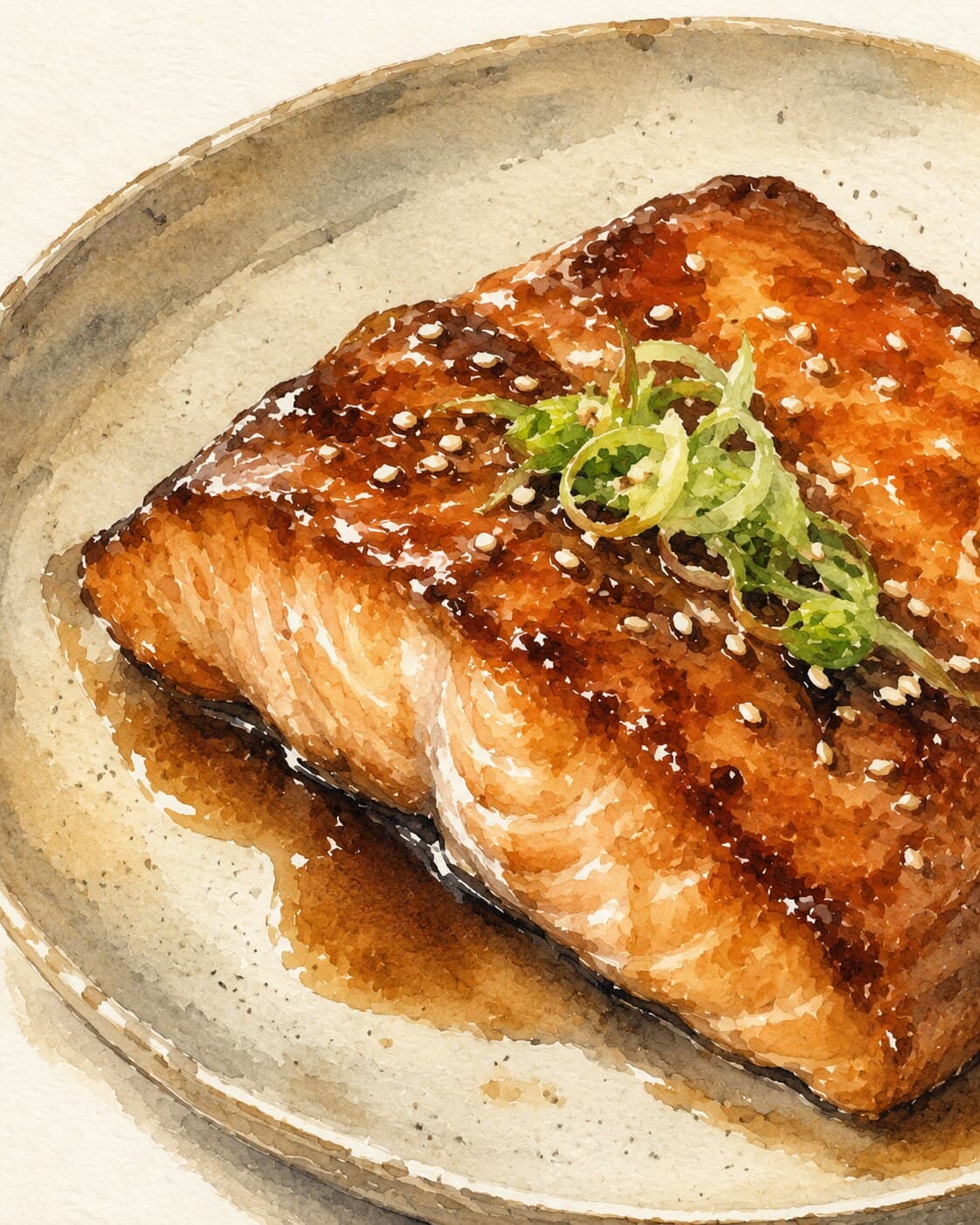
This Teriyaki Salmon features a crispy skin and a glossy glaze, perfectly balancing sweet and savory flavors.
Contents (5 sections)▾
Ingredients
- 300 g salmon fillet
- 60 ml soy sauce
- 30 ml mirin
- 30 ml sake
- 15 g sugar
Steps
Pat the salmon fillet dry using paper towels to ensure it sears well rather than steams during cooking.
In a saucepan, combine soy sauce, mirin, sake, and sugar. Heat over medium until sugar dissolves, then reduce to low and simmer for about 10 minutes, or until the sauce thickens and can coat the back of a spoon.
Heat a cast-iron skillet over medium-high heat. Once hot, add the salmon skin-side down and cook for about 6-7 minutes, until the skin is crispy.
Flip the salmon and cook for an additional 3-4 minutes, or until the flesh reaches an internal temperature of 63°C and is just opaque.
Remove the pan from heat and brush the teriyaki glaze over the salmon. Let it sit for a minute to allow the glaze to adhere.
Tools you'll want
- · Cast-iron skillet (Lodge, 6.5–10in)
Why this works
The key to achieving a glossy teriyaki glaze while ensuring the salmon is perfectly cooked lies in the technique of pan-searing and the timing of glazing. By patting the salmon dry, you promote a proper sear, which prevents steaming. Cooking the skin first allows it to become crispy, enhancing texture and flavor. Glazing at the end is crucial because cooking the glaze too long can lead to scorching due to the sugar content. If the salmon fillet seems to be cooking too quickly, reduce the heat to maintain a steady temperature without burning the exterior. If the glaze appears too runny, continue to simmer until it thickens to your desired consistency, ensuring it clings beautifully to the salmon.
Common mistakes
Putting damp salmon skin into the pan.
Target: Skin blotted properly dry — dry enough that a paper towel comes away clean.
Why it matters: Water has to boil off before anything can brown. While the surface is wet, the fish is sitting in its own steam at 100°C, and steam cannot crisp skin — it softens it into something slack and rubbery. Only once the surface is dry can it climb past 140°C and start the Maillard reaction (the browning that gives roasted, savoury flavours). One wet fillet can cost you the crisp skin entirely.
What to do: Press paper towel firmly onto both sides, and pay particular attention to the skin. If you have time, leave the fillet uncovered on a rack in the fridge for 20–30 minutes; the surface dries further and the skin crisps noticeably better.
Moving the fillet in the first minute.
Target: Skin-side down, held flat for the first 20–30 seconds, then left completely alone for 6–7 minutes.
Why it matters: Fish skin shrinks as it heats, so an untouched fillet lifts at the edges and only its centre touches the pan — you get a burnt middle and pale, flabby edges. And skin sticks to a pan until a browned crust has formed; that crust is what releases it. Prodding at it before then tears the skin off and leaves it behind.
What to do: Lay the fillet down away from you, then press gently along its length with a spatula or your fingertips for 20–30 seconds to keep it flat. Then stop touching it. When the crust has formed, the fillet will slide freely if you nudge the pan.
Brushing the glaze on while the pan is still on the heat.
Target: Pan off the heat first, then glaze — exactly as the recipe orders it.
Why it matters: The glaze contains 15 g of sugar, plus more sugar from the mirin. Sugar starts to caramelise and then burn well below the temperature of a searing skillet, and burnt sugar is bitter in a way nothing can rescue. It also goes from glossy to matte and tacky the second it scorches. Glazing off the heat means the residual warmth is just enough to make the sauce cling, without pushing it over the edge.
What to do: Take the pan off the burner, wait about 15 seconds, then brush the glaze over the fish and let it sit a minute.
Reducing the sauce too far.
Target: Thick enough to coat the back of a spoon — roughly 10 minutes at a low simmer.
Why it matters: A sauce keeps thickening as it cools, because sugar syrups stiffen at lower temperatures. If you reduce it until it looks right while it is bubbling hot, it will set into a sticky, almost toffee-like layer on the plate, and it will taste over-salty too — reducing 60 ml of soy sauce concentrates its salt into a smaller volume.
What to do: Stop while the sauce still looks slightly looser than you want. If it does over-thicken, take it off the heat and stir in a teaspoon of water at a time until it flows again.
Cooking the salmon past the point of tenderness.
Target: 63°C at the thickest part, flesh just turned opaque.
Why it matters: Salmon is delicate: its proteins tighten and squeeze out moisture over a very narrow range, so the gap between "silky" and "dry and chalky" is only a few degrees and often less than a minute. The fish also carries on cooking after it leaves the pan from the heat already inside it (carryover cooking), so anything you leave in the pan "just to be sure" is overcooking.
What to do: Slide an instant-read thermometer in from the side of the fillet, into the middle. Take it off the heat at 63°C. Do not go by minutes alone — a thick centre-cut piece and a thin tail piece behave completely differently.
What to look for
- Salmon ready for the pan: the surface looks matte rather than shiny-wet, and the skin feels dry and slightly tacky to the touch.
- Pan hot enough: a drop of water flicked in beads up and skitters, then vanishes in a second or two. The fillet should start sizzling the instant it lands — silence means it will stick.
- Skin crisping properly: a steady, even sizzle (not a violent spitting roar, which means the heat is too high), and the smell turns from clean and marine to nutty and toasted. Around the edge, the flesh turns from translucent orange to opaque pale pink, creeping upward — when that pale band has climbed about two thirds of the way up the side, it is time to turn.
- Ready to turn: nudge the pan; the fillet slides. If it grips, give it another 30 seconds and try again rather than forcing it.
- The sauce reducing: it starts as a thin liquid with small, fast bubbles. As water leaves, the bubbles get larger, slower and glossier, and the surface takes on a shine. Draw a spoon through it and lift: it should coat the back in an even film, and a finger drawn across that film should leave a line that holds.
- Salmon done: 63°C in the centre; the flesh is opaque all the way through and separates into flakes when nudged with a fork, but still with a little resistance rather than falling apart. A few small white beads on the surface are normal protein; heavy white curds pushing out mean it has gone too far.
- The finished glaze: it lies on the fish in a thin, mirror-like coat that holds its shine. If it looks dull and sits in a thick blob, it was reduced too far; if it runs straight off into the plate, it needs another minute in the pan.
A note on history
Teriyaki is a Japanese cooking method rather than a bottled sauce, and its name says exactly what it is: teri (照り), gloss or shine, and yaki (焼き), to grill. It took shape in the Edo period (1603–1868), when mass fermentation made soy sauce widely available, and combining it with sweet mirin produced a glaze that both flavoured food and helped preserve it. Fish was the original subject — the earliest known written use of the word appears in 1813, in Shikitei Sanba's Shijūhachi Kuse, describing shrimp teriyaki — which makes salmon a return to teriyaki's roots rather than a variation on chicken. (Source: New World Encyclopedia — Teriyaki)
Get the essays in your inbox — free
Weekly notes on flavor, fermentation, and food history — the writing behind the Atlas of Flavor. No spam; unsubscribe anytime.