
Taimeshi (Sea Bream Rice)
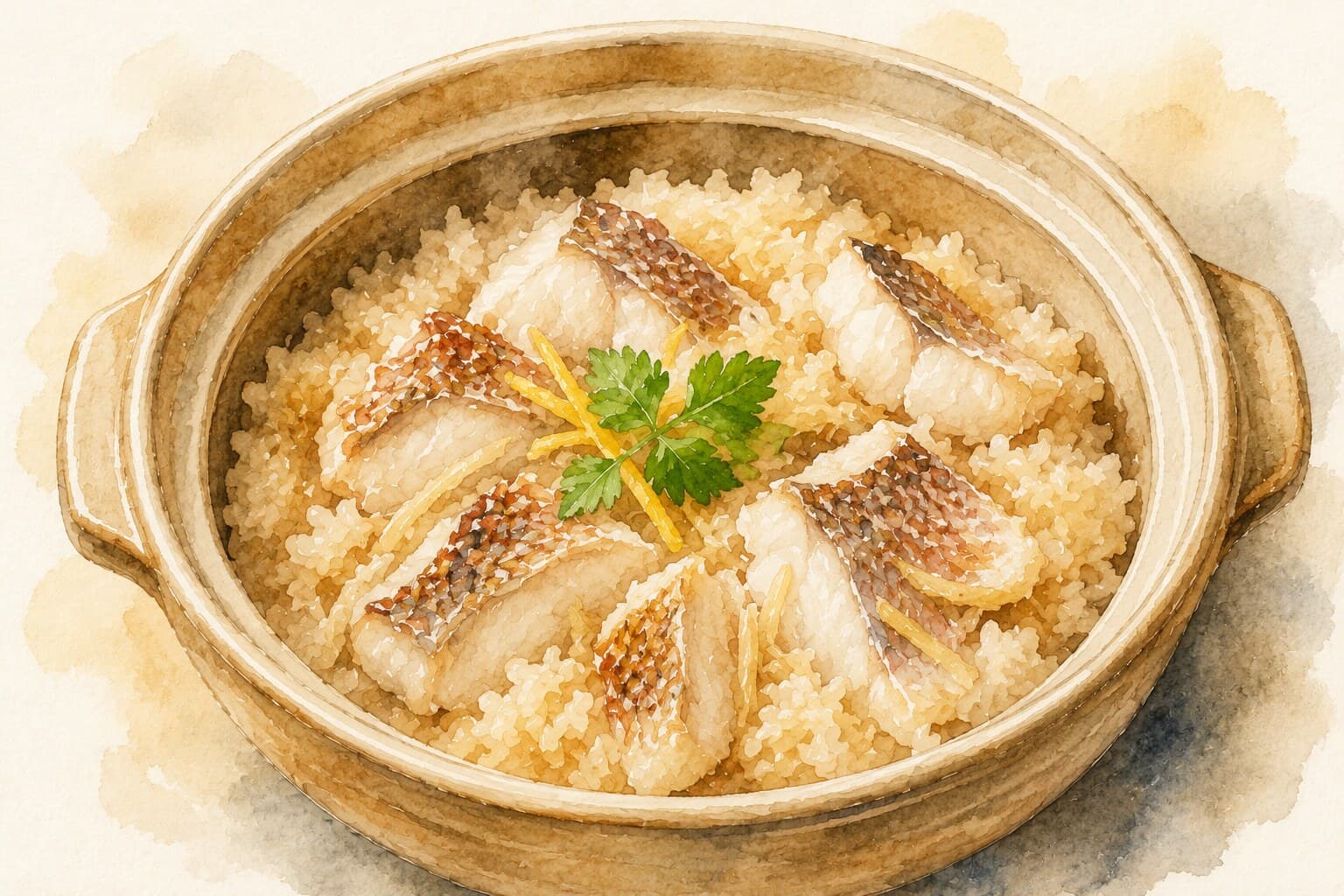
This Taimeshi recipe features whole salted sea bream steamed over dashi-infused rice, creating a flavorful celebration dish.
Contents (5 sections)▾
Ingredients
- 1 whole sea bream (about 600g), cleaned and salted
- 2 cups Japanese short-grain rice
- 3 cups dashi stock
- 1 tbsp soy sauce
- 1 tbsp sake
- 1 tsp salt
- 2 green onions, finely chopped
- to taste: shiso leaves for garnish
Steps
Rinse the rice under cold water until the water runs clear, then soak it in water for 30 minutes to ensure even cooking.
In a pot, combine the soaked rice, dashi stock, soy sauce, sake, and salt. Stir gently to mix.
Place the salted sea bream on top of the rice mixture, ensuring it's centered.
Cover the pot and bring to a boil over medium heat. Once boiling, reduce to low heat and simmer for 15 minutes.
After 15 minutes, turn off the heat and let the pot sit, covered, for an additional 10 minutes to allow the flavors to meld.
Remove the sea bream, flake the fish into bite-sized pieces, and fold it gently into the rice.
Serve the Taimeshi hot, garnished with chopped green onions and shiso leaves.
Tools you'll want
Why this works
Cooking rice with a whole salted sea bream allows the fish's fat and umami to permeate the rice, enhancing its flavor significantly. The dashi stock serves as a delicate base, complementing the natural sweetness of the sea bream. By placing the fish on top during cooking, you let the steam carry the flavors into the rice. If the sea bream seems too large for your pot, consider removing the head or cutting the fish in half to fit. The resting phase after cooking is crucial; it ensures that the rice absorbs all remaining moisture and flavors. If the rice appears too dry, add a splash of warm dashi before serving to achieve the desired consistency.
Common mistakes
- Skipping the salt-rest on the whole fish. A wet, unsalted bream weeps cloudy water into the rice and goes flat.
- Target: salt the gutted fish inside and out, rest on a rack 20–30 minutes, then wipe surface moisture before laying it on the rice.
- Why it matters: salt pulls out the thin watery layer beneath the skin and the residual blood near the spine — that's the source of the muddy, "fishy" pot. A short rest also seasons the flesh through, so the rice tastes of bream, not of liquid bream.
- What to do: Lay the fish on a rack over a tray in the fridge. After 20 minutes, blot it dry with a paper towel; don't rinse — you'll wash off what you just gained.
- Using a fish that doesn't fit your pot. Forcing a whole bream into a too-small donabe (Japanese clay pot for tabletop rice and stews) deforms the cook.
- Target: the fish should sit flat on the rice with a finger's gap to the lid; if not, behead, halve crosswise, or split along the spine.
- Why it matters: if the fish is curled or touching the lid, parts of it never get steam contact, and the rice underneath cooks unevenly because the fish blocks circulation. Halving a too-big fish is traditional, not a compromise.
- What to do: Measure first. A 600 g bream needs a roughly 24 cm donabe; smaller pots want a 400 g fish or a head-and-tail-removed body. The head can go in alongside for flavor.
- Cooking the fish through and through during the active phase. Sea bream is lean and over-cooks fast on a hot bed of steam.
- Target: active simmer 15 minutes, off-heat rest 10 minutes; internal temperature at end of rest 63°C / 145°F, flesh just opaque and flaking.
- Why it matters: the rest is doing real cooking work. Push the active phase longer and the loins go dry and stringy while the belly and cheek stay fine; the dish loses its delicate edge.
- What to do: Trust the timing. Don't peek mid-simmer. At the end of the rest, lift the fish onto a board, flake by hand, and check — opaque, moist, no translucent core.
- Folding the flaked fish back in while the rice is still piping hot and wet. The flakes break up to mush and the dish looks tired.
- Target: lift the fish off, fluff the rice with a shamoji once, then fold the flakes back in in two or three gentle motions.
- Why it matters: fluffing releases trapped steam and resets the grain; if you fold the fish in before that, the rice is sticky and the flakes shred. Folding too many times also greys the rice.
- What to do: Fluff first, then fold. Reserve a few intact pieces for the top of the bowl — that's the photo, and the dish reads as fish-on-rice rather than mixed pilaf.
What to look for
- A puff of clean, kelp-and-sea steam when you finally lift the lid — savory, not fishy. (Dashi here is the kelp-and-bonito base stock that gives so much Japanese cooking its savoury backbone.)
- Skin that has shrunk back from the bones at the head and tail; that's a sign the fish is properly cooked through.
- Rice grains tinted faintly amber by the dashi and fish fat, each one distinct rather than a sticky mass.
- Large, almost translucent flakes of belly meat that hold their shape when you lift them onto the rice with chopsticks.
A note on history
The Matsuyama style of taimeshi, with a whole salted bream (the sea bream that gives this dish its name — a lean white fish prized in Japan for celebrations) laid on the rice and cooked together, is a celebration dish from central Ehime on Shikoku, recognized as a regional cuisine of the prefecture. The pun on tai and medetai — "auspicious" — made bream the standard fish for weddings, New Year and the Boys' Festival, and traditional accounts describe the dish being cooked with seawater in the old days along the Seto Inland Sea coast. It is distinct from the Uwajima or Nanyo style of southern Ehime, which serves raw sashimi-grade bream over hot rice with a raw-egg sauce — a separate lineage traced to the kaizoku-meshi (literally "pirate rice", the on-board cooking of Edo-era Iyo naval clans) of the Iyo naval clans.
Get the essays in your inbox — free
Weekly notes on flavor, fermentation, and food history — the writing behind the Atlas of Flavor. No spam; unsubscribe anytime.