
Sundubu Jjigae (Soft Tofu Stew)
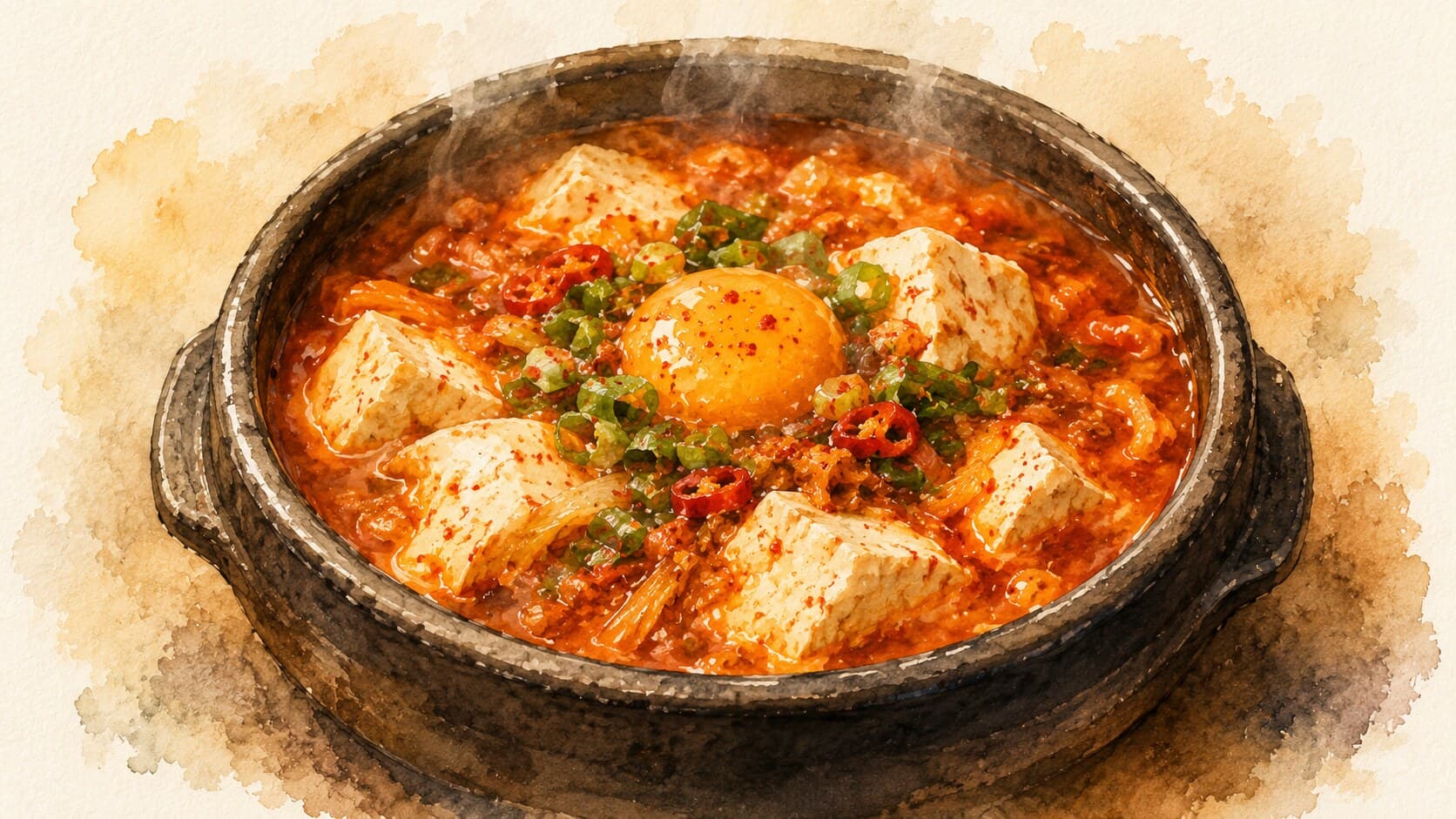
Sundubu Jjigae is a spicy Korean soft tofu stew featuring silky tofu in a rich, bubbling broth.
Contents (5 sections)▾
Ingredients
- 1 tbsp gochugaru chili powder
- 2 tbsp vegetable oil
- 4 cups water
- 1/4 cup dried anchovies, heads removed
- 1/4 cup sliced mushrooms
- 1 clove garlic, minced
- 1/2 tsp soy sauce
- 200 g silken tofu, uncurdled
- 2 eggs
- 1 green onion, sliced
- Salt to taste
Steps
In a medium pot, heat vegetable oil over medium heat. Add gochugaru chili powder and bloom for 1-2 minutes until fragrant. This creates the rich red base.
Pour in water and add dried anchovies and sliced mushrooms. Bring to a boil over high heat, then reduce to a simmer for 5-7 minutes to infuse flavors.
Strain out the anchovies and mushrooms, returning the broth to the pot. Stir in minced garlic and soy sauce, then let simmer for another 2 minutes.
Gently slide in the silken tofu without breaking the pieces. Allow it to warm through for about 3 minutes.
Serve the stew in a stone pot and crack an egg into each serving at the table. Garnish with sliced green onion and season with salt to taste.
Why this works
Blooming gochugaru in oil enhances its flavor, releasing essential oils that deepen the stew's color and taste. The quick anchovy broth adds a savory umami base, making the dish rich and satisfying. Using silken tofu is vital; its delicate texture contrasts beautifully with the spicy broth. If the tofu breaks during cooking, simply lower the heat and allow it to warm gently instead of boiling, which can cause it to disintegrate. This method preserves the silky consistency that defines Sundubu Jjigae. The addition of a fresh egg at serving enriches the stew and allows the diners to enjoy the theatrical experience of cracking it open at the table, enhancing the overall flavor as it blends with the spicy broth.
Safety note — the egg. Crack the egg into the stew while it is still vigorously bubbling and let it cook a minute or two until the white sets; for a fully cooked egg, or when serving anyone who should avoid undercooked egg, stir it through until set or use a pasteurized egg.
Common mistakes
-
Skipping the gochugaru bloom.
- Target: chili powder fried in warm oil over medium heat for 30-60 seconds, until the oil turns deep red and the kitchen smells toasted and fruity — not acrid.
- Why it matters: raw gochugaru (Korean coarse red-chili powder) in broth tastes dusty and one-note. Blooming releases the carotenoids and aroma compounds that give sundubu its characteristic red colour and rounded heat.
- What to do: start the oil cold or barely warm, add the powder, and stir constantly. Pull it off the heat the moment it darkens — burnt gochugaru turns bitter fast.
-
Boiling the silken tofu hard from the start.
- Target: broth at a gentle simmer when the tofu goes in; bring back to a strong bubble only at the very end for the egg.
- Why it matters: silken tofu (the soft, custard-like, undrained kind) is set with very little coagulant. Aggressive boiling shatters the curds into a grainy slurry. The signature texture is "barely held," and that lives or dies in the last few minutes.
- What to do: slide the tofu in gently with a spoon, let it warm through at a low simmer, then crank the heat right before serving so the broth is violently bubbling when it hits the table.
-
Adding the egg to a stew that has already calmed down.
- Target: the broth must be at a hard rolling boil when the egg goes in, and stay bubbling for 1-2 minutes after.
- Why it matters: residual heat alone is not enough to set a whole egg in a stone pot once the surface stops moving. For vulnerable diners (pregnant, elderly, young children, immune-compromised), the egg must be fully set — stir it through or use a pasteurized egg.
- What to do: time the egg for the table. Bring the pot up to a violent bubble at the stove, crack the egg straight in, carry it to the table, and let it bubble visibly for at least a minute before lifting a spoon.
-
Using firm or "medium-firm" tofu and calling it sundubu.
- Target: uncurdled silken tofu — the pourable kind that comes in a tube or soft block.
- Why it matters: the dish is named for the tofu. Firm tofu makes a stew that tastes correct but feels wrong — no silkiness, no cloud-like break against the spoon, no contrast with the bubbling broth.
- What to do: look for 순두부 (sundubu) tubes at a Korean market, or use the softest silken tofu you can find. Slide it in in big spoonfuls, don't dice it.
What to look for
- A deep, glossy red broth — not orange, not brown — that coats the back of a wooden spoon in a thin sheen.
- Soft tofu that breaks into cloud-like curds against the spoon, holding together in big shreds rather than dissolving into the soup.
- A stone pot still visibly boiling when it reaches the table, the broth climbing over itself in slow waves.
- A clean, toasted-chili aroma — fruity and warm, never harsh or dusty in the back of the throat.
A note on history
Sundubu jjigae is built on a much older Korean ingredient — soft, uncurdled "sundubu" tofu — that traces back to the Joseon era (the Korean dynasty that ruled from 1392 to 1897). The village of Chodang in Gangneung, on Korea's east coast, became famous for its 초당순두부, a tofu set with seawater rather than standard brine, which gives the curds an especially soft, slightly briny character. The bubbling red, spicy version most people picture today is more recent. The popular American style was largely defined in Los Angeles's Koreatown in the 1990s, where BCD Tofu House (opened by Hee-sook Lee in 1996, named after the Seoul neighbourhood Buk Chang Dong) is widely credited with establishing the stone-pot, table-side-cracked-egg presentation as a category of its own.
Get the essays in your inbox — free
Weekly notes on flavor, fermentation, and food history — the writing behind the Atlas of Flavor. No spam; unsubscribe anytime.