
Wiener Schnitzel (Breaded Veal Cutlet)
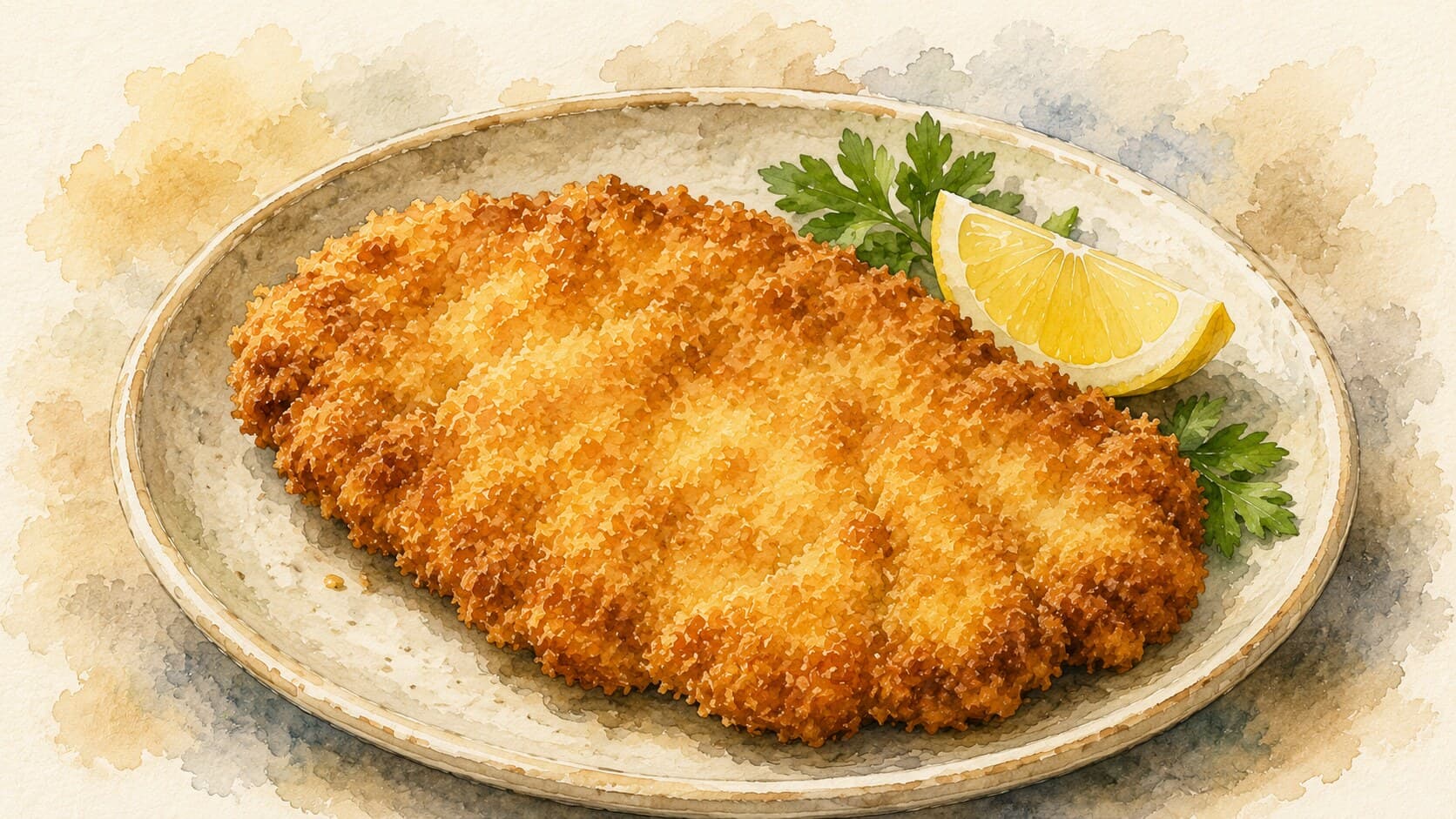
A classic Wiener Schnitzel features paper-thin veal cutlets, lightly breaded and fried to achieve a puffy, golden crust.
Contents (5 sections)▾
Ingredients
- 400 g thin veal cutlets
- 100 g all-purpose flour
- 2 large eggs
- 150 g breadcrumbs
- Salt to taste
- Black pepper to taste
- 500 ml vegetable oil for frying
- Lemon wedges for serving
Steps
Place the veal cutlets between two sheets of plastic wrap and pound them with a meat mallet until they are paper-thin, about 1/4 cm thick. Thinness is crucial for achieving the right texture.
Season the flour with salt and pepper in a shallow dish. In another dish, beat the eggs, and in a third dish, place the breadcrumbs.
Dredge each cutlet lightly in flour, shaking off excess, then dip in beaten eggs, and finally coat with breadcrumbs, ensuring a loose coverage.
In a large skillet, heat the vegetable oil over medium-high heat until shimmering, about 180°C. The oil should be deep enough to submerge the cutlets partially.
Carefully add the breaded cutlets to the hot oil and immediately swirl the pan. Fry for about 3-4 minutes per side until golden brown. Swirling helps the crust to puff away from the meat.
Remove the schnitzels and drain on paper towels. Serve immediately with lemon wedges to squeeze over the top.
Tools you'll want
Why this works
The key to a perfect Wiener Schnitzel lies in the technique of pounding the meat until it is paper-thin. This ensures that the cutlet cooks quickly and evenly, allowing the crust to develop a delightful puffiness. By loosely breading the cutlet, you create air pockets that contribute to the soufflé-like texture of the crust. Frying in plenty of hot oil while swirling the pan allows the crust to lift off the meat, preventing it from sticking, which is essential. If the crust seems too dense or sticks to the cutlet, check the oil temperature; it should be hot enough to create a sizzling sound upon adding the meat. If it breaks, don’t worry—just reshape it and continue frying. The final result is a crispy, golden exterior that contrasts beautifully with the tender veal inside.
Common mistakes
Cutlets pounded unevenly.
- Target: even 3-4 mm (about 1/4 cm) thickness across the whole piece, no thick spots in the center.
- Why it matters: thick patches stay raw while the edges overcook, and the crust (the breaded outer coating that goes crisp in the oil) cannot puff evenly over an uneven surface.
- What to do: work from the center outward with steady, overlapping strokes; if any spot resists, lift the meat, rotate, and try again rather than pounding harder.
Oil too cool when the cutlet hits the pan.
- Target: 170-180°C — a small breadcrumb dropped in should sizzle vigorously and turn golden in 10-15 seconds.
- Why it matters: cool oil soaks into the breading, producing a greasy, dense, sticking crust instead of the souffleed wrinkled coating that lifts away from the meat.
- What to do: use a thermometer if possible; otherwise test with a crumb before the first cutlet. Bring the oil back up to temperature between batches.
Breading pressed on too tightly.
- Target: breadcrumbs gently and loosely coating the cutlet, not packed down.
- Why it matters: the signature puffed crust forms because steam from the meat lifts the loose crumbs away — a packed coat cannot rise.
- What to do: drop the cutlet into the crumbs, sprinkle more crumbs on top, then just tap the edges. No pressing.
Pan kept still instead of swirled.
- Target: continuous gentle swirling so hot oil washes over the top of the cutlet (a thin slice of meat — here veal, pounded thin) from the moment it enters.
- Why it matters: the basting motion (spooning or sloshing hot oil over the top of the meat as it fries) is what actually puffs the crust off the meat and gives Wiener Schnitzel its characteristic wrinkled, lifted coating.
- What to do: hold the pan handle and swirl gently for the entire frying time — do not walk away, do not leave the cutlet sitting still.
What to look for
- the breading puffs up off the meat as soon as the cutlet hits the oil, forming a wrinkled, soufflé-like jacket
- the crust turns an even pale gold (not deep brown) within 60-90 seconds per side
- when lifted, the cutlet shows tiny gaps between meat and breading — the hallmark "lifted" crust
- the veal is just opaque through the center and the juices run clear
A note on history
Wiener Schnitzel is closely associated with Vienna and is a protected term in Austria, where law reserves the name for veal cutlets — pork or other meats cooked the same way are sold as Wiener Art ("Vienna style") or Schnitzel Wiener Art. The earliest known printed recipe identifying the dish as such appears in Maria Neudecker's Allerneuestes allgemeines Kochbuch in 1831, though the broader European tradition of breading and frying thin cutlets is older.
Get the essays in your inbox — free
Weekly notes on flavor, fermentation, and food history — the writing behind the Atlas of Flavor. No spam; unsubscribe anytime.