
Spaetzle (German Egg Noodles)
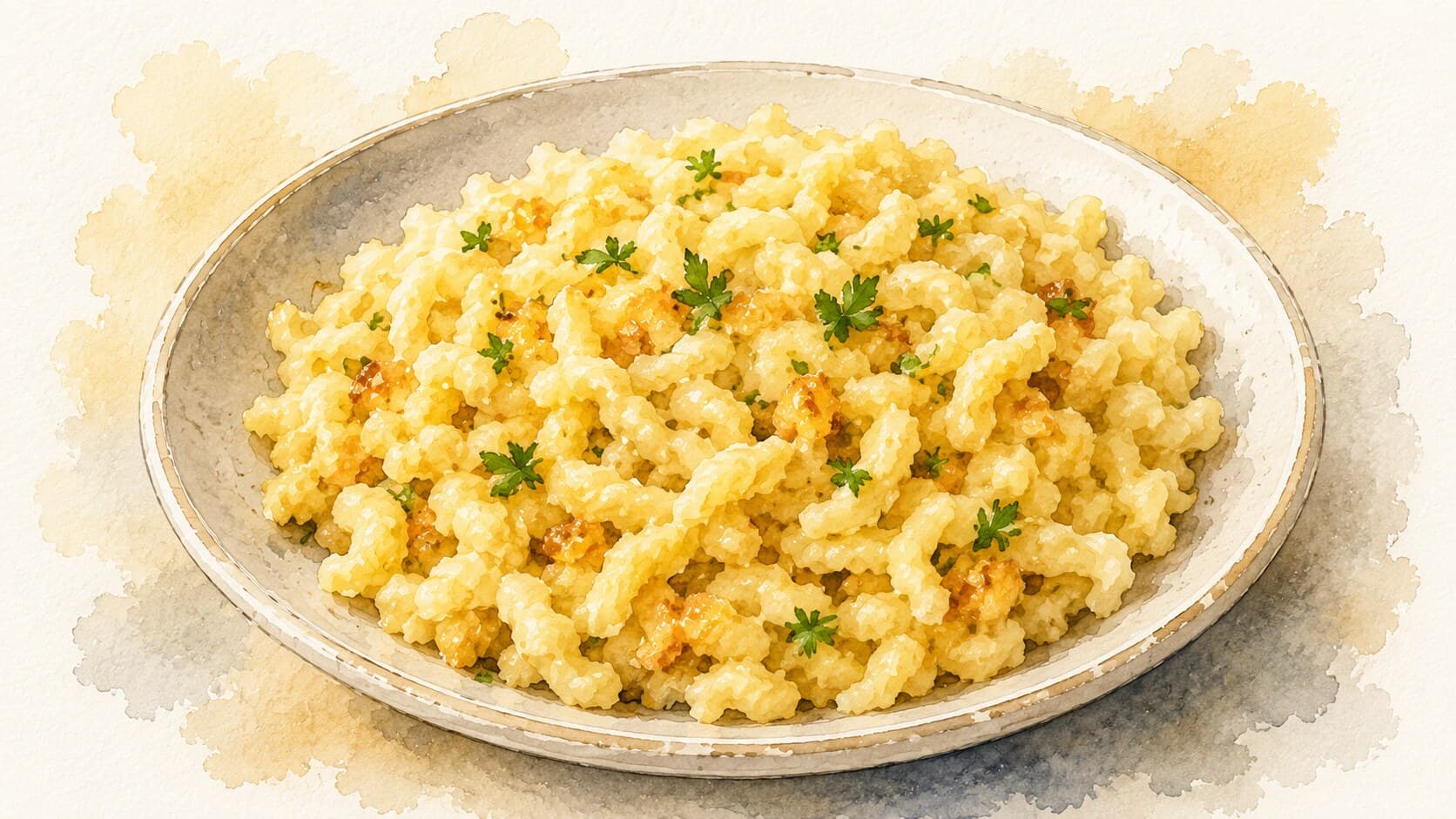
Craft rustic German spaetzle with a simple egg-flour batter that turns into delightful dumplings in boiling water.
Contents (5 sections)▾
Ingredients
- 200 g all-purpose flour
- 3 large eggs
- 100 ml water
- 1 tsp salt
- 2 tbsp unsalted butter
- Grated cheese (for kasespatzle, to taste)
Steps
In a bowl, mix the flour, eggs, water, and salt until you have a smooth, loose batter. Let it rest for about 10 minutes.
Bring a large pot of salted water to a rolling boil over high heat.
Using a spatula, scrape the batter into the boiling water in small portions, letting it cook for about 2-3 minutes until they float to the surface.
Once the spaetzle float, remove them with a slotted spoon and transfer them to a bowl.
In a pan, melt butter over medium heat and toss the cooked spaetzle until well-coated. For kasespatzle, add grated cheese and stir until melted.
Why this works
The key to making spaetzle lies in the loose batter, which, when scraped into boiling water, puffs up and forms irregular dumplings. The high moisture content in the batter helps achieve this unique texture, creating a delightful bite. If the batter seems too thick, add a little more water to achieve the desired consistency; conversely, if it's too watery, it may lose shape in the boiling water. The dumplings serve as a perfect vehicle for butter or cheese, enhancing their flavor. The cooking time is crucial; they usually float to the surface when done, indicating they are ready to be drained. Always remember to toss them in butter immediately to prevent them from sticking together.
Common mistakes
Mixing the batter into a smooth, over-worked paste.
Target: Mix only until you see no dry flour streaks — the batter should look thick, glossy, and slightly ribbon-like, with visible air bubbles when you lift the spoon.
Why it matters: Flour and water develop gluten (the elastic protein network of bread doughs) when worked. A spaetzle batter wants just enough gluten to hold its shape in the water, not enough to turn tough and chewy. Over-mixing produces dense, rubbery noodles that sink heavily instead of puffing up as they cook.
What to do: Whisk the eggs and water first, then add the flour and stir with a wooden spoon in slow, even strokes — about 60 seconds — until the streaks are gone. Stop. Let the batter rest the full 10 minutes so the flour hydrates and any tough strands relax.
Boiling water that is too gentle, or not salted enough.
Target: A vigorous rolling boil in well-salted water — about a tablespoon of salt per 2 litres.
Why it matters: Spaetzle cook by surface starch gelatinizing (swelling and setting into a soft skin in hot water) rapidly when it hits very hot water — that fast set is what gives them a defined surface and a tender, airy interior. A weak simmer lets the strands sit on the bottom and become gummy; under-salted water leaves them bland from the inside out, since you cannot fix the seasoning afterwards.
What to do: Use the biggest pot you have. Bring it to a full, audible boil before scraping in any batter. Keep the heat high — adding cold batter cools the water briefly, and you want it back to a hard boil within seconds.
Cooking the spaetzle in one big mass instead of small batches.
Target: Scrape no more than a third of the batter at a time, so the dumplings have room to move.
Why it matters: Crowded water drops in temperature and the spaetzle stick to one another in clumps, with raw centres and gummy surfaces. The egg dough needs space to puff and the heat to recover quickly between batches so the surfaces set cleanly.
What to do: Work in three loose batches. Scrape, let the strands float for 30–60 seconds, lift them out with a slotted spoon into a buttered bowl, then return to high boil before the next batch. Confirm with the next mistake's cue.
Eating spaetzle whose centres are still raw egg dough (food-safety failure).
Target: The pieces should float for at least 60–90 seconds, then read cooked through when you cut one — no slick, raw-egg gloss in the centre, no sticky doughy resistance against the knife.
Why it matters: This is an egg-flour dough — undercooked centres mean undercooked egg, which is the same food-safety concern as undercooked custard or fresh egg pasta. Floating is the signal that cooking has started, not finished; the pieces still need to finish in the boil for another minute or so.
What to do: When the largest piece floats, give it the full 60–90 seconds more, then cut one open as a check. The interior should look matte, set, and uniformly pale yellow — not glossy or translucent. If in doubt, give it another 30 seconds.
What to look for
- The batter after rest: thick enough to fall in slow ribbons from a spoon, glossy, slightly bubbly on the surface. Pourable but not runny.
- As the batter hits the water: the strands sink for a second or two, then bob upward as a cloud of irregular shapes — pale gold, slightly translucent at the edges. This is starch setting and trapped air expanding.
- A piece cut in half once fully cooked: matte and uniformly pale yellow inside, springy when pressed, no glossy raw-dough core.
- In the buttered pan: each piece holds its rough, sparrow-like shape and glistens evenly — no clumping into a sticky mass. That tells you the surface starch set cleanly and the spaetzle were not over-crowded.
A note on history
Spätzle belong specifically to Swabia — the historical southwestern German region covering southern Baden-Württemberg, southwestern Bavaria, eastern Switzerland, and parts of Alsace (Wikipedia — Swabian cuisine, MasterClass — What Is Spätzle). The Swabian name comes from Spatz (sparrow) — "little sparrows" — and a parallel name Knöpfle ("little buttons") describes the smaller, rounder version made with a press. A 1725 reference by the Württemberg physician Rosino Lentilio already mentions spazen and knöpflein as common flour dishes, and Schwäbische Spätzle / Schwäbische Knöpfle now hold a European Protected Geographical Indication (Draeger's — Origin of Spaetzle). The hand-scraping method — schaben, from a Spätzlebrett (scraping board) — is the original technique that this recipe's spatula-scrape into boiling water is a small-kitchen adaptation of.
Get the essays in your inbox — free
Weekly notes on flavor, fermentation, and food history — the writing behind the Atlas of Flavor. No spam; unsubscribe anytime.