
Rajma (Kidney Bean Curry)
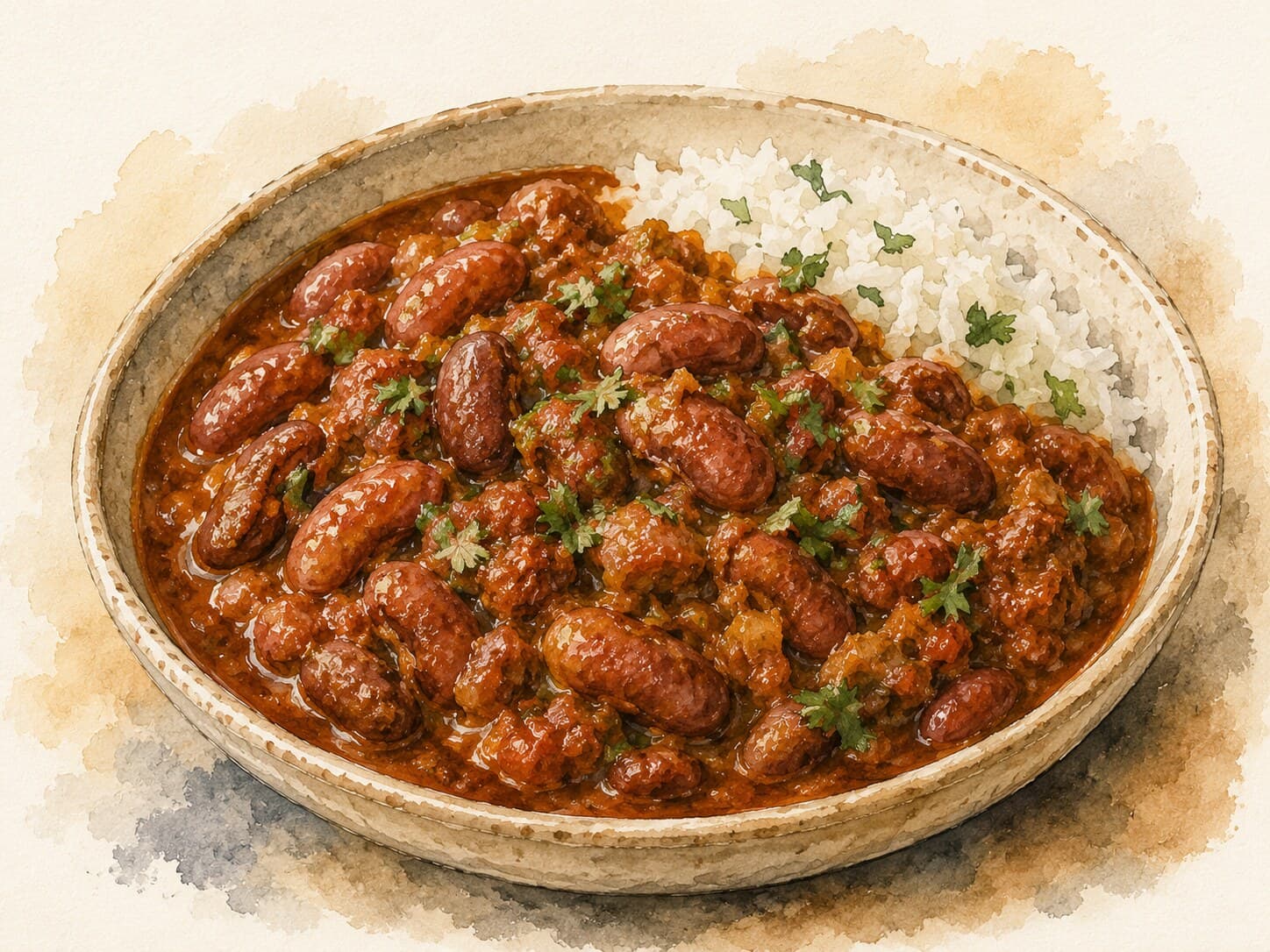
Rajma is a comforting North Indian kidney bean curry simmered until thick and rich, perfect with rice.
Contents (5 sections)▾
Ingredients
- 400 g red kidney beans, soaked overnight
- 2 tbsp vegetable oil
- 1 large onion, finely chopped
- 2 medium tomatoes, pureed
- 1 tbsp ginger-garlic paste
- 1 tsp cumin seeds
- 1 tsp turmeric powder
- 1 tsp red chili powder
- 1 tsp garam masala
- 2 cups water
- Salt to taste
- Fresh coriander leaves for garnish
Steps
In a large pot, heat the vegetable oil over medium heat and add the cumin seeds. Sauté until they sizzle.
Add the finely chopped onion and sauté until golden brown, about 8-10 minutes, stirring frequently to prevent burning.
Stir in the ginger-garlic paste and cook for another 2 minutes, until fragrant.
Add the tomato puree, turmeric powder, red chili powder, and salt. Cook until the oil separates from the masala, about 5-7 minutes.
Add the soaked kidney beans and water to the pot. Bring to a boil, then reduce the heat to low. Cover and simmer for 30-40 minutes, stirring occasionally, until the beans are soft and the gravy thickens.
Once cooked, sprinkle garam masala and mix well. If the curry seems too thick, add a little water to reach the desired consistency.
Garnish with fresh coriander leaves and serve hot with rice or flatbreads.
Why this works
Rajma achieves its signature creamy texture through the technique of slow simmering soaked kidney beans in a richly spiced onion-tomato masala. As the beans cook, they break down and release their starches, naturally thickening the gravy without the need for cream or flour. This method allows the flavors to meld beautifully over time, enhancing the overall taste of the curry. It's important to maintain a low simmer; if the heat is too high, the beans might break apart too quickly and not thicken the gravy as desired. If the curry seems too thick at any point, simply add a little water and stir to adjust the consistency. This ensures you retain the perfect balance of flavors and texture, making the dish a comforting staple in North Indian cuisine.
Common mistakes
Cooking dried kidney beans without a hard, rolling boil at the start. Target: soaked dried red kidney beans brought to a hard, rolling boil for at least 10 minutes — bubbles breaking violently and continuously across the entire surface — before reducing to a simmer. Why it matters: raw and undercooked red kidney beans contain phytohaemagglutinin (PHA), a natural lectin that causes severe nausea, vomiting and diarrhea within hours of eating. This compound is destroyed only by sustained high heat — about 100°C / 212°F for 10 minutes minimum. A slow cooker on low (around 80°C / 175°F) is not enough and can actually increase the toxin's effect by warming without destroying. This is a BLOCK-level safety guard. What to do: soak the beans overnight in plenty of water, drain, cover with fresh water, and boil hard for a full 10 minutes uncovered before lowering to a simmer for the rest of the cook. Canned kidney beans have already been pressure-cooked at the factory and are safe.
Under-browning the onion masala and ending up with a thin, watery gravy. Target: finely chopped onion sautéed until deeply golden-brown (not pale yellow), about 8–12 minutes over medium heat, with the edges starting to caramelize. Why it matters: the bhuna (frying) of onion is what builds the curry's body. Browning develops sweetness via the Maillard reaction (amino acids and sugars rearranging at heat into hundreds of new flavor compounds) and breaks down the onion's water content. Stop too early and the gravy stays sharp, raw and thin no matter how long the beans simmer. What to do: be patient. Stir often after the first 5 minutes to prevent burning. The color should deepen from yellow to amber to deep gold — this is the point at which you add ginger-garlic, then tomato.
Adding garam masala at the start of cooking. Target: ground garam masala added in the last 2–3 minutes of cooking, off the heat or on very low heat, with the lid on briefly to bloom. Why it matters: garam masala is a blend of toasted, ground aromatic spices — cardamom, clove, cinnamon, pepper. Its volatile aromatics are heat-fragile (heat-sensitive flavor molecules that evaporate during long cooking). Add it early and you boil away the perfume; add it late and it lifts the whole pot. What to do: keep the curry powders and turmeric in the masala base for the long cook; sprinkle garam masala at the very end and stir gently.
Skipping the oil-separation step (tarka / chhonk). Target: when the masala is properly cooked, you see beads of orange-tinged oil rising and pooling at the edges of the pan. Why it matters: that visible oil separation is the sign the masala paste has cooked through — the water from the onions and tomatoes has evaporated and the spices are now suspended in fat rather than water. This is when the flavor base is fully "set." Skip it and the curry tastes raw and oily-on-top. What to do: cook the masala over medium heat, stirring, until you can see oil pulling away from the solids at the edges before you add the beans and water.
What to look for
- A gravy that thickens noticeably as it cools on the spoon — that's the bean starch doing its work. If the sauce stays watery even after long simmering, mash a few spoonfuls of beans against the side of the pot and stir back in.
- Beans that hold their shape but split slightly when you press one between thumb and tongue — the perfect texture sits between firm and falling-apart. A bean that crushes to paste under no pressure is overcooked; one that resists is undercooked.
- A glossy, oil-rich surface rather than a dull, watery one — gloss means the masala emulsified properly into the gravy. Dull means the bhuna step was rushed.
- A deep red-brown color, not bright tomato-orange — bright orange means the masala didn't cook long enough for the tomato and spices to deepen; the brick-brown hue is the marker of a properly developed rajma.
A note on history
Although rajma is now iconic to Punjab and adjacent North Indian regions, the red kidney bean itself originated in Mesoamerica (modern-day Mexico and Peru), where it was domesticated about 8,000 years ago (Wikipedia: Rajma). Beans crossed the Atlantic with Portuguese and Spanish ships in the 16th century as part of the Columbian Exchange (the global swap of crops, animals, and people that followed European contact with the Americas), entering the Indian subcontinent through coastal trade ports like Goa (Slurrp: Rajma — How Mexican Kidney Beans Came to India). In the colder Himalayan foothills and the plains of Punjab, the bean settled into the local masala vocabulary, and rajma chawal (rajma with rice) became a Sunday-comfort staple that the Punjabi diaspora (the communities of Punjabi origin who emigrated abroad, especially after the 1947 Partition) carried worldwide.
Get the essays in your inbox — free
Weekly notes on flavor, fermentation, and food history — the writing behind the Atlas of Flavor. No spam; unsubscribe anytime.