
Nasi Lemak (Malaysian Coconut Rice)
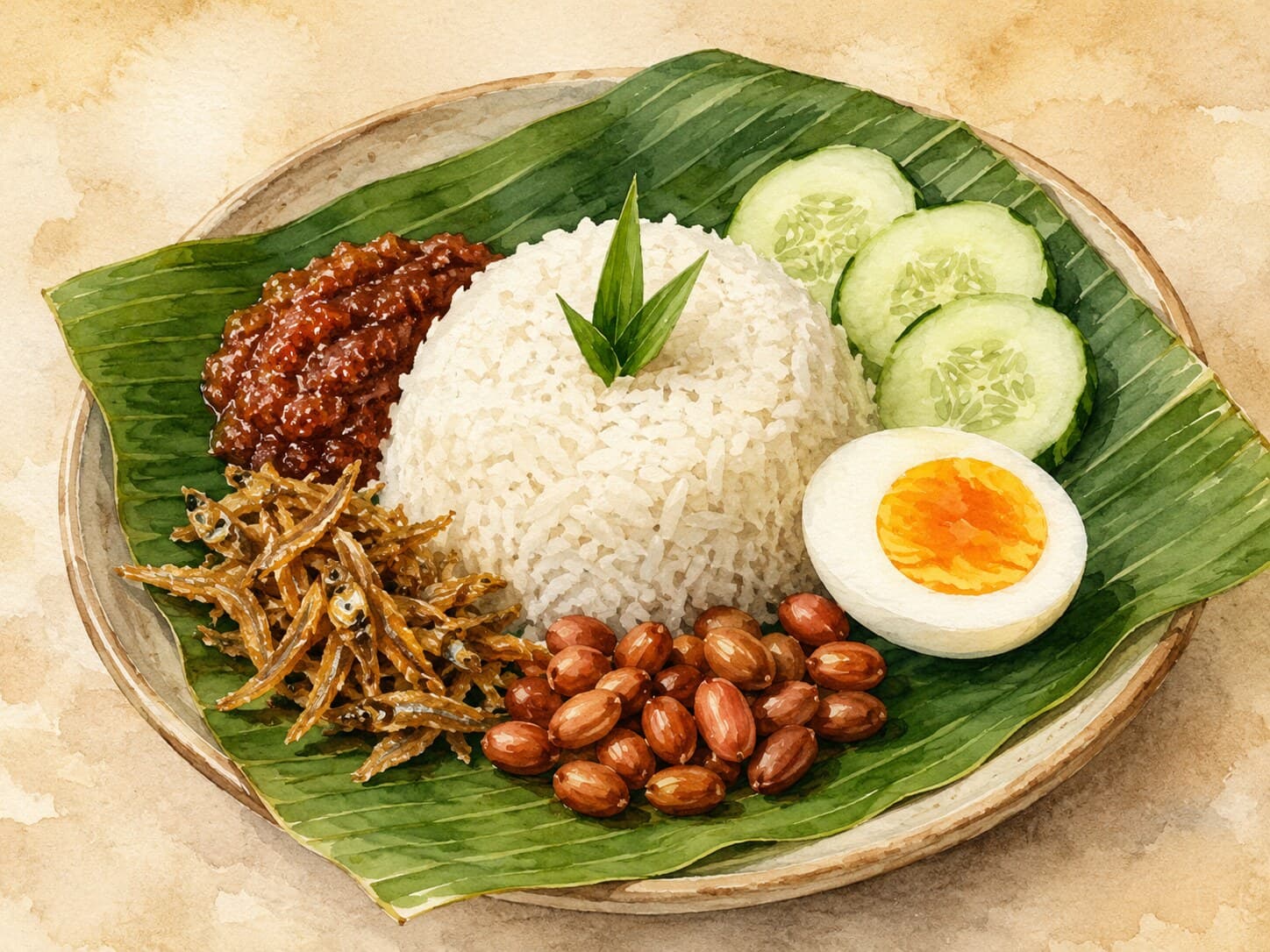
Nasi lemak is a fragrant Malaysian coconut rice dish served with contrasting sides, including sambal.
Contents (5 sections)▾
Ingredients
- 2 cups jasmine rice
- 400 ml coconut milk
- 1 cup water
- 2 pandan leaves, tied in a knot
- 1 tsp salt
- 3 tbsp sambal (to taste)
- 50 g fried anchovies
- 50 g roasted peanuts
- 1 cucumber, sliced
- 2 boiled eggs, halved
Steps
Rinse the jasmine rice under cold water until the water runs clear, about 3-4 times. This removes excess starch for a fluffier texture.
In a pot, combine the rinsed rice, coconut milk, water, salt, and pandan leaves. Stir gently to mix, ensuring the rice is evenly distributed.
Bring the mixture to a boil over medium heat, then reduce to low, cover, and simmer for 15 minutes until the rice absorbs the liquid.
Turn off the heat and let the rice sit, covered, for an additional 10 minutes to allow it to steam and become fluffy.
While the rice rests, prepare the sides: slice cucumber, halve the boiled eggs, and arrange fried anchovies and peanuts on a plate.
Once the rice is ready, fluff it with a fork and serve it on a banana leaf, surrounded by the prepared sides and a dollop of sambal.
Why this works
Cooking jasmine rice (a slender long-grain rice from Southeast Asia, prized for its naturally sweet, popcorn-like aroma) in coconut milk infuses each grain with rich flavor and creaminess, while the pandan leaves (long green leaves from a tropical screwpine — Southeast Asia's answer to vanilla, with a sweet grassy aroma) impart a unique fragrance that adds to the dish. The key is to balance the moisture; if the rice seems too wet after cooking, let it rest longer with the lid on to absorb excess moisture. The contrasting sides of spicy sambal (a Southeast Asian chilli paste cooked down with shallot, garlic, and shrimp paste — savory-hot, not just spicy), crunchy anchovies, and fresh cucumber create a vibrant plate that enhances the creamy rice. This combination offers delightful textures and provides a balanced palate experience, making nasi lemak a breakfast dish in Malaysia.
Common mistakes
Boiling the coconut milk hard and watching it split. Target: a gentle simmer — never a rolling boil — once the coconut milk is in the pot. Why it matters: coconut milk is an emulsion of coconut oil, coconut solids, and water. At a hard boil the emulsion breaks (the oil separates from the solids), and instead of the silky, fragrant grains of cooked-in coconut rice you get watery rice with greasy beads on top and curdled white flecks. The same physics that breaks a Mornay or a risotto mantecatura breaks coconut milk. What to do: bring everything to a gentle bubble at medium heat, then drop to low the moment it simmers, cover, and let the rice absorb the liquid quietly. Don't stir mid-cook.
Skipping the rinse, then complaining the rice is gluey. Target: jasmine rice rinsed 3–4 times until the water runs clear, drained well. Why it matters: unrinsed long-grain rice carries a coating of surface starch. In coconut milk that starch turns the dish into a creamy congee — fine for a different recipe, but not for nasi lemak, where the ideal is fragrant grains that stand apart while still being rich. The rinse removes that excess starch without taking the inner texture. What to do: rinse in a bowl, swirl with your hand, drain, and repeat until the water comes out almost clear. Drain well so you can measure the cooking liquid accurately.
Cooking the boiled eggs until the yolk turns grey-green. Target: whites fully opaque all the way through; yolk just-set for general eating, fully firm for vulnerable diners (pregnancy, immunocompromised, very young or elderly). Why it matters: undercooked egg whites still translucent at the yolk edge can carry Salmonella risk. On the other end, the grey-green ring around an overcooked yolk is iron sulfide — harmless but a sign the eggs were boiled too hot for too long, with a sulfurous smell that fights the coconut rice's fragrance. What to do: start eggs in cold water, bring to a gentle boil, then cover and rest off heat for 9–11 minutes depending on egg size. Plunge into ice water to stop cooking. For vulnerable diners, hold the rest at 11–12 minutes to fully firm the yolk.
Burning the sambal because the pan was too hot. Target: a low, patient sauté — sambal slowly turning from raw red to deep brick-red — typically 20–30 minutes. Why it matters: sambal is a paste of chilli, shallot, garlic, and shrimp paste (belacan) cooked down in oil. Push the heat too high and the sugars in the shallot scorch before the chilli's flavour rounds out; you get bitter, dark, hot — instead of the deep, savoury, slow-burning sambal the dish needs. What to do: medium-low, lots of oil at the start so the paste fries rather than burns. Stir often. The cue is colour: when the sambal turns a glossy brick-red and the oil at the edge separates orange, it is done.
What to look for
- Rice grains that stay distinct when you fluff with a fork, glossed but not gummed — the test for proper coconut-milk rice. Sticky clumps mean too much liquid or too vigorous a stir; mushy grains mean it sat too long covered.
- A pandan-and-toasted-coconut smell rising as you lift the lid — the aromatic compounds (2-acetyl-1-pyrroline in pandan, lactones in coconut) volatilising from heat. A flat smell means underseasoned or the rice wasn't hot enough at the rest.
- Sambal a deep brick-red with a thin orange oil halo at the edge — the doneness cue. A muddy brown or scorched-dark sambal means the heat was too high.
- Anchovies (ikan bilis) crisp and bronze, no dark spots or burnt tail tips — fried at the right temperature (~170 °C / 340 °F). Pale and chewy means oil was too cool, dark and bitter means too hot.
A note on history
Nasi lemak traces back to rural Malay communities — most commonly placed on the west coast of the peninsula in the 19th century — where rice farmers needed a portable, dense, energy-rich breakfast for long days in the fields. Coconut and dried anchovies were both abundant near the coast, and the dish that emerged paired fragrant coconut-cooked rice with the sharp, salty contrast of sambal and ikan bilis. The name nasi lemak translates roughly as "rich rice" — referring to the richness of coconut milk, not luxury. Today it is recognised as the national dish of Malaysia (Wikipedia: Nasi lemak; Singapore Roots: Nasi Lemak).
Get the essays in your inbox — free
Weekly notes on flavor, fermentation, and food history — the writing behind the Atlas of Flavor. No spam; unsubscribe anytime.