
Roti Canai
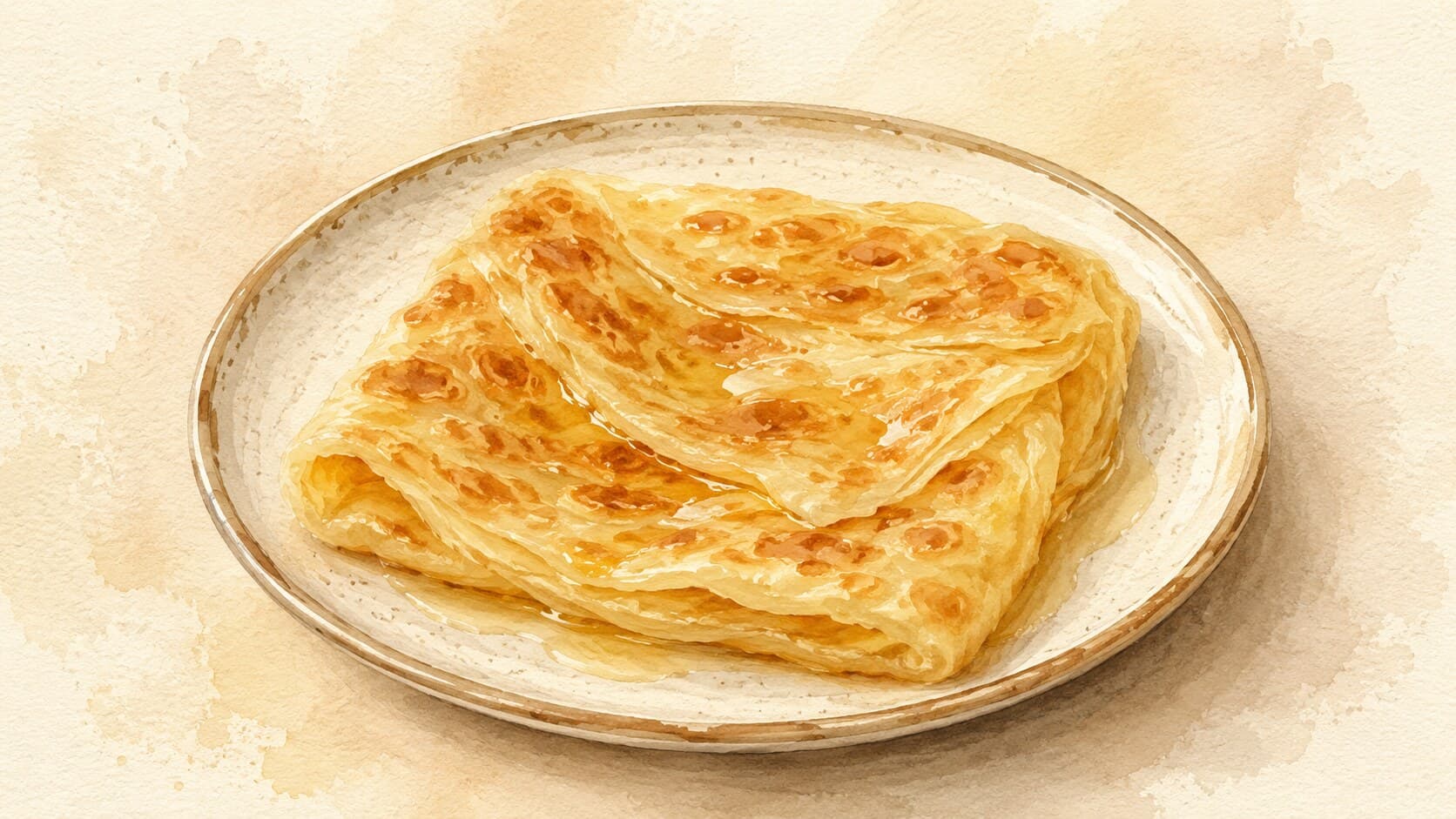
Roti Canai is a Malaysian flaky flatbread made from a soft enriched dough, perfect for pairing with curry.
Contents (5 sections)▾
Ingredients
- 500g all-purpose flour
- 1 tsp salt
- 2 tbsp sugar
- 1 tbsp condensed milk
- 200ml water
- 100ml ghee (for frying)
- 50ml vegetable oil (for resting and stretching)
Steps
In a large bowl, mix the flour, salt, and sugar. In a separate bowl, blend the condensed milk with water, then combine it with the dry ingredients. Knead for about 10 minutes until the dough is smooth and elastic.
Divide the dough into 8 equal balls and coat each with vegetable oil. Place them in a container, cover, and let rest in the refrigerator overnight to develop flavor and texture.
On a well-oiled surface, take one dough ball and flatten it with your hands. Use your fingers to stretch the dough gently, working from the center outwards until it becomes a translucent sheet.
Fold the stretched dough into a coil, starting from one edge and working your way to the other. This creates layers that will give the roti its flakiness.
Heat a pan over medium heat and add ghee. Once hot, place the coiled dough in the pan and cook for about 4-5 minutes on each side until golden brown and crispy.
Remove the roti from the pan and let it drain on paper towels. Serve warm, preferably with dal curry or your choice of dip.
Why this works
The technique of resting the enriched dough overnight allows the gluten to relax, making it easier to stretch into a thin sheet without tearing. Stretching the dough to a translucent sheet is crucial as it ensures the final product has those signature flaky layers. The folding into a coil creates multiple layers, which, when fried in ghee, results in a contrast of a crispy exterior and a soft, layered interior. If your dough tears while stretching, don't worry; simply patch it with a bit of dough and continue stretching. The use of ghee adds a rich flavor and aids in achieving that golden crispiness. This method showcases the art of lamination through folding and teaches the essential skill of dough stretching, making it a worthwhile weekend project for anyone interested in bread-making.
Common mistakes
Skipping the overnight rest.
- Target: At least 8 hours in the fridge, ideally a full overnight, with each ball coated in oil and covered so the surface stays supple.
- Why it matters: Freshly kneaded dough is tight and elastic — pull on it and it springs back instead of stretching out. Without a long, cold rest the gluten never relaxes enough to let you stretch a sheet thin enough to see your fingers through.
- What to do: Knead, divide into balls, coat them in oil, cover well, and leave them in the fridge from one evening to the next morning. Bring back to room temperature for 30 minutes before you start stretching.
Stretching on a dry surface.
- Target: A generously oiled work surface and oiled hands — slick, not sticky.
- Why it matters: Roti canai is stretched by sliding outward, not rolled. On a dry surface the dough grabs and tears in seconds; on an oiled one it slides under your palms and goes paper-thin without splitting.
- What to do: Brush the counter with vegetable oil before each ball, and keep a small bowl of oil at hand to re-grease your fingertips as you work.
Coiling the dough too tightly.
- Target: A loose spiral coil with a little air visible between turns, not a dense rope.
- Why it matters: The flaky layers come from the gaps in the spiral expanding in the hot ghee. Wound up too tight, the layers fuse and you bake a hard puck instead of a layered round.
- What to do: After stretching, fold the sheet into a long strip, then coil that strip loosely with just enough tension to hold the shape. Press lightly only at the end.
Trying to cook in barely-warm ghee.
- Target: Medium heat with the ghee shimmering, around 175–185°C. A scrap of dough should bubble immediately when it goes in.
- Why it matters: Roti needs to hit hot fat so the outside crisps quickly while the inside layers steam open. Lukewarm ghee (clarified butter with the milk solids removed, common in South Asian cooking) soaks in instead of frying, and the bread turns greasy and pale.
- What to do: Preheat the pan with the ghee until it shimmers; test with a small piece of dough; if the dough sinks and stays still, wait another 30 seconds.
What to look for
- Held up to the light, the stretched sheet is translucent enough that you can see your fingers through it.
- In the hot ghee, the coil swells visibly and the surface blisters into golden-brown pockets.
- Tapped after cooking, the roti sounds dry and crackly — not heavy or muffled.
- Torn open, the inside pulls apart in distinct soft layers rather than a single dense crumb.
A note on history
Roti canai descends from the layered Indian flatbread tradition (closely related to paratha, the pan-fried laminated flatbread of the Indian subcontinent), and it travelled to the Malay Peninsula with South Indian — largely Tamil-Muslim — migrants during the colonial era, roughly between the 1880s and 1930s. The Tamil-Muslim community in Malaysia, often called "Mamak" (the Malay term for Tamil-Muslim shopkeepers and the small eateries they run), popularised it through their coffee shops and street stalls, and over generations the dough absorbed local touches — condensed milk, a softer crumb, a faster flip — until it became a distinctly Malaysian breakfast staple. The "canai" in the name is most often traced either to the Tamil word channa or to a Malay term meaning to roll dough thin.
Get the essays in your inbox — free
Weekly notes on flavor, fermentation, and food history — the writing behind the Atlas of Flavor. No spam; unsubscribe anytime.