
Lomo Saltado (Peruvian Beef Stir-Fry)
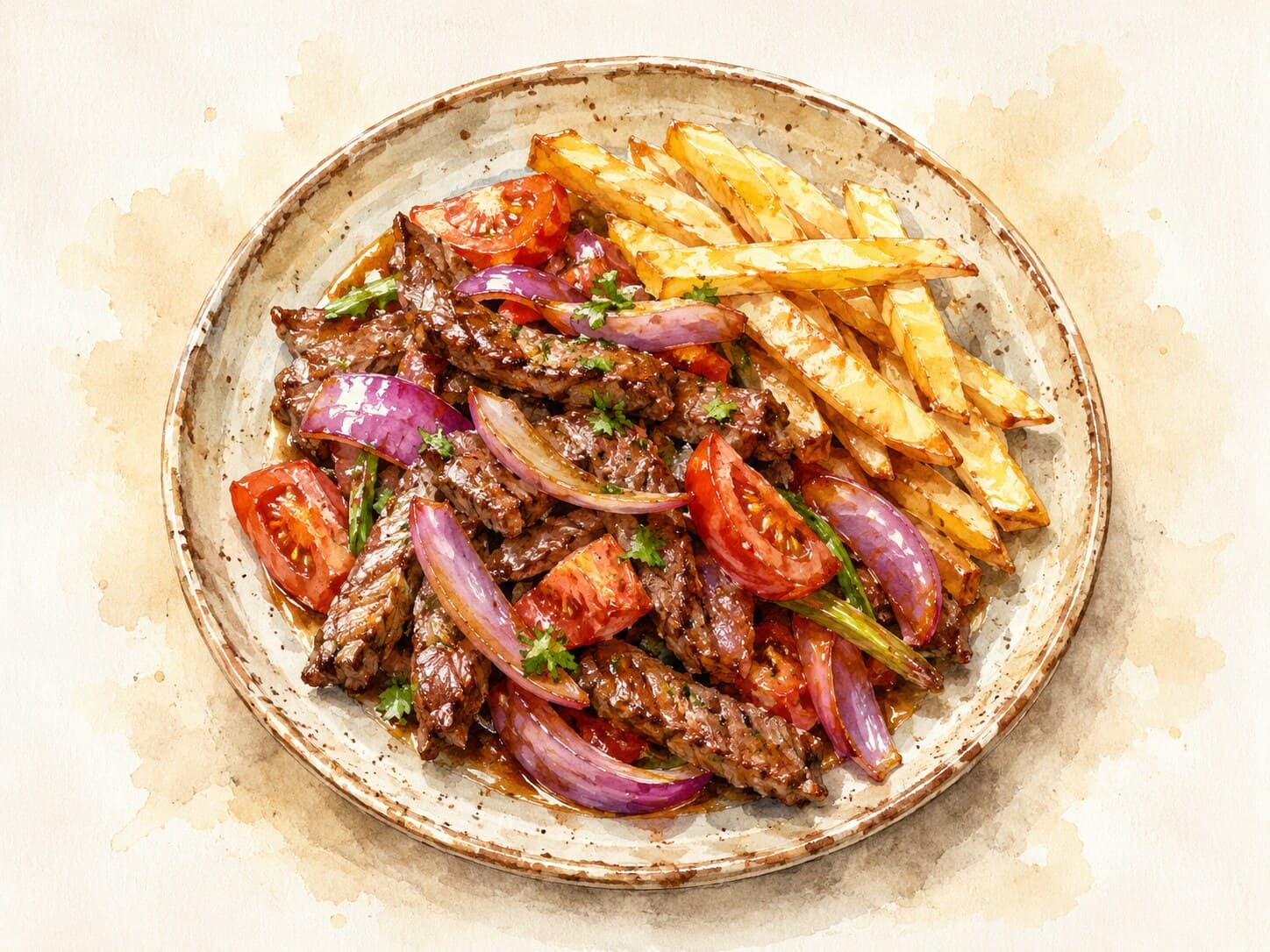
Experience the vibrant flavors of Peru with this quick and delicious Lomo Saltado, a beef stir-fry served with fries.
Contents (5 sections)▾
Ingredients
- 500 g beef sirloin, sliced into thin strips
- 2 tbsp soy sauce
- 1 tbsp red wine vinegar
- 1 tbsp vegetable oil
- 1 medium onion, sliced
- 2 medium tomatoes, sliced
- 1 clove garlic, minced
- Salt to taste
- Black pepper to taste
- 400 g frozen French fries, for serving
- Fresh cilantro, for garnish
Steps
Marinate the sliced beef sirloin in a mixture of soy sauce, red wine vinegar, salt, and black pepper for at least 15 minutes.
In a large wok, heat the vegetable oil over high heat until shimmering (about 2 minutes). This ensures a quick sear.
Add the marinated beef to the wok and stir-fry for about 3-4 minutes until browned but still tender.
Add the sliced onion and minced garlic, and stir-fry for an additional 2 minutes until fragrant.
Incorporate the sliced tomatoes and sauté for 1-2 minutes, then deglaze the wok with the remaining marinade.
Simultaneously, prepare the French fries according to package instructions.
Serve the beef stir-fry over the fries and garnish with fresh cilantro.
Why this works
The key to a successful Lomo Saltado lies in the high-heat stir-frying technique used to quickly cook the marinated beef, preserving its tenderness while developing a rich flavor. The combination of soy sauce and red wine vinegar creates a balance of salty and tangy notes that enhance the beef and vegetables. When you deglaze the wok with the marinade, it captures the fond left behind from cooking, infusing the dish with added depth. If the beef seems too tough, ensure your wok is adequately hot before adding it, allowing for a proper sear. Overcrowding the wok can lead to steaming instead of stir-frying; if this happens, work in batches for a better result. This dish exemplifies the fusion of Chinese and Peruvian cuisine and is best enjoyed piping hot.
Common mistakes
Beef stir-fried before the wok is properly hot. Lomo saltado depends on the wok hei effect — the smoky char on the surface of the meat that comes from very high heat for a very short time. A cold or warm wok makes the meat steam in its own juices, turning grey and rubbery. Target: wok heated until the oil shimmers and a drop of water vaporises on contact within 1 second. Beef strips cut against the grain into 5–7 mm slices, patted bone-dry before they hit the oil. Why it matters: when the surface is wet, the first thing the heat does is evaporate that water — which steals energy that should have been searing the beef. The Maillard reaction (the brown crust and the savoury aroma) only kicks in around 140°C. A lukewarm pan never gets there. What to do: dry the beef thoroughly with paper towels after marinating. Heat the wok over the highest flame for at least 2 minutes before adding oil. Work in 2–3 batches if your wok is small — overcrowding drops the temperature instantly.
Beef left rare or pink in the middle. This is a safety line, not a style choice. Lomo saltado is built on stir-fried beef strips — thin enough that a hot wok cooks them through quickly. The exterior char is correct; the interior must be fully cooked. There is no medium-rare framing here. Target: beef strips that show no pink in the middle when you cut one. The texture should be firm-tender, not soft and red. Why it matters: thin slices are intended to cook through in 2–3 minutes of high-heat stir-frying. Char on the outside does not mean cooked inside — that's only true when the slice is thin and the heat is high. If your slices are thick, they need a few seconds longer; if your heat is wrong, the cooking is unsafe. What to do: slice the beef thin (5–7 mm), against the grain. Cook in batches so the pan stays hot. Cut into one piece before serving — if you see pink, return everything to the wok for another 30 seconds. "Char outside" is fine; "char outside + pink inside" is not done.
Marinade poured into the wok all at once. The whole point of the deglaze at the end is to use the marinade as a sauce — but if you dump it in too early or too much at once, the wok cools, the beef stews, and the sauce never reduces to a glaze. Target: marinade added in two stages — most of it after the tomatoes go in, with the wok still ripping hot, then a small splash at the end if a sauce-coat is needed. Why it matters: liquid hitting a screaming wok flashes to steam (carrying volatile aromatics into the air) and reduces quickly. Liquid hitting a moderately hot wok just sits there, simmering everything into a wet braise. Texture contrast is lost. What to do: keep the heat on full. Add the marinade in a thin pour around the edge of the wok, not the centre — the edges are hottest. Toss for 30 seconds and pull the pan off the flame.
Tomatoes added too early, so they collapse. The whole identity of lomo saltado depends on the tomatoes being just-barely-warm — softened at the surface, still holding their wedge shape, still juicy. Add them with the beef and they break down into sauce. Target: tomatoes (cut into wedges, not dice) added in the last 60–90 seconds of cooking, only long enough to warm through and release a thin slick of juice. Why it matters: tomato cell walls collapse around 80–85°C, releasing water and pectin. A wedge that holds its shape for one bite is the textural anchor of the dish. Fully collapsed tomato turns the whole stir-fry into sloppy sauce. What to do: add tomatoes after the onions are just softened and the beef has gone back in. Toss for one minute, then plate. The shape should still be visible on the plate.
What to look for
- A faint blue haze rising off the wok before the oil goes in. That haze means the metal is at stir-fry temperature — hot enough to instantly sear, not just to fry. If you see no haze, wait another 30 seconds.
- Beef strips with dark mahogany char on the outside, firm-tender (no pink) inside when cut. Both halves matter equally: the char is the flavour, the cooked-through interior is the safety.
- Onion wedges that are translucent at the edges but still snap when bitten. Lomo saltado onions are not caramelised — they are just barely cooked. If they're floppy and brown, they were in too long.
- A thin glossy slick of sauce coating everything, with no pool at the bottom of the plate. The marinade should reduce in seconds on a hot wok and cling to the meat and vegetables. A puddle on the plate means the wok wasn't hot enough or there was too much liquid added at once.
A note on history
Lomo saltado is the most-eaten proof of one of South America's most consequential migrations. Beginning in 1849, around 100,000 mostly Cantonese-speaking Chinese labourers were brought to Peru as indentured workers (L.A. Taco, Food52). When that labour trade ended in 1874, many of them stayed, opened kitchens, and over the next half-century the hybrid cuisine chifa — a Peruvianised Spanish rendering of the Cantonese word for "eat rice" — took shape. The earliest cookbook reference to a dish recognisable as lomo saltado dates from 1903; soy sauce, vinegar, and the wok came from the Cantonese side, while ají amarillo, tomatoes, onions, and the now-mandatory papas fritas came from Peru (Wikipedia, Fodor's).
Get the essays in your inbox — free
Weekly notes on flavor, fermentation, and food history — the writing behind the Atlas of Flavor. No spam; unsubscribe anytime.