
Causa Limeña
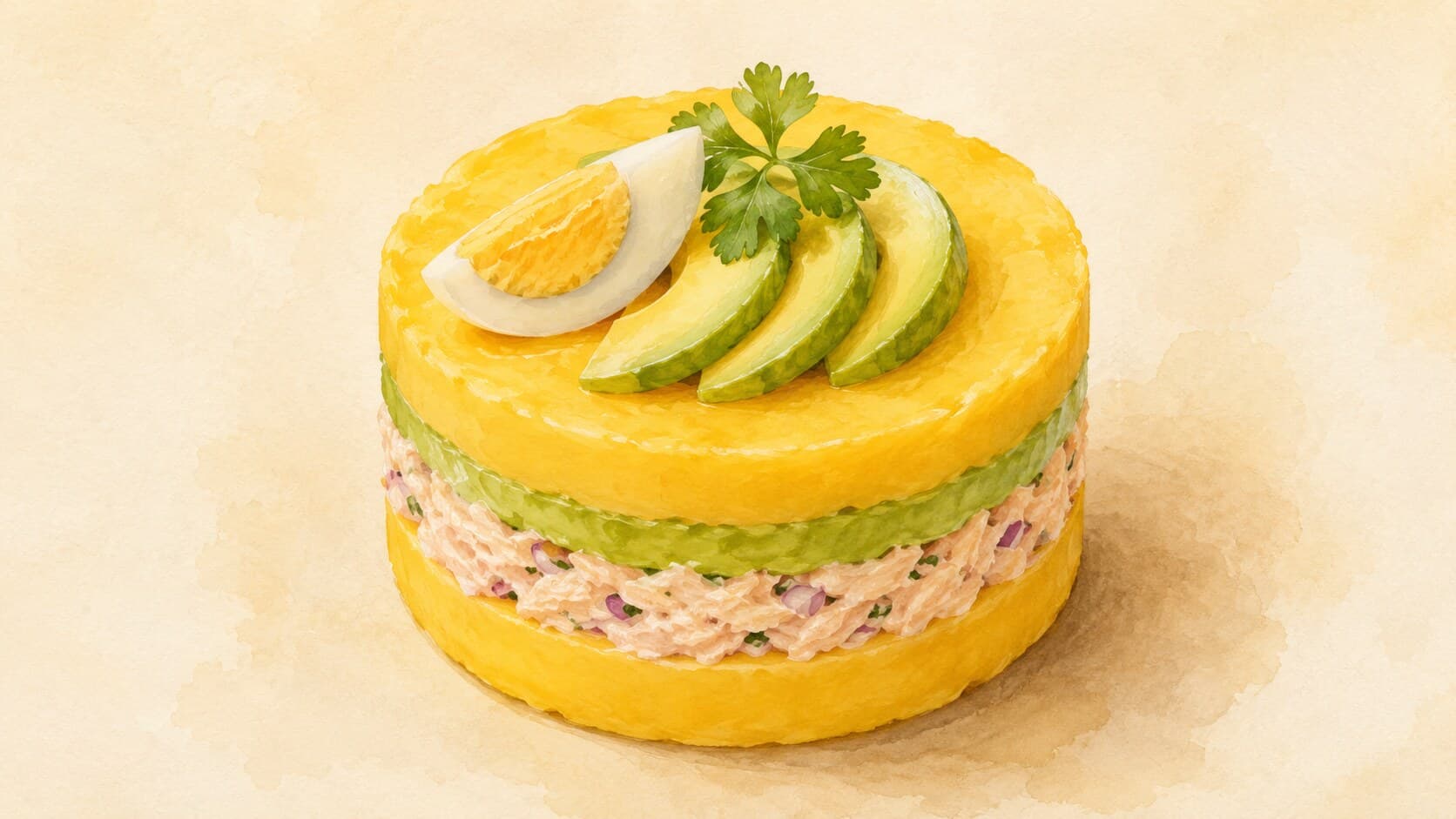
Causa Limeña is a Peruvian starter made with layered yellow potato and aji amarillo mash, filled with chicken or tuna.
Contents (5 sections)▾
Ingredients
- 500 g yellow potatoes
- 2 tbsp lime juice
- 2 tbsp aji amarillo paste
- 200 g cooked chicken or tuna, shredded
- 100 g mayonnaise
- 1 boiled egg, sliced
- 4 black olives, sliced
- Salt to taste
- Pepper to taste
Steps
Boil the yellow potatoes in salted water for about 15 minutes until fork-tender. This ensures a creamy mash.
Once cooked, drain and peel the potatoes. While still warm, mash them in a bowl.
Add lime juice, aji amarillo paste, salt, and pepper to the mashed potatoes. Mix until smooth and vibrant.
In a separate bowl, combine the shredded chicken or tuna with mayonnaise, adding salt and pepper to taste.
In a mold or terrine, layer half of the potato mash, followed by the chicken or tuna mixture, and then top with the remaining potato mash.
Smooth the top and refrigerate for at least 30 minutes to set before serving. This helps the layers to firm up.
To serve, carefully unmold and slice into portions. Garnish with slices of boiled egg and olives on top.
Why this works
The combination of yellow potatoes, lime, and aji amarillo (a fruity Peruvian yellow chili paste) creates a unique flavor that is distinctly Peruvian. The potatoes provide a creamy texture, enhanced by the acidity from lime juice which balances the richness of the dish. Aji amarillo adds a mild heat and a beautiful color that makes the dish visually appealing. When layering, it's crucial to pack the layers well; if the layers seem too loose or wobble when unmolding, you can gently press them down while still in the mold. Additionally, chilling the Causa Limeña helps the flavors to meld and the structure to hold when slicing, ensuring a clean presentation. If it breaks when unmolding, simply use a spatula to reshape it on the plate before garnishing.
Common mistakes
Mashing the potatoes after they've cooled, or using a watery variety.
Target: Starchy yellow potatoes, drained well and mashed while still warm.
Why it matters: Warm potato starch is soft and pliable, so it mashes into a smooth, cohesive paste that binds the layer together. Cold potato turns gluey and resistant — working it then develops a pasty, sticky texture. A waxy, high-moisture potato never firms up enough to slice cleanly.
What to do: Mash the moment they're cool enough to handle. A ricer or fork gives a finer result than a masher and avoids over-working.
Treating the cooked chicken or tuna as if chilling makes it safe.
Target: Filling made from fully cooked, properly handled protein, assembled and kept cold.
Why it matters: This is a cold dish, and cold does not cook — it only slows bacteria. A mayonnaise-bound chicken or tuna filling left at room temperature sits in the danger zone (roughly 4–60°C / 40–140°F), where bacteria multiply fast. The risk is in the protein and the mayonnaise, not the potato.
What to do: Cook the chicken through (or use well-drained tinned tuna), cool it quickly, mix with mayonnaise, and keep everything refrigerated until serving. Don't let the assembled dish stand out on a buffet for hours.
Under-seasoning the potato layer.
Target: Potato that tastes bright and distinctly limey-spicy on its own, before any filling.
Why it matters: Potato is bland and mutes seasoning, and serving the dish cold flattens flavor further — chilled food tastes less salty and less acidic than the same food warm. A layer seasoned to taste "right" while warm will read as dull straight from the fridge.
What to do: Season the warm mash assertively with lime, salt, and ají amarillo (a fruity Peruvian yellow chili paste, more flavor than fierce heat). Taste and push it slightly past comfortable — chilling will pull it back.
Slicing or unmolding while still soft.
Target: At least 30 minutes chilled (longer is better) until the layers are firm and set.
Why it matters: As cooked potato cools, its starch re-firms — a process called retrogradation — and the mash sets into something sliceable. Cut too early and the layers slump and smear instead of holding clean lines.
What to do: Chill until firm to a light press. Run a knife dipped in hot water for clean slices, and if a slice does break, reshape it on the plate with a spatula before garnishing.
What to look for
- Mashed potato: smooth and cohesive, holds a soft peak, glossy yellow from the ají. Gluey or sticky means it was worked cold or over-mashed.
- Seasoned layer (tasted warm): bright lime up front, gentle building warmth, fully salted. If it tastes balanced warm, it will taste flat cold — push it further.
- Filling: moist and spreadable, not wet or sloppy. Excess liquid will soften the potato and undermine the layers.
- After chilling: firm to a light press, layers distinct at the edge. A knife should leave a clean wall, not a collapsing one.
A note on history
Causa traces to pre-Columbian Peru, where Andean cooks ate mashed potato seasoned with chili; lime and onion entered after Spanish contact (Wikipedia). The name is debated: one theory ties it to the Quechua kawsay ("sustenance," also a word for the potato), while the more popular account dates it to around 1820, when women along the coast sold the potato dish to raise money for the independence forces of San Martín and Bolívar — selling it por la causa, "for the cause" (Wikipedia, Peru Fusion Ireland).
Get the essays in your inbox — free
Weekly notes on flavor, fermentation, and food history — the writing behind the Atlas of Flavor. No spam; unsubscribe anytime.