
Anticuchos
Grill tender beef heart skewers marinated in a rich Peruvian spice paste for a unique culinary experience.
Contents (5 sections)▾
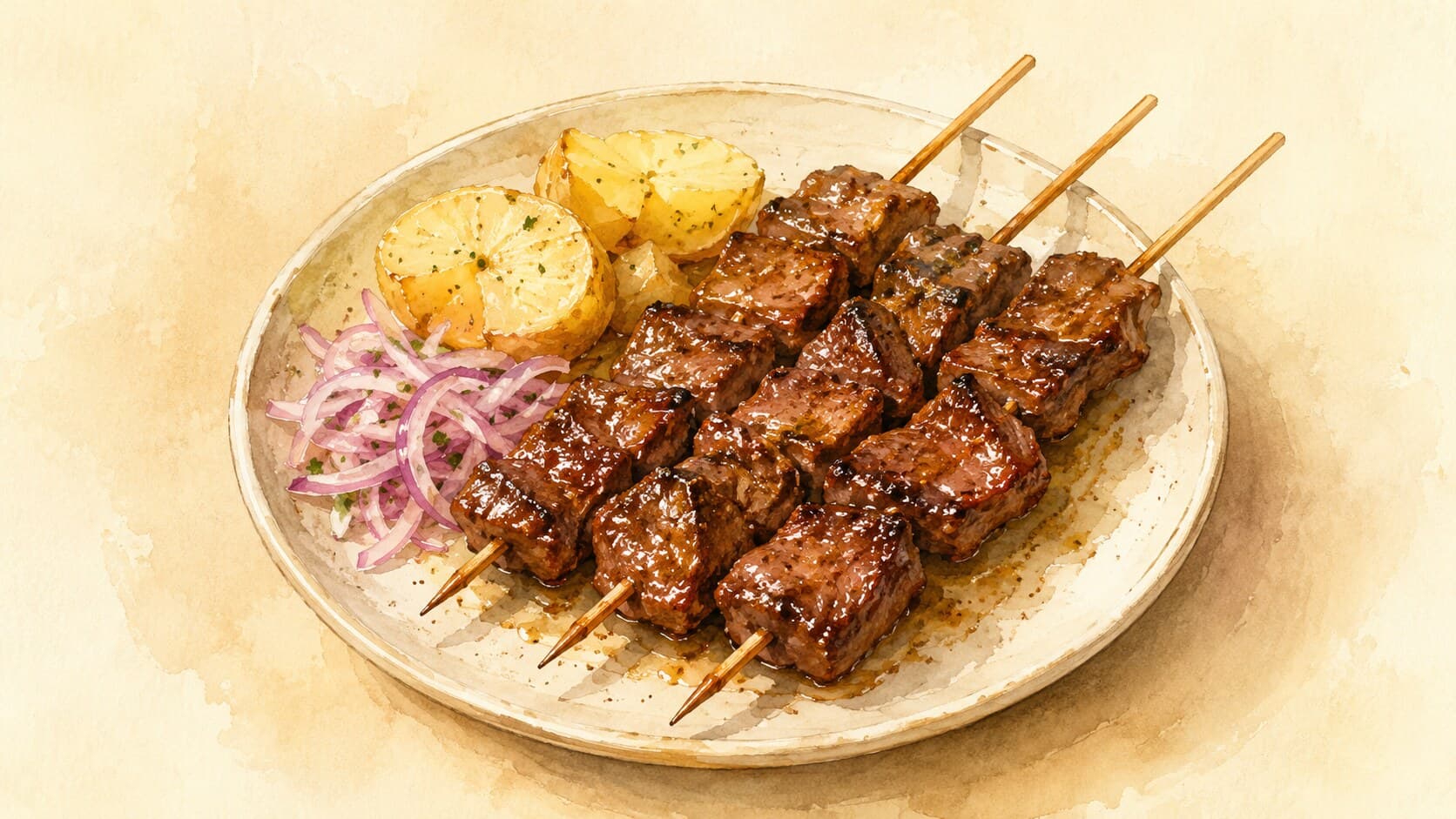
Ingredients
- 500 g beef heart, trimmed and cubed
- 3 tbsp ají panca paste
- 60 ml red wine vinegar
- 2 cloves garlic, minced
- 1 tsp cumin
- 1 tsp salt
- 1 tsp black pepper
- skewers, soaked in water for 30 minutes (if wooden)
Steps
In a bowl, combine ají panca paste, red wine vinegar, minced garlic, cumin, salt, and black pepper to create a marinade.
Add the cubed beef heart to the marinade, ensuring all pieces are evenly coated. Cover and refrigerate for at least 1 hour.
Soak wooden skewers in water for 30 minutes to prevent burning during grilling.
Preheat your grill to high heat (about 230°C/450°F). This high temperature is essential for achieving a good char on the meat.
Thread the marinated beef heart cubes onto the skewers, leaving a little space between each piece for even cooking.
Grill the skewers for about 10-15 minutes, turning occasionally, until nicely charred and cooked through to 71°C / 160°F in the center on an instant-read thermometer.
Remove from the grill and let rest for 5 minutes before serving with boiled potatoes and a green sauce.
Why this works
Using beef heart allows for a unique flavor that is often overlooked. The marinade (a seasoned liquid you soak the meat in to flavor and tenderize it), primarily made with ají panca (a mild, fruity Peruvian red chili paste), adds a depth of flavor and a slight smokiness that complements the rich taste of the meat. The vinegar helps tenderize the beef, while the spices create a savory crust when grilled at high temperatures. Beef heart tightens quickly when overcooked, so the goal is to cook it safely through to the center without pushing far past — cook to 71°C / 160°F in the center on an instant-read thermometer, then pull before the texture firms. If the skewers seem too dry while grilling, baste them (brush liquid over them as they cook) with a little extra marinade to keep them moist. Use a meat thermometer to track internal temperature, and let the skewers rest briefly after grilling so they come off their peak heat before you eat.
Safety note. Beef heart is muscular tissue anatomically, but USDA consumer cooking guidance groups heart with organ and variety meats (heart, kidney, liver, tongue) and recommends cooking them to 71°C / 160°F — higher than the 63°C used for whole beef steaks (USDA FSIS). Cook the skewers to 71°C / 160°F in the center, measured with an instant-read thermometer; that is the endpoint for every diner, not only high-risk ones. Source the heart fresh and properly trimmed from your butcher (silver-skin — the tough, shiny membrane on the meat — and fat removed).
Common mistakes
Skewering the heart while it's still cold from the fridge.
Target: Let the marinated cubes sit at room temperature for 15–20 minutes before grilling.
Why it matters: A cold center forces you to leave the meat over the fire longer to cook through, and that extra time is exactly what overcooks the outside and seizes (tightens and toughens) the lean muscle. Letting the chill come off means the inside reaches a safe temperature at roughly the same moment the surface chars.
What to do: Pull the bowl out while the grill preheats. Thread the skewers as the grate comes up to heat.
Grilling on a lukewarm grate.
Target: A genuinely hot grill, around 230°C/450°F, grate fully preheated for 10+ minutes.
Why it matters: Heart is very lean, so it has little fat to buy you time. On a moderate grate the surface never browns before the inside overcooks — you get grey, dry, rubbery meat instead of a charred crust. High heat triggers the Maillard reaction (the browning of proteins and sugars that builds savory, roasted flavor) fast, so the outside sears while the inside stays just-cooked.
What to do: Preheat hard and wait for it. The grate should make the meat hiss the instant it touches.
Crowding the cubes tight against each other on the skewer.
Target: Leave a small gap (a few millimeters) between pieces.
Why it matters: Touching faces trap steam between them, so those surfaces boil instead of sear — no char, uneven cooking. A gap lets dry heat reach every side.
What to do: Thread loosely. Use a second skewer alongside if the cubes spin when you turn them.
Treating "charred" as "burnt."
Target: Cooked through to 71°C / 160°F in the center, with deep brown edges — not blackened.
Why it matters: Heart cooks fast and goes from juicy to dry in under a minute past doneness. Black, bitter char is burnt sugar and scorched spice paste, not flavor. The target is a dark, aromatic crust over meat that is fully cooked but still tender.
What to do: Watch the edges and the thermometer, not the clock. Pull the skewers when the surface is deeply browned and the center reads 71°C / 160°F, then rest 5 minutes.
What to look for
- The grate makes the meat hiss on contact — confirms the surface is hot enough to sear rather than steam. Silence means the grill is too cool; wait.
- Deep mahogany-brown edges, not grey or black — brown is a proper seared crust; grey means it stewed; black means burnt spice paste. Aim for the color of dark chocolate.
- An instant-read thermometer reads 71°C / 160°F in the center of a cube — the endpoint that confirms the heart is safely cooked through; browning and firmness are texture signals, not the safety check.
- The cube feels firm but still has a slight give when pressed — fully set but not yet hard. A rock-hard cube has gone past tender into dry.
A note on history
Anticuchos trace back to the Andes before the Spanish arrived, when cooks grilled native meats such as llama and alpaca on skewers; the name is often linked to Quechua roots (anti, the eastern Andean region, and cuchu, "to cut") (Explore Peru, Amigofoods). During the colonial era, Spanish settlers kept the prime beef cuts for themselves, and Andean and enslaved African cooks transformed the discarded beef heart — marinating it with vinegar, garlic, and ají panca and grilling it over fire — into the dish recognized today as anticuchos de corazón (ASU, Explore Peru).
Get the essays in your inbox — free
Weekly notes on flavor, fermentation, and food history — the writing behind the Atlas of Flavor. No spam; unsubscribe anytime.