
Lahmacun (Turkish Flatbread)
Lahmacun is a delightful Turkish flatbread topped with a spiced minced meat mixture, offering a crisp yet tender bite.
Contents (5 sections)▾
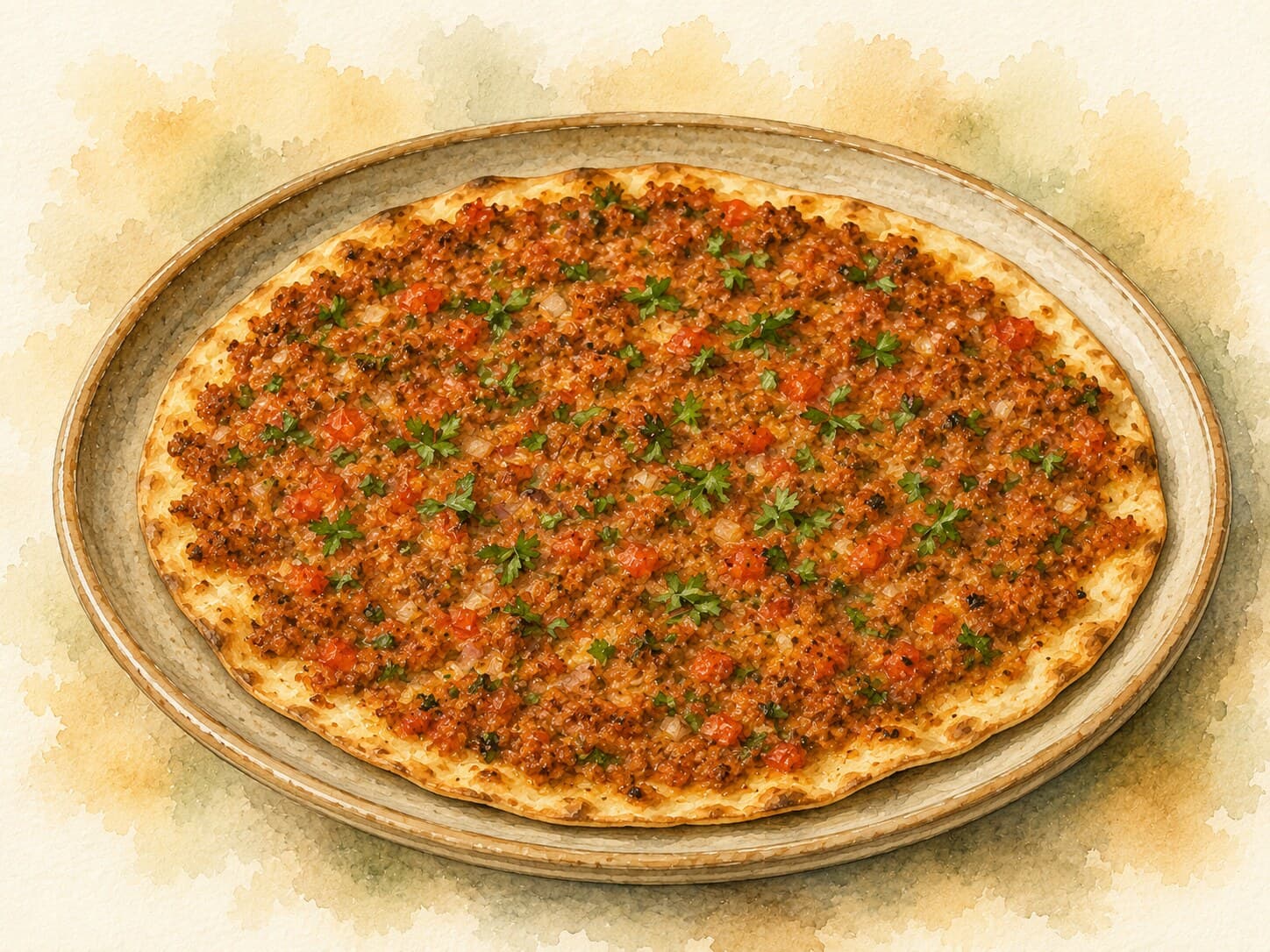
Ingredients
- 250 g all-purpose flour
- 150 ml warm water
- 5 g active dry yeast
- 5 g salt
- 1 tbsp olive oil
- 200 g minced lamb or beef
- 1 small onion, finely chopped
- 2 cloves garlic, minced
- 1 tsp red pepper flakes
- 1 tsp ground cumin
- 1 tsp paprika
- 1 tbsp tomato paste
- Salt and pepper to taste
- Fresh parsley, chopped, for garnish
- Lemon wedges, for serving
Steps
In a bowl, mix flour, yeast, and salt. Gradually add warm water and olive oil, kneading until a smooth dough forms. Let it rest for 30 minutes.
Preheat your oven to 250°C (482°F). Prepare a baking sheet lined with parchment paper or a pizza stone if available.
In another bowl, combine minced meat, onion, garlic, red pepper flakes, cumin, paprika, tomato paste, and season with salt and pepper. Mix well.
Divide the dough into four equal portions. Roll each portion into a thin round, about 3 mm thick, ensuring the edges are slightly thicker to hold the toppings.
Spread a thin layer of the meat mixture evenly over the dough, leaving a small border around the edges.
Transfer the dough with the topping to the preheated baking sheet. Bake for 10-15 minutes or until the edges are crisp and the meat is just cooked. Cook the ground meat until it reaches 71 °C / 160 °F on an instant-read thermometer (no longer pink throughout) — colour, float and time are guides, not the safety test.
Remove from the oven, garnish with fresh parsley, and serve immediately with lemon wedges.
Why this works
Lahmacun is all about contrasting textures: the crispy edges of the flatbread versus the soft, spiced meat layer. Rolling the dough paper-thin allows it to cook quickly in a hot oven, achieving the desired crispness without overcooking the meat. The high temperature helps to create a beautiful golden color and crisp edges. If you find that your dough is too thick when rolled out, ensure that you're using a light touch and a well-floured surface to prevent sticking. A thicker crust can lead to a chewy texture, so aim for that paper-thin finish. Should the meat mixture seem overly moist, consider adding a bit more flour to the topping to help it hold together better during baking. Even a little adjustment can dramatically affect the final result, ensuring a delightful balance between crunch and flavor.
Common mistakes
Meat layer spread too thick. Target: A thin, even smear — roughly 2–3 mm — so you can almost see the dough underneath through the topping. Why it matters: Lahmacun cooks for only 10–15 minutes at very high heat. A thick meat layer cannot bake through in that window; the surface dries while the centre stays underdone, and the dough beneath steams instead of crisping. What to do: Mix the meat with grated onion (the juice loosens it) and spread with your fingertips or the back of a spoon in a translucent layer. Less feels wrong — until you taste it.
Ground meat not cooked through (BLOCK-level safety). Target: An instant-read thermometer pushed into the topping reads 71 °C / 160 °F or above — that reading is the safety test — with no pink remaining in the meat layer. Why it matters: When meat is minced, any bacteria that lived on the outer surface (Maillard browning kills those before they spread, but only on whole cuts) get folded throughout the mass. A thin lahmacun layer baked just to crispness can leave the centre under-temperature. What to do: Preheat the oven fully (250 °C / 482 °F) before sliding in the bread, and check the topping with an instant-read thermometer — 71 °C / 160 °F is the safety test. Cutting into one piece to see uniformly grey-brown meat with no rosy patches, and clear juices, is a supporting sign, not a substitute for the reading.
Dough too wet or too tight. Target: A soft, supple dough that pulls back gently when stretched but does not snap or tear. Why it matters: Wet dough sticks and tears as you roll; over-kneaded dough fights you and springs back, so you can't get it thin enough. Either way, the bread bakes uneven — thick chewy patches alongside scorched edges. What to do: After mixing, let the dough rest the full 30 minutes (this relaxes the gluten strands — the protein network that gives bread its chew). If it still resists, rest another 10 minutes; gluten relaxes more in time than in force.
Edges scorched before centre cooks. Target: Edges deep golden, slightly blistered; centre cooked through but not dry. Why it matters: A thin disc placed on the oven floor hits the heat from below and from radiant ceiling at once. Edges, having less mass, brown first; if your oven runs hot or the bread is too thin at the rim, they char. What to do: Make the dough slightly thicker around the perimeter (a small lip) and roll the centre thinner. Use a preheated pizza stone or heavy baking sheet — even radiant heat from below cooks the centre through before the edges burn.
What to look for
- A barely-translucent sheen of meat over visible dough: this is your signal that the layer is thin enough to cook through in the oven's short window.
- Edges that puff and blister in the first 4–5 minutes: the dough has gone into the oven hydrated and active; if it lies flat and pale, the oven isn't hot enough — wait, don't rush.
- The meat layer turning uniformly matte grey-brown, no glistening pink: this is the visual cue that surface proteins have set and the centre has reached safe temperature.
- A faint shatter when you lift the edge: properly baked lahmacun feels light and just-crisp at the rim, soft in the middle so it rolls without cracking.
A note on history
The name lahmacun comes from the Arabic laḥm bi-ʿajīn — "meat with dough" — and the dish's roots run through the kitchens of southeastern Anatolia, Armenia, Syria, and the broader Levant, where thin flatbreads topped with minced meat were traditionally baked in communal stone ovens. Both Turkish lahmacun and Armenian lahmajoun descend from the same lineage, with cities like Gaziantep, Urfa, and Aleppo regarded as historic strongholds. Lahmacun reached Istanbul in any meaningful way only with internal migration from eastern Turkey in the 1950s. Sources: Lahmacun (World Food Story), Who created Lahmajoun? (The Armenian Kitchen).
Get the essays in your inbox — free
Weekly notes on flavor, fermentation, and food history — the writing behind the Atlas of Flavor. No spam; unsubscribe anytime.