
Korokke (Japanese Potato Croquette)
Enjoy crispy Japanese korokke made with mashed potatoes and sautéed ground beef for a delicious main dish.
Contents (5 sections)▾
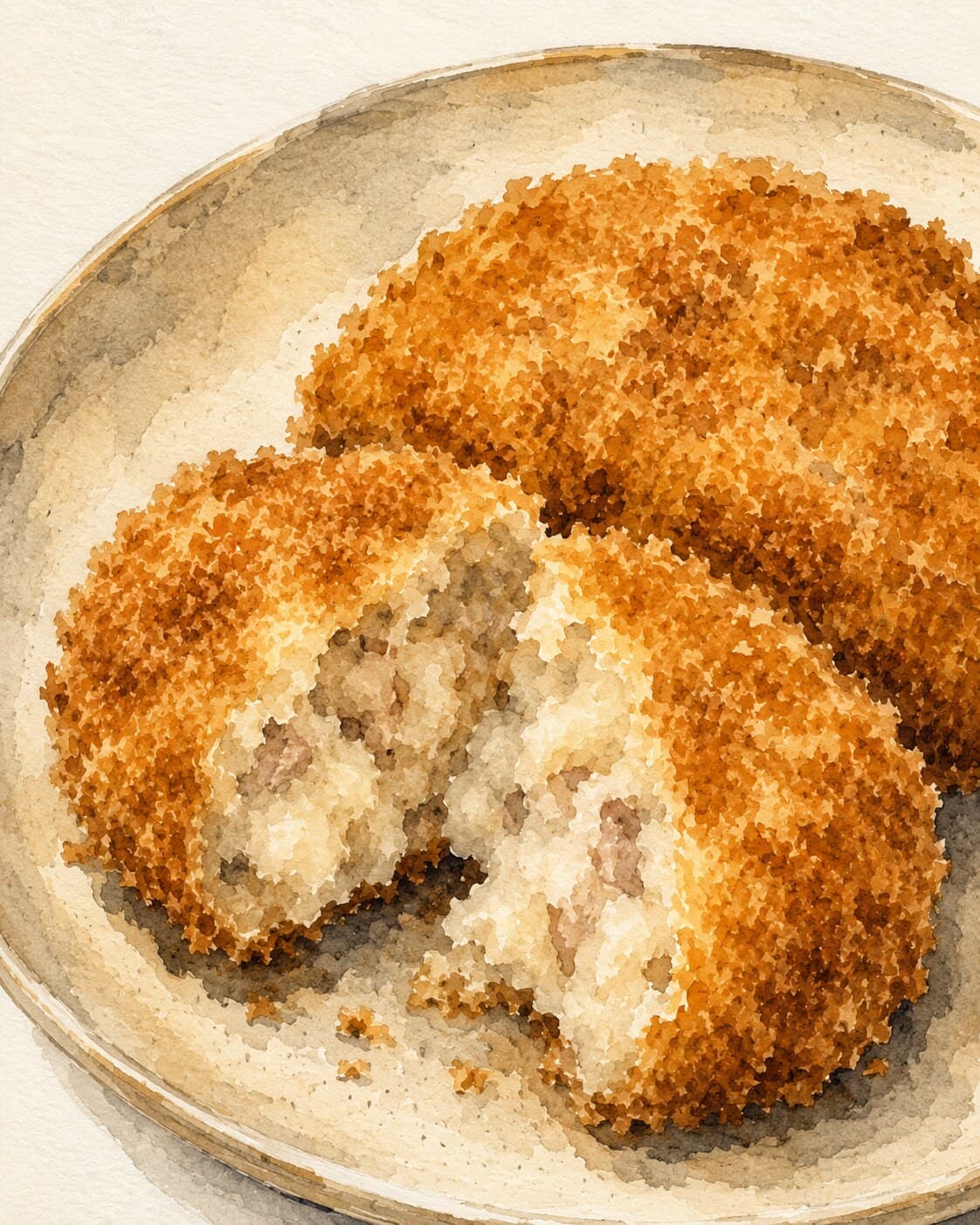
Ingredients
- 500 g potatoes, peeled and cubed
- 250 g ground beef (or beef-pork mix)
- 1 medium onion, finely chopped
- 100 g panko breadcrumbs
- 1 large egg
- 50 g all-purpose flour
- neutral oil for frying, as needed
- salt to taste
- pepper to taste
Steps
Boil the cubed potatoes in salted water for about 15 minutes or until tender. Drain and mash until smooth.
In a skillet, heat a tablespoon of neutral oil over medium heat. Add the chopped onion and sauté until soft and translucent, about 5 minutes.
Add the ground beef to the skillet, season with salt and pepper, and cook until browned and fully cooked through — the ground beef should reach 71 °C / 160 °F with no pink (the later fry only crisps the crust and the patty goes in chilled, so the meat must be fully cooked now). Mix this into the mashed potatoes and allow to cool slightly.
Shape the mixture into patties or balls. Chill the shaped korokke in the refrigerator for 20 minutes to help them hold their shape during frying.
Set up a breading station with flour, beaten egg, and panko. Dredge each korokke in flour, dip in egg, and coat with panko.
Heat oil in a deep pan to 175–180°C. Fry the korokke in batches for about 3–4 minutes or until deep golden brown. Drain on paper towels.
Tools you'll want
Why this works
The key to making perfect korokke lies in the technique of chilling the shaped patties before frying. This step helps the korokke hold their shape and prevents them from bursting in the hot oil. Cooking the filling completely before shaping ensures that the frying process is primarily about achieving a crispy crust, rather than cooking the inside. If the korokke seem too soft after shaping, consider chilling them for a longer time, or gently reshaping them. The panko breadcrumbs (coarse, flaky Japanese breadcrumbs that fry up lighter than fine ones) create a light, airy texture that enhances the overall crunch. If they break while frying, it may be due to insufficient chilling or overcrowding the pan, so ensure you keep the oil temperature steady and fry in small batches.
Common mistakes
A wet, heavy mash.
Target: Potatoes drained the moment they are tender, returned to the dry hot pan for 30 seconds to steam off, then mashed — the mash should hold a mound, not slump.
Why it matters: Water is the enemy of a korokke. Inside 175°C oil, any excess moisture turns to steam and expands violently; if the filling is wet, that steam has to go somewhere, and it blows a hole through the crust. Boiled potatoes soak up water while they cook, so drying them off is not fussiness — it is the step that decides whether your korokke stays whole.
What to do: Cut the potatoes in even, fairly large cubes so less surface is exposed to the water, drain thoroughly, and let them steam-dry in the empty pan over low heat until the surfaces look powdery. Mash while hot; cold potatoes turn gluey when worked.
Cooking the onion and beef without driving off their liquid.
Target: Onions softened and translucent, beef browned with the pan juices cooked down until the mixture looks glossy rather than soupy.
Why it matters: Same problem as above, from a different direction. Onions are roughly 90% water and beef releases plenty of its own. If you fold a wet meat mixture into carefully dried potato, you have simply put the water back. Cooking it down also concentrates the savoury flavour instead of leaving it in a puddle you drain away.
What to do: Keep the heat at a lively medium and let the liquid bubble away for a minute after the beef browns. Season with salt and pepper at this stage — the filling is the only part you can season, since the crust cannot be.
Breading or frying while the filling is still warm.
Target: The mixture cooled to at least room temperature before shaping, then the shaped korokke chilled for the full 20 minutes.
Why it matters: Warm mash is soft and loose, so patties shaped warm sag and crack. Chilling firms the fat and starch so the patty holds together, and it also means the inside starts cold — giving the crust time to set and turn golden before the centre gets hot enough to build up pressure. Warm centres burst.
What to do: Spread the filling on a tray to cool fast rather than leaving it in a deep bowl. If your kitchen is warm, chill 40 minutes rather than 20; longer never hurts.
A breading job with gaps in it.
Target: Flour everywhere (a thin, even dusting with no bare patches), then egg everywhere, then a full, even coat of panko.
Why it matters: The three layers each do a job: flour dries the surface and gives the egg something to grip, egg is the glue, panko is the armour. A bare patch is a direct escape route for steam — that is exactly where the korokke will split. Panko's large, flaky crumbs are also why the crust is light and shatters rather than turning dense; they absorb less oil than fine breadcrumbs.
What to do: Work with one dry hand and one wet hand so the stations don't turn into paste. Press the panko on gently but definitely, and check the edges and corners, which are the usual gap sites.
Oil that is too cool, or a pan packed too full.
Target: 175–180°C, and no more than 2–3 korokke in the pan at once, with the oil no more than a third to half up the pan.
Why it matters: In correctly hot oil, the moisture at the crust's surface boils outward fast enough to hold the oil back — that is what the vigorous bubbling is. Too cool, and the oil soaks in instead, giving a greasy, soggy crust and a filling that heats slowly and expands. Adding too many at once drops the temperature by 20–30°C in seconds and causes exactly that.
What to do: Use a thermometer if you have one, wait for the oil to come back up to temperature between batches, and never fill a deep pan more than halfway — hot oil rises when food goes in, and an overfull pan is a real fire risk.
What to look for
- Potatoes ready: a skewer or knife tip slides through a cube with no resistance, about 15 minutes. After draining and steam-drying, the cut surfaces look dry and faintly floury, not wet and shiny.
- Onions ready: they have gone from opaque white to translucent and soft, smell sweet rather than sharp, and have not taken on brown colour — about 5 minutes.
- Beef ready: no pink remains anywhere in the crumbles and the juices in the pan have cooked down. Ground beef needs to be fully cooked through; there is no rare option here.
- Filling ready to shape: cool enough to hold comfortably in your hand, and firm enough that a squeezed handful keeps its shape without weeping liquid.
- Well-breaded patty: a uniform pale-beige surface with no dark, damp-looking spots showing through, and a fluffy panko texture you can still see the individual crumbs in.
- Oil at temperature: drop in a single panko crumb — it should sink briefly, then rise and sizzle steadily within about a second. If it sits on the bottom, the oil is too cool; if it browns instantly, too hot.
- Frying: the moment a korokke goes in, a steady curtain of medium bubbles surrounds it. As it finishes, the bubbling slows and the sound quiets — that change means most of the surface water has gone and the crust is crisping.
- Done: deep, even golden brown all over, and the korokke feels light and firm when lifted with tongs, about 3–4 minutes. Drain on a rack or paper and let the surface stop steaming before serving; that is when the crust is at its crispest.
A note on history
Korokke belongs to yōshoku — the family of Western-derived dishes that Japan absorbed and made its own from the Meiji era onward. The French croquette reached Japan in the late nineteenth century, and a recipe distinguishing the potato version from the cream-sauce original appeared in a Japanese women's magazine in 1895; the potato form is generally thought to have taken hold because dairy processing was not yet widespread in Japan. First a costly restaurant dish, korokke had become an everyday, affordable food — the butcher-shop staple it still is — by the Taishō era (1912–1926) (source: Korokke, Wikipedia).
Get the essays in your inbox — free
Weekly notes on flavor, fermentation, and food history — the writing behind the Atlas of Flavor. No spam; unsubscribe anytime.