
Katsu Curry
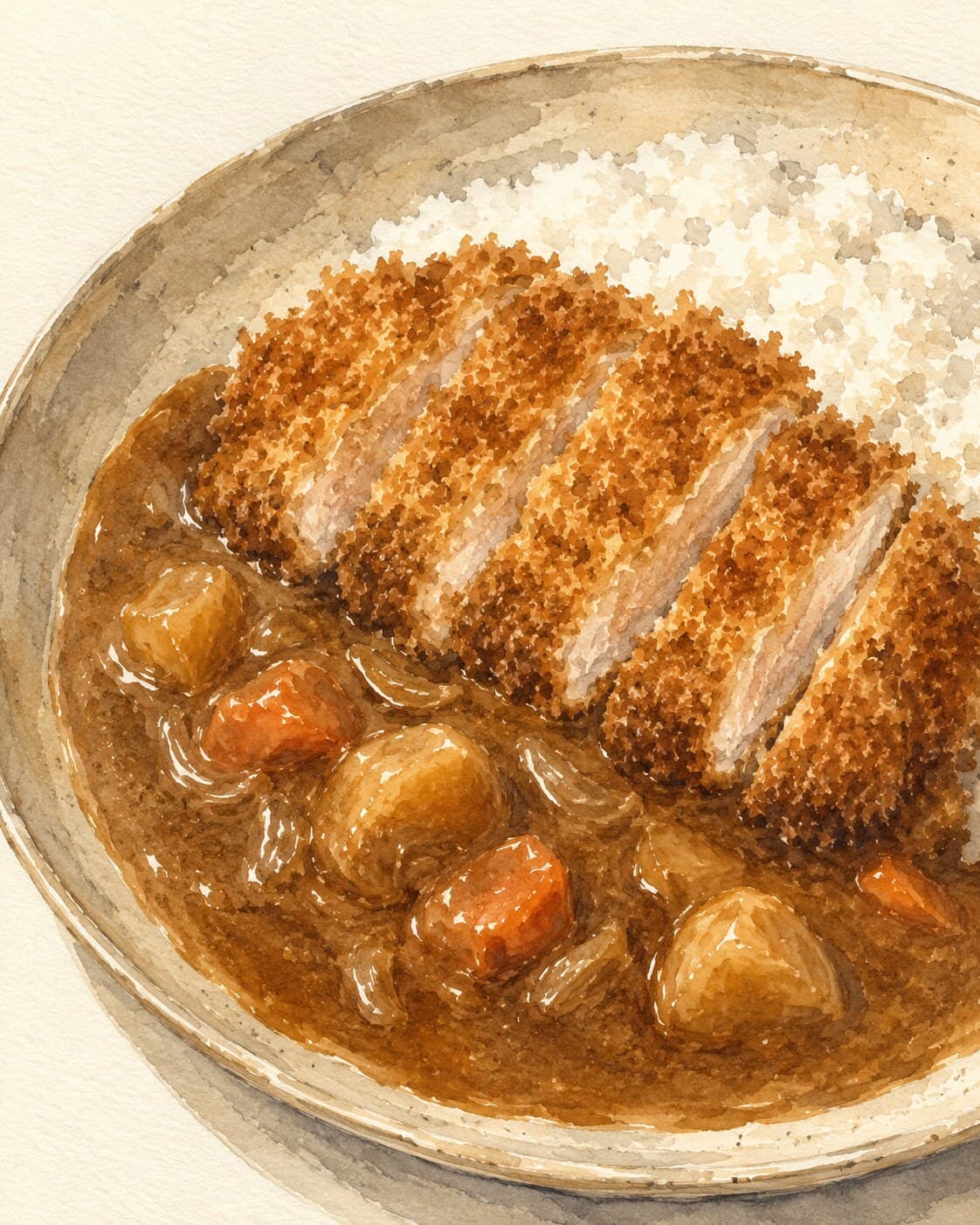
Assemble a crisp katsu cutlet over savory Japanese curry and rice for a satisfying meal.
Contents (5 sections)▾
Ingredients
- 2 pieces tonkatsu or chicken cutlet
- 1 block Japanese curry roux
- 1 medium onion, chopped
- 1 medium carrot, diced
- 1 medium potato, diced
- 2 cups rice, uncooked
- 4 cups water
- to taste salt and pepper
- oil for frying
Steps
Cook rice in a rice cooker according to package instructions. This ensures fluffy rice that pairs well with the curry.
In a saucepan, heat 4 cups of water and add chopped onion, carrot, and potato. Bring to a boil, then reduce heat and simmer for 10 minutes until vegetables are tender.
Add the Japanese curry roux to the vegetable mixture and stir until dissolved. Simmer for another 5 minutes to thicken the curry sauce.
Heat oil in a deep frying pan to 170°C. Fry the cutlets until golden brown and cooked through (internal temperature should reach 74°C), about 4-5 minutes on each side.
Once cooked, remove the cutlets from the oil and place on a cooling rack for a minute to let excess oil drain. This maintains crispiness.
Slice the katsu cutlet just before serving. On a plate, serve a portion of rice, ladle the curry over the rice, and finally place the sliced cutlet on top. Serve immediately to keep the cutlet crispy.
Tools you'll want
- · Cast-iron skillet (Lodge, 6.5–10in)
Why this works
Assembling katsu curry in this manner preserves the crispness of the cutlet, a key feature of this dish. By frying the cutlet until golden and allowing it to rest briefly on a cooling rack, you minimize moisture absorption that can lead to a soggy crust. It's essential to slice the cutlet just before serving; this way, the cutlet retains its crunchy texture above the curry sauce line. If the cutlet seems too oily, lightly pat it with paper towels to absorb excess oil without compromising the crust. For best results, ensure your oil is at the correct temperature; too low and the cutlet will absorb more oil, becoming greasy. Conversely, if the oil is too hot, the cutlet may burn before cooking through. Aiming for an internal temperature of 74°C guarantees that the meat is thoroughly cooked without compromising the crunchy exterior.
Common mistakes
Ladling the curry over the cutlet.
Target: Curry on the rice, cutlet resting on top with only its bottom edge touching the sauce.
Why it matters: A fried crust is a dry, porous shell full of tiny air pockets. Sauce poured over the top fills those pockets within seconds, and the crunch you spent fifteen minutes building is gone before the plate reaches the table.
What to do: Spoon the curry onto one side of the rice, then lay the sliced katsu across the other side so it bridges the sauce rather than swimming in it.
Adding the roux block to a hard-boiling pot.
Target: Heat off or very low, roux broken into small squares, stirred until fully dissolved — then a gentle 5-minute simmer.
Why it matters: Japanese curry roux is flour and fat pressed together with spices. Dropped whole into violently boiling liquid, the outside gels instantly and seals the middle, so you get lumps that never dissolve — and the flour can scorch on the bottom of the pan and taste burnt.
What to do: Turn the heat off. Break the block up, add it, and stir until the liquid is smooth and uniformly glossy. Then return to a gentle simmer to thicken.
Frying at the wrong oil temperature.
Target: 170°C, allowed to recover between cutlets.
Why it matters: Too cool, and the breading absorbs oil before it can set — heavy, pale, greasy. Too hot, and the crust darkens and starts to taste bitter well before the middle of the cutlet reaches a safe 74°C.
What to do: Use a thermometer rather than guessing. Fry one cutlet at a time in a home pan, and wait for the oil to climb back to 170°C before the second goes in.
Draining the cutlet flat on paper towel.
Target: Standing on a wire rack, with air circulating underneath.
Why it matters: Steam keeps coming out of a hot cutlet for a minute or two. Lying flat, that steam is trapped against the plate or the paper and turns the underside soft and soggy — the one part you can't see until you cut it.
What to do: Set a rack over a tray before you start frying, and rest the cutlet on it for a minute after it comes out of the oil.
Slicing the cutlet too far ahead.
Target: Cut on a board immediately before plating, in one confident stroke per slice.
Why it matters: Every cut exposes moist meat, and that moisture travels sideways into the crust. A cutlet sliced five minutes early is noticeably softer than one sliced at the last moment. Sawing back and forth also crushes the breading off the meat.
What to do: Plate the rice and curry first, then slice, then lay the pieces on top and take it straight to the table.
What to look for
- Oil at 170°C: a breadcrumb dropped in sinks just below the surface, comes back up, and browns in about 20–25 seconds, surrounded by steady fine bubbles.
- While the cutlet fries: a strong, deep bubbling that gradually turns lighter and higher-pitched. That change in pitch means most of the surface water has gone and the crust is setting.
- Cutlet ready to come out: an even golden brown — the color of a digestive biscuit, not dark chestnut — and it feels light and firm when tapped with chopsticks. Confirm 74°C in the center with a thermometer.
- Vegetables in the curry: a bamboo skewer slides into a potato chunk with just a little resistance, and no crunch at the core. Carrots should bend slightly when pressed rather than snapping.
- Curry ready to serve: thick enough to coat the back of a spoon so a line drawn with your finger holds its shape, glossy rather than dull, and it should smell of toasted spice — if you can smell raw flour, give it another minute or two of simmering.
- On the plate: the crust makes an audible crackle when the knife goes through, and the sauce line stays at the base of the cutlet instead of creeping up the sides.
A note on history
Curry reached Japan in the Meiji era not from India directly but through the British Royal Navy, which had thickened and tamed the Indian original; the Japanese Imperial Navy adopted it as a practical, nutritious shipboard meal, and sailors carried it home. Topping that curry with a fried cutlet came much later — the Ginza restaurant Swiss claims the combination in 1948, created at the request of a regular customer, the Yomiuri Giants player Shigeru Chiba, though other restaurants dispute the date. (Sources: Katsu curry — Wikipedia, Nippon.com: The Pleasures of Katsu Curry)
Get the essays in your inbox — free
Weekly notes on flavor, fermentation, and food history — the writing behind the Atlas of Flavor. No spam; unsubscribe anytime.