
Japanese Soufflé Pancakes
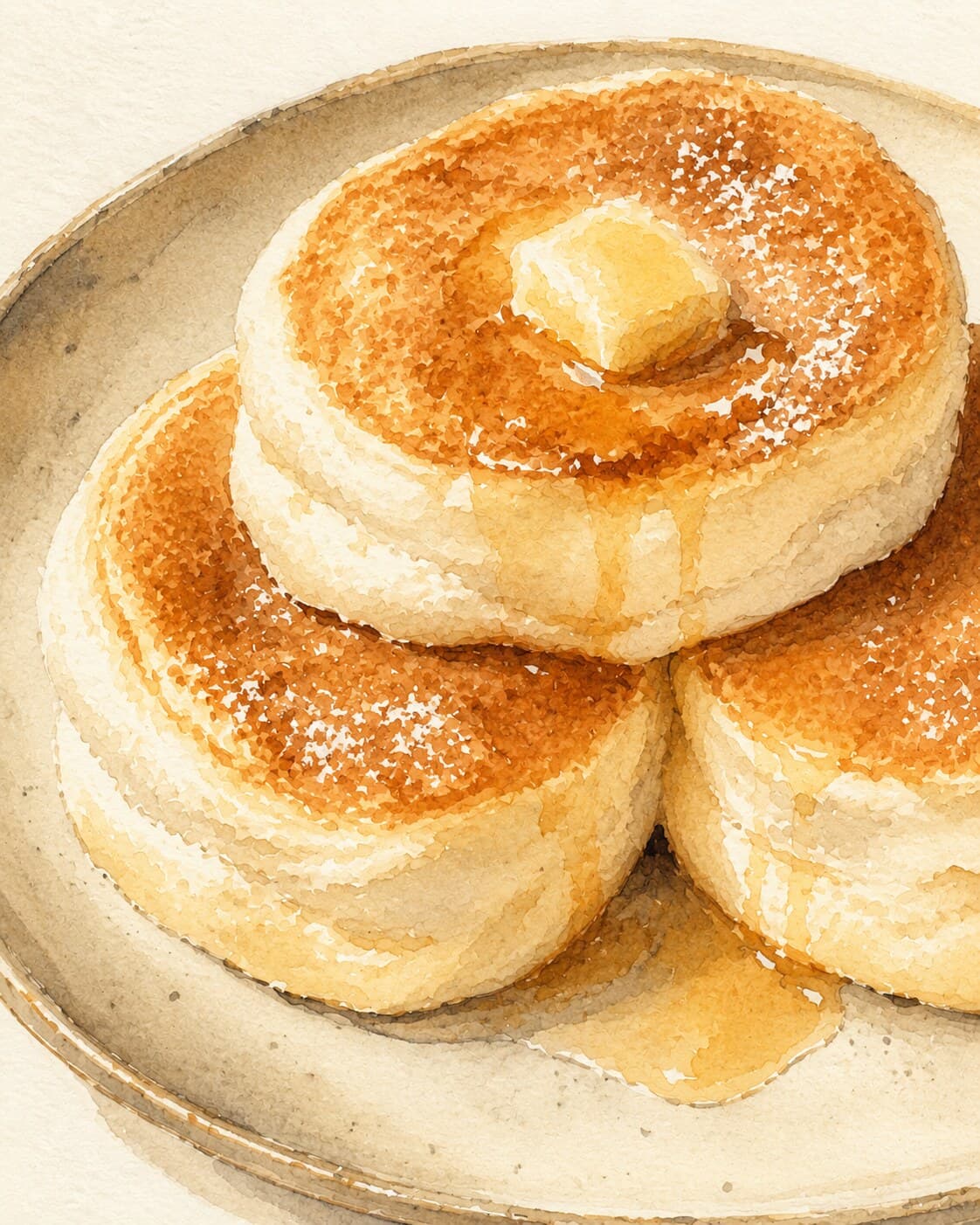
Experience the delight of tall, fluffy Japanese soufflé pancakes with this easy recipe.
Contents (5 sections)▾
Ingredients
- 2 large eggs, separated
- 60 ml milk
- 100 g cake flour
- 30 g sugar
- 1 tsp baking powder
- 1/2 tsp vanilla extract
- water for steaming
Steps
In a mixing bowl, beat the egg whites until firm, glossy peaks form. This aeration will give the pancakes their lift.
In another bowl, whisk together the egg yolks, milk, vanilla, and sugar until well combined.
Sift the cake flour and baking powder into the yolk mixture, folding gently until just combined.
Carefully fold the whipped egg whites into the yolk batter in three parts, being cautious not to deflate the mixture.
Preheat a non-stick skillet over low heat (about 150°C). Grease ring molds and place them in the skillet.
Spoon the batter into the molds, filling them about 2/3 full. Add a splash of water to the skillet and cover with a lid to create steam.
Cook for about 7 minutes, or until the pancakes have risen and the tops are set. Gently flip them over and cook for another 5 minutes.
Remove from the heat, carefully take off the ring molds, and serve immediately with your favorite toppings.
Tools you'll want
Why this works
The key to achieving tall soufflé pancakes lies in the technique of whipping the egg whites to firm but glossy peaks. This process traps air, which is crucial for rising. When folding (lifting the mixture over itself with a spatula instead of stirring, so the air stays in) the meringue (the whipped egg whites, beaten until they hold their shape) into the yolk batter, it's essential to do so gently to avoid deflating the mixture, ensuring the lightness is retained. Cooking at a low temperature (around 150°C) allows the pancakes to rise slowly and set through without collapsing. The steam created by adding water to the skillet helps to keep the pancakes moist while cooking. If your pancakes seem too flat, it might be due to overmixing the batter or under-whipping the egg whites, so pay attention to the texture of both components. Additionally, using ring molds helps maintain their shape, making them easier to flip without losing their airy crumb (the light, spongy inside). If they break when flipping, let them cook a bit longer to firm up before attempting again.
Common mistakes
A trace of yolk or grease in the egg-white bowl.
Target: A bowl and whisk that are bone dry and completely clean, and whites with not one speck of yellow in them.
Why it matters: Whipping works by unfolding the proteins in egg white so they link into a net around air bubbles (cooks call this denaturation — proteins uncurling and re-joining). Fat gets in between those proteins and stops the net from forming. A single drop of yolk, or oily film left in a plastic bowl, can keep the whites at a loose foam no matter how long you beat them.
What to do: Separate each egg into a small cup first, so one broken yolk doesn't ruin the batch. Use metal or glass rather than plastic, and wipe the bowl with a little vinegar or lemon juice on kitchen paper if you are unsure.
Whipping the whites too little — or too much.
Target: Firm, glossy peaks: lift the whisk and the peak stands up with just a slight curl at the tip, and the foam does not slide when the bowl is tipped.
Why it matters: Under-whipped whites hold too little air and collapse under the weight of the flour, so the pancakes come out flat. Over-whipped whites go dry, dull and grainy — the protein net has tightened so far that it tears instead of stretching, and it breaks apart the moment you fold, releasing the air you just worked to trap.
What to do: Slow down and check every 15 seconds once the foam turns white and thick. Note that this recipe puts all the sugar in the yolk batter, which makes the whites quicker to whip but less forgiving — if you find yourself overshooting, borrow a spoonful of that same 30 g and whip it into the whites instead, where dissolved sugar thickens the liquid between the bubbles and makes the foam far more stable.
Stirring the meringue in instead of folding it.
Target: Folding (a gentle over-and-under lifting motion, not a circular stir) in three additions, stopping the moment the streaks disappear.
Why it matters: Every stir bursts bubbles. The first third of the whipped whites is sacrificial — it loosens the thick yolk batter so the remaining two-thirds can be blended with far fewer strokes. Skip that step and you will need twice the mixing, which costs you most of your lift.
What to do: Cut down through the middle with a spatula, sweep along the bottom, lift over the top, rotate the bowl a quarter turn, repeat. A few faint white streaks are better than a perfectly uniform, deflated batter.
Cooking over heat that is too high.
Target: Low heat, around 150°C at the pan surface — the pancakes should take about 7 minutes on the first side, not 2.
Why it matters: These pancakes rise because the trapped air expands and the steam inside pushes outward, and they hold that height only once the egg proteins set into a scaffold. High heat browns and toughens the bottom long before the middle has set, so the raw centre stays heavy and the whole thing sinks. Low and slow lets the rise and the setting happen together.
What to do: Preheat gently, and if your pan runs hot, lift it off the burner for 20–30 seconds at a time rather than raising the heat to compensate elsewhere.
Losing the steam — or letting the batter wait.
Target: A splash of water in the skillet, the lid on, and the batter cooked immediately after folding.
Why it matters: The steam keeps the exposed tops of the pancakes moist and warm, so they set without drying into a crust that cracks. Every lid lift lets that steam escape and drops the temperature. Meanwhile, whipped-white batter starts losing air within minutes as the foam drains, so batter that sits while you find the ring molds bakes shorter and denser.
What to do: Grease the molds and set up the pan before you whip. Lift the lid once, at around 6–7 minutes, to check and flip.
What to look for
- Whites at the right stage: the foam turns from translucent and bubbly to opaque white and satiny. Lifted whisk leaves a peak that stands with a small curl; tilt the bowl and nothing slides. If it looks like dry cotton wool or you can see grainy flecks, it has gone too far.
- Folded batter: pale and even with no white streaks, thick enough to mound softly on the spatula rather than pour in a stream. If it runs like cream, the air is gone.
- Pan at the right heat: a drop of water should sizzle quietly and take a couple of seconds to evaporate. If it skitters and vanishes instantly, the pan is far too hot — cool it down before you pour.
- Cooking well: steady quiet steam from under the lid and a soft hiss, never loud sizzling or any smell of scorching.
- Ready to flip: the batter has climbed above the rim of the mold, the top surface has turned from wet and shiny to matte and dry to a light touch, and the edges look set. A wobble is fine; a wet, sloshing top is not.
- Cooked through: a skewer pushed into the centre comes out clean and dry, and the pancake springs back slowly when you press the side with a fingertip. If your finger leaves a dent that stays, give it another minute or two.
- Right after cooking: the pancakes jiggle when the plate is nudged but hold their height. A little settling as they cool is normal for all soufflé-style batters — serve them straight away and that hardly shows.
A note on history
The tall, jiggling soufflé pancake is a recent creation rather than a traditional Japanese sweet. Its rise is usually traced to the Hawaiian restaurant Eggs 'n Things, which opened in Tokyo in 2010 and brought fluffy American-style pancakes to a Japanese audience, and then to the Osaka chain Gram, founded in 2014, whose meringue-based "fluffy pancakes" set the now-familiar style of three tall rounds cooked slowly under a lid. From there the format spread through cafés across Asia and beyond during the second half of the 2010s (sources: Voyapon, Gram Cafe & Pancakes).
Get the essays in your inbox — free
Weekly notes on flavor, fermentation, and food history — the writing behind the Atlas of Flavor. No spam; unsubscribe anytime.