
Japanese Cotton Cheesecake
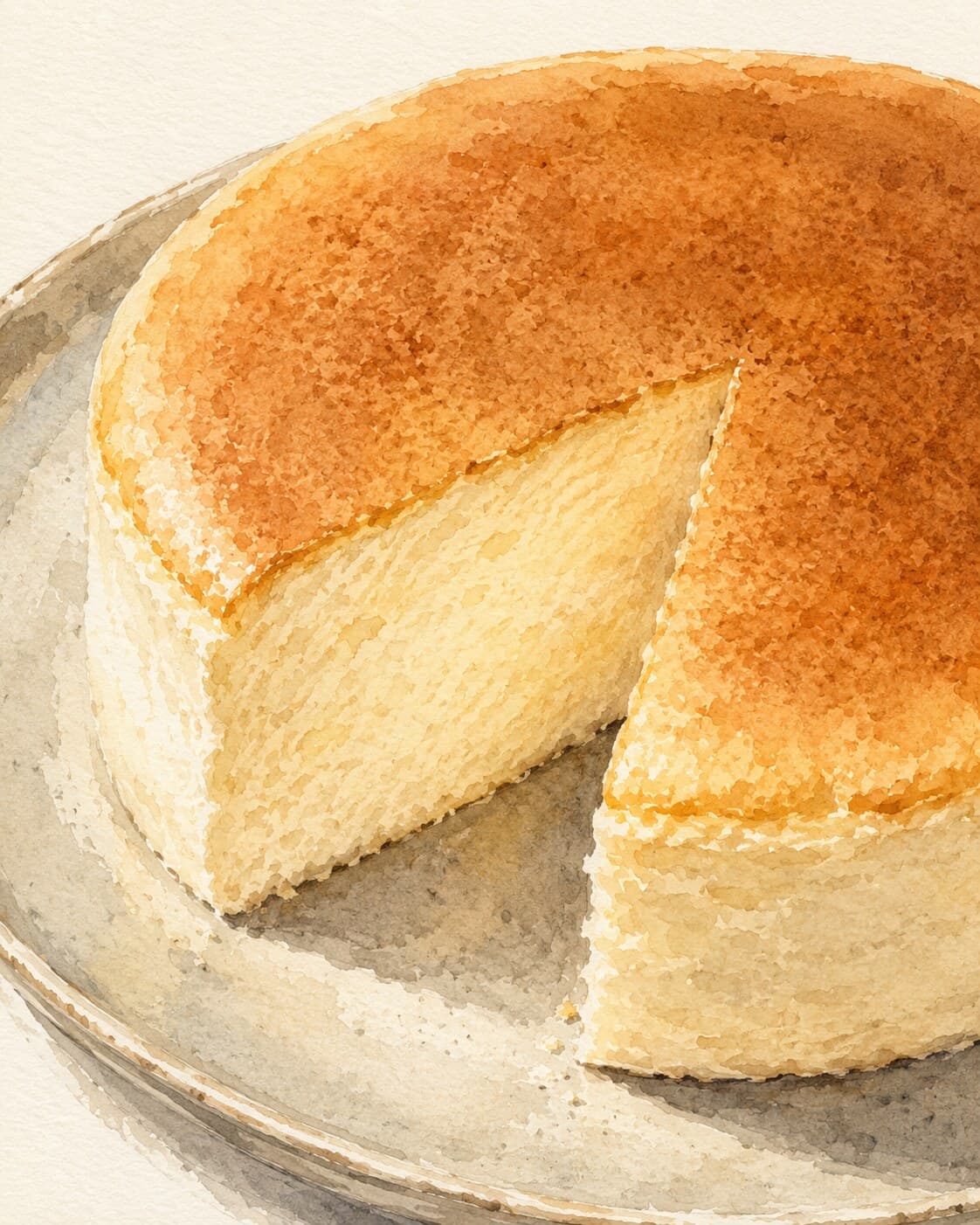
A light and fluffy Japanese cotton cheesecake that is tall, jiggly, and melts in your mouth.
Contents (5 sections)▾
Ingredients
- 250 g cream cheese, softened
- 100 g sugar, divided
- 4 large eggs, separated
- 60 ml milk
- 30 g unsalted butter, melted
- 50 g cake flour
- 1/2 lemon, juiced and zested
Steps
Preheat the oven to 150°C and prepare a 20 cm round cake pan by lining the bottom with parchment paper and wrapping the outside with aluminum foil to prevent water from seeping in.
In a saucepan, heat together the cream cheese, milk, and melted butter over low heat until smooth. Remove from heat and let it cool slightly before adding the egg yolks, lemon juice, and zest.
Sift in the cake flour and mix until just combined. Set aside.
In a separate bowl, whisk the egg whites until soft peaks form, then gradually add in 50 g of sugar and continue whisking until stiff peaks form.
Gently fold the meringue into the cream cheese mixture in three additions, ensuring that you do not deflate the mixture too much.
Pour the batter into the prepared cake pan and place it in a larger baking dish. Fill the larger dish with hot water to create a bain-marie.
Bake for 60 minutes or until the cheesecake is set and jiggles slightly in the center. Turn off the oven and leave the cheesecake inside for 30 minutes to cool gradually.
Remove the cheesecake from the oven and let it cool completely at room temperature before refrigerating for at least 4 hours. Serve chilled.
Tools you'll want
Why this works
The key to a successful Japanese cotton cheesecake lies in the careful balancing of the ingredients and the baking technique. By using a meringue made from whipped egg whites, the cheesecake achieves a light and airy texture, allowing it to rise beautifully without cracking. Baking in a bain-marie (a water bath — the cake pan sits in a tray of hot water so the heat reaches it gently) at a controlled temperature of 150–160°C ensures even cooking and prevents the cake from drying out. The gradual cooling in the turned-off oven helps avoid sudden temperature changes that can cause deflation. If the cheesecake seems too soft after baking, it may need additional time in the refrigerator to firm up, ensuring that it retains its delicate structure. Remember, the goal is a moist and fine crumb (the soft inside texture of the cake), distinct from denser styles like New York cheesecake, so patience is key in the cooling process.
Common mistakes
Adding the egg yolks while the cheese mixture is still hot.
Target: The cream cheese, milk and butter mixture cooled to comfortably warm — you can rest a fingertip on the side of the pan without flinching (roughly body temperature to 40°C).
Why it matters: Egg yolk proteins begin to set around 65°C. Stir yolks into a hot base and you get scrambled specks that will never smooth out, and those specks show up as gritty flecks in a cake that is supposed to be seamless.
What to do: Take the pan off the heat and let it stand a few minutes, stirring now and then to release steam, before the yolks go in. If you are in a hurry, sit the pan in a bowl of cool water for a minute.
Whipping the egg whites past their peak.
Target: Stiff but still glossy and smooth — when you lift the whisk, the peak stands up with just a slight bend at the very tip.
Why it matters: Whipping egg whites builds a network of unfolded proteins around air bubbles (this unfolding is called denaturation — proteins losing their coiled shape and linking into a mesh). Go too far and that mesh tightens and dries; the meringue looks matte, cottony and starts to clump. A dry meringue cannot stretch as the cake rises, so the surface splits and the cake collapses as it cools.
What to do: Slow the mixer once the whites turn opaque and start checking every few seconds. Glossy and smooth means stop. If you see the surface go dull or little dry clumps cling to the whisk, you have gone past it — fold in a spoonful of unwhipped white to loosen it back.
A trace of fat in the egg-white bowl.
Target: A bowl and whisk that are bone dry and squeak clean, and whites with not one speck of yolk in them.
Why it matters: Fat — from yolk, from butter residue, from an oily plastic bowl — gets in between the egg proteins and stops them linking up. The whites will foam a little and then refuse to climb, and no amount of extra whisking fixes it.
What to do: Separate each egg over a small cup first, so one broken yolk doesn't spoil the whole batch. Use metal or glass rather than plastic, and wipe the bowl with a little lemon juice on kitchen paper before you start.
Folding the meringue in like you are stirring.
Target: Three additions, each cut in with a spatula until the batter is one uniform pale colour with no white streaks — and no longer than that.
Why it matters: All the height in this cake is air you already trapped in the meringue. Beating or over-mixing pops those bubbles, and a deflated batter bakes into a dense, damp layer at the bottom of the pan instead of an even, cotton-fine crumb.
What to do: Loosen the heavy cheese base with the first third of the meringue — stir that one in fairly freely, it is a sacrifice. For the rest, cut down through the middle with the spatula, sweep along the bottom, and lift over, turning the bowl a quarter each time. Stop the moment the streaks disappear.
Rushing the cooling, or unmoulding while warm.
Target: 30 minutes in the switched-off oven, then completely cool at room temperature, then at least 4 hours in the fridge before slicing.
Why it matters: Hot air inside the cake is expanded; pull the cake straight into a cool kitchen and that air contracts fast, dragging the still-soft structure down with it and wrinkling the sides. The crumb also needs the fridge time for the fat in the cream cheese to firm, which is what lets you cut a clean slice.
What to do: Be patient. Leave it in the turned-off oven for the full 30 minutes, cool it on the counter still in its pan, and only then chill it. Slice with a warm, dry knife, wiping between cuts.
What to look for
- Cheese base ready for the flour: completely smooth and glossy, no lumps of cream cheese visible. It should fall off the whisk in a thick ribbon that sinks back within a couple of seconds.
- Egg whites at soft peaks (before the sugar): the foam holds a shape but the peak flops right over when you lift the whisk. This is the moment to start adding the sugar.
- Finished meringue: bright white, satin-glossy, peaks standing with a small bend at the tip. Tilt the bowl — the mass should slide as one piece, not slosh.
- Batter after folding: one even pale-cream colour, no white ribbons or streaks, still light enough to pour smoothly. If it feels heavy and pours in a slow lump, air has been lost.
- The cake during baking: risen with a domed, pale-gold top and a faint sweet-eggy smell. Deep brown before 45 minutes means the oven runs hot.
- Doneness: nudge the pan — the whole cake wobbles as one soft, slow unit, like set jelly. If the centre ripples or sloshes independently, it needs more time. The top should spring back gently when touched, not leave a dent.
- The next morning, chilled: the surface is smooth and slightly moist, the sides straight rather than caved in, and a cut slice shows an even, fine crumb with no dense wet band at the bottom.
A note on history
This cake is a Japanese reinvention of a German one. Tomotaro Kuzuno, of the Kobe confectioner Morozoff, is credited with encountering Käsekuchen — German quark cheesecake, which also relies on whipped egg whites — on a trip to Berlin in the 1960s, and adapting it at home by substituting cream cheese for the quark. The result was lighter and more soufflé-like than its German parent, and it spread through Japan from the 1970s onward, with Osaka's Rikuro Ojisan among the shops that made it famous.
Source: Japanese cheesecake — Wikipedia · A Short History of Japanese Cheesecake — Metropolis
Get the essays in your inbox — free
Weekly notes on flavor, fermentation, and food history — the writing behind the Atlas of Flavor. No spam; unsubscribe anytime.