
Hambagu (Japanese Hamburg Steak)
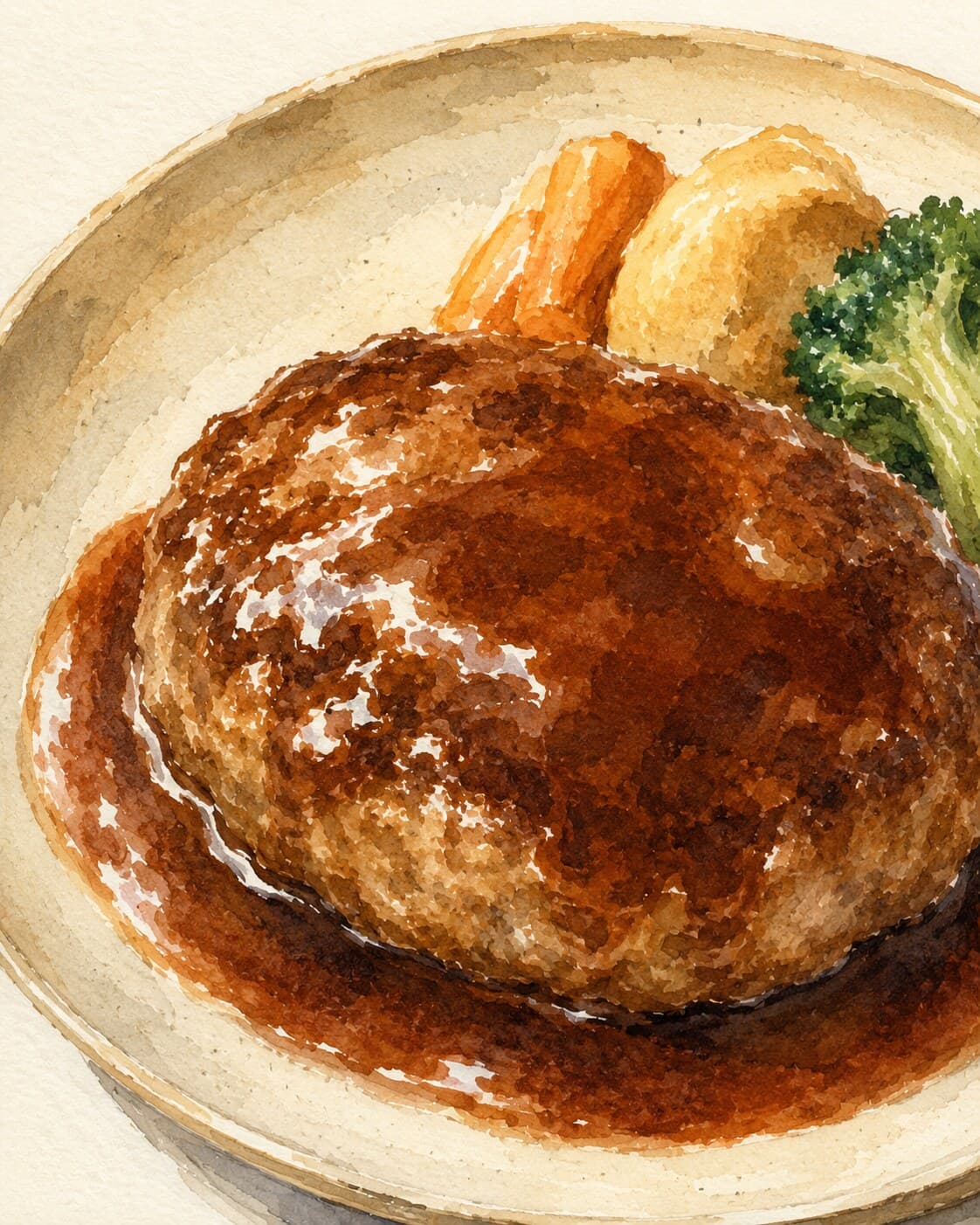
Juicy and flavorful Japanese Hambagu, a delightful mix of beef and pork, perfect for a comforting main dish.
Contents (5 sections)▾
Ingredients
- 200 g ground beef
- 200 g ground pork
- 1 medium onion, finely chopped
- 50 g panko breadcrumbs
- 50 ml milk
- 1 large egg
- 1/4 tsp nutmeg
- Salt, to taste
- Pepper, to taste
- 50 g ketchup
- 30 g Worcestershire sauce
Steps
In a skillet, sauté the finely chopped onion over medium heat until translucent (about 5 minutes). Allow it to cool slightly.
In a large bowl, combine the ground beef, ground pork, sautéed onions, panko, milk, egg, nutmeg, salt, and pepper. Mix gently until just combined.
Divide the mixture into two equal portions and shape each into a patty, dimple the center to help it stay flat during cooking.
Heat a cast-iron skillet over medium-high heat and add a little oil. Once hot, place the patties in the skillet without pressing down.
Sear the patties for about 3-4 minutes on each side until a nice crust forms. Lower the heat, cover the skillet with a lid, and steam for an additional 5-7 minutes until the centre reaches 71 °C / 160 °F on an instant-read thermometer; colour, juices and time are guides, not the safety test.
Remove the patties from the skillet and let them rest for a few minutes before serving. Meanwhile, prepare the sauce by mixing ketchup and Worcestershire sauce in the skillet.
Serve the Hambagu patties with the pan sauce drizzled over them.
Tools you'll want
- · Cast-iron skillet (Lodge, 6.5–10in)
Why this works
The combination of beef and pork creates a juicy texture, while the sautéed (cooked gently in a little fat until soft) onions add moisture and flavor. The panko and milk panade (a paste of breadcrumbs soaked in milk that holds moisture inside the meat) binds the ingredients, ensuring the patties remain tender. Searing (cooking the surface hard and fast so it browns) at high heat develops a flavorful crust, while covering and steaming on low heat cooks the inside gently, preventing dryness. The use of a thermometer ensures that the patties reach the ideal temperature for safety without losing juiciness. If the patties seem too dry after cooking, they may have been overcooked, so monitor the temperature carefully and let them rest briefly before serving so they are not cut at their hottest. Dimpling the center helps them cook evenly without puffing up, maintaining a flat surface for sauce.
Common mistakes
Mixing the onions in while they are still warm.
Target: Onions cooled to at least room temperature — cool enough to hold in your hand.
Why it matters: Warm onions melt the fat in the beef and pork on contact. Once that fat turns liquid inside the mix, it smears rather than staying in little solid pieces, and it runs straight out of the patty in the pan. The result is a greasy skillet and a dry, crumbly hambagu — the exact opposite of what you want.
What to do: Spread the cooked onions on a plate rather than leaving them heaped in the pan; they cool in about 10 minutes. If you are in a hurry, put the plate in the fridge for 5 minutes.
Under-mixing, so the patty cracks and leaks in the pan.
Target: A mixture that turns slightly paler and sticky, and holds a clean thumbprint without crumbling.
Why it matters: Salt pulls a protein called myosin out of the meat, and that protein is the glue that holds a patty together. Mix too little and there is no glue, so the patty splits along a fault line and all the juice escapes through the crack. Mix too much, on the other hand, and it tightens into something bouncy and sausage-like. This recipe's "gently until just combined" means combined enough — sticky, not smooth.
What to do: Mix in one direction with your hand or a sturdy spatula for roughly 30–60 seconds, stopping the moment the mass clings to itself in one piece.
Leaving air pockets inside, and skipping the dimple.
Target: A dense patty with no visible air gaps, and a clear thumb-deep dent in the centre.
Why it matters: Trapped air expands as it heats and blows a hole in the patty, taking the juices with it. And a patty of even thickness always swells in the middle, because the meat proteins shrink and push inward — a domed patty rocks on the plate, cooks unevenly, and sheds its sauce.
What to do: Toss the shaped patty from hand to hand five or six times, slapping it firmly — you will hear the air being knocked out. Then press a hollow about 1 cm deep in the centre. It will flatten out as it cooks.
Pressing down on the patty with a spatula.
Target: Hands off. Place it once, and leave it alone for the full 3–4 minutes per side.
Why it matters: Pressing is the fastest way to squeeze out exactly the juice you spent all this effort keeping in — that hiss and flare when you press is your dinner leaving. It also breaks the crust that is forming, so you lose browning as well as moisture.
What to do: Set the patty down and do not touch it. When a crust has formed it will release from the pan on its own; if it sticks when you try to lift it, it is not ready to turn.
Deciding it's done by the clock, or by "the juices look clear."
Target: 71 °C / 160 °F measured in the centre with a thermometer.
Why it matters: This is minced meat, not a steak. When meat is ground, anything that was on the outside surface gets mixed all the way through, so a hambagu genuinely has to be cooked through — a pink centre is not a style choice here, it is a safety problem. Juice colour is an unreliable guide: it can run clear well before the meat is safe, and can stay pink long after it is.
What to do: Push an instant-read thermometer in from the side, into the thickest part. Keep the lid on and the heat low until it reads 71 °C / 160 °F, then rest the patties a few minutes before serving.
What to look for
- Onions, done: they go from opaque white to glassy and translucent, they slump and lose volume, and the sharp raw smell turns soft and sweet. You want no brown edges — browning here adds a bitterness that fights the sauce.
- Panade ready: the panko soaked in milk should look like a thick, uniform paste with no dry white crumbs left. If you still see dry panko, give it another minute.
- Mixture ready to shape: it looks a shade paler and slightly tacky, and when you lift the bowl and tip it, the mass moves as one lump rather than falling apart.
- Skillet hot enough: a drop of water flicked in skitters and evaporates in a second or two; a patty placed down starts a steady, confident sizzle immediately. Silence means the pan is too cool and the patty will stick.
- Ready to turn: look at the side of the patty — the meat has gone from pink-red to grey-brown about a third of the way up, and the patty lifts cleanly with no tugging. The underside is an even deep brown.
- During the covered steaming stage: you can hear gentle bubbling rather than aggressive frying, and the patty firms up. Pressed lightly with a fingertip it springs back instead of feeling soft and yielding.
- Done: 71 °C / 160 °F in the centre, the patty feels springy all over, and the top surface is slightly puffed and beaded with juice.
A note on history
Hambagu is yōshoku — a Western dish naturalised in Japan. Its ancestor is the German-style Hamburg steak, and a prototype was reportedly served in 1882 at Japan's first cooking school, with the dish appearing on Tokyo's Western-style restaurant menus by the late 1890s. It only became a home-kitchen staple much later: improvements in refrigeration between 1955 and 1964 made ground meat something an ordinary butcher could sell, and through the 1960s hambagu spread as an affordable way to put meat on a family table. (Source: Highlighting Japan, Government of Japan — "Hambagu: A Yoshoku Dish Uniquely Evolved in Japan")
Get the essays in your inbox — free
Weekly notes on flavor, fermentation, and food history — the writing behind the Atlas of Flavor. No spam; unsubscribe anytime.