
Garlic-Infused Oil
Learn how to safely infuse garlic into oil for a flavorful condiment.
Contents (5 sections)▾
Ingredients
- 1 cup neutral oil or olive oil
- 5 cloves garlic, peeled and lightly crushed
Steps
In a small saucepan, combine the oil and crushed garlic over low heat (around 90°C/194°F). This gentle heat helps release garlic's aroma without burning.
Allow the garlic to infuse in the oil for about 10-15 minutes. Keep an eye on the garlic; if it starts to brown, remove it from heat immediately to prevent bitterness.
Once infused, remove the saucepan from heat and let the oil cool completely with the garlic cloves still in it for an extra flavor boost.
Strain the oil through a fine-mesh sieve into a clean bottle or jar, discarding the garlic cloves. Refrigerate the oil and use it within 3-4 days — never store garlic-in-oil at room temperature.
Why this works
Infusing oil with garlic (gently warming garlic in oil so the flavor moves into the oil) is a technique that requires careful attention to heat levels to avoid burning, which can lead to an unpleasant bitter taste. By using low heat, around 90°C (194°F), the garlic can impart its flavor into the oil without reaching the threshold that causes burning. The slow extraction process allows the aromatic compounds to dissolve into the oil, enhancing its flavor. If the garlic starts browning, remove it from heat immediately; otherwise, the oil may develop a burnt flavor. Additionally, allowing the oil to cool with the garlic increases the infusion depth, enhancing the overall flavor. Remember, patience is key; rushing the process can lead to undesired results.
Safety note — garlic in oil. Raw garlic stored in oil at room temperature can grow Clostridium botulinum, the bacterium that causes botulism. Cook the garlic gently in the oil until pale gold, cool it, then keep the oil refrigerated and use it within 3-4 days. Never leave garlic-in-oil at room temperature.
Common mistakes
Storing the finished oil at room temperature.
Target: Refrigerate as soon as the oil cools, use within roughly 4 days; freeze in small portions for longer keeping.
Why it matters: This is the central food-safety failure for this recipe. Garlic is a low-acid vegetable, and oil creates an anaerobic (oxygen-free) environment. Together, those are exactly the conditions in which Clostridium botulinum spores can germinate and produce botulinum toxin — a neurotoxin that is tasteless, odorless, invisible, and potentially fatal. Heating the garlic in the oil drives off flavor compounds but does not destroy these spores. Refrigeration slows the bacteria; freezing stops it.
What to do: Strain into a clean glass jar, label it with the date, and put it straight in the fridge. If you will not use it within about 4 days, pour into an ice-cube tray and freeze. Discard if you cannot remember when you made it, if it smells off, or if the oil has been left out overnight.
Running the heat too high so the garlic browns.
Target: Low heat, around 90°C (194°F); pale gold at most, never brown.
Why it matters: Once garlic browns, the natural sugars and amino acids go past the gentle Maillard reaction (the browning chemistry that builds savory flavor) into bitter, acrid compounds. The oil takes on a burnt, harsh note that no straining can remove.
What to do: Use a small, heavy saucepan and your lowest burner. If your stove runs hot, slide the pan half off the flame. Watch for the first faint colour and pull off the heat immediately — carry-over heat from the oil will keep cooking the garlic for another minute.
Leaving the garlic in big, whole cloves.
Target: Lightly crushed or thinly sliced cloves so the surface area is open.
Why it matters: A whole, intact clove has very little cut surface, so flavor compounds (allicin and the sulfur compounds that follow it) leach into the oil slowly. The oil ends up under-flavored, and you are tempted to push the heat — which lands you in the previous mistake.
What to do: Smash each clove with the flat of a knife so it cracks open, or slice thinly. You want exposed flesh, not pulverised paste.
Re-using oil that has been sitting in the fridge for a week.
Target: Use within about 4 days of making, even refrigerated.
Why it matters: Refrigeration slows Clostridium botulinum but does not stop it indefinitely. The standard home-kitchen window for refrigerated garlic-in-oil is short on purpose — beyond a few days, risk creeps up even at fridge temperatures.
What to do: Make small batches that match what you will actually use this week. Date the jar. When in doubt, throw it out — there is no visible or olfactory warning sign for botulinum toxin.
What to look for
- As the oil heats: tiny, lazy bubbles rising from the garlic, no sizzling. This is moisture leaving the cloves at low temperature. If you see fast, foamy bubbling, the heat is too high.
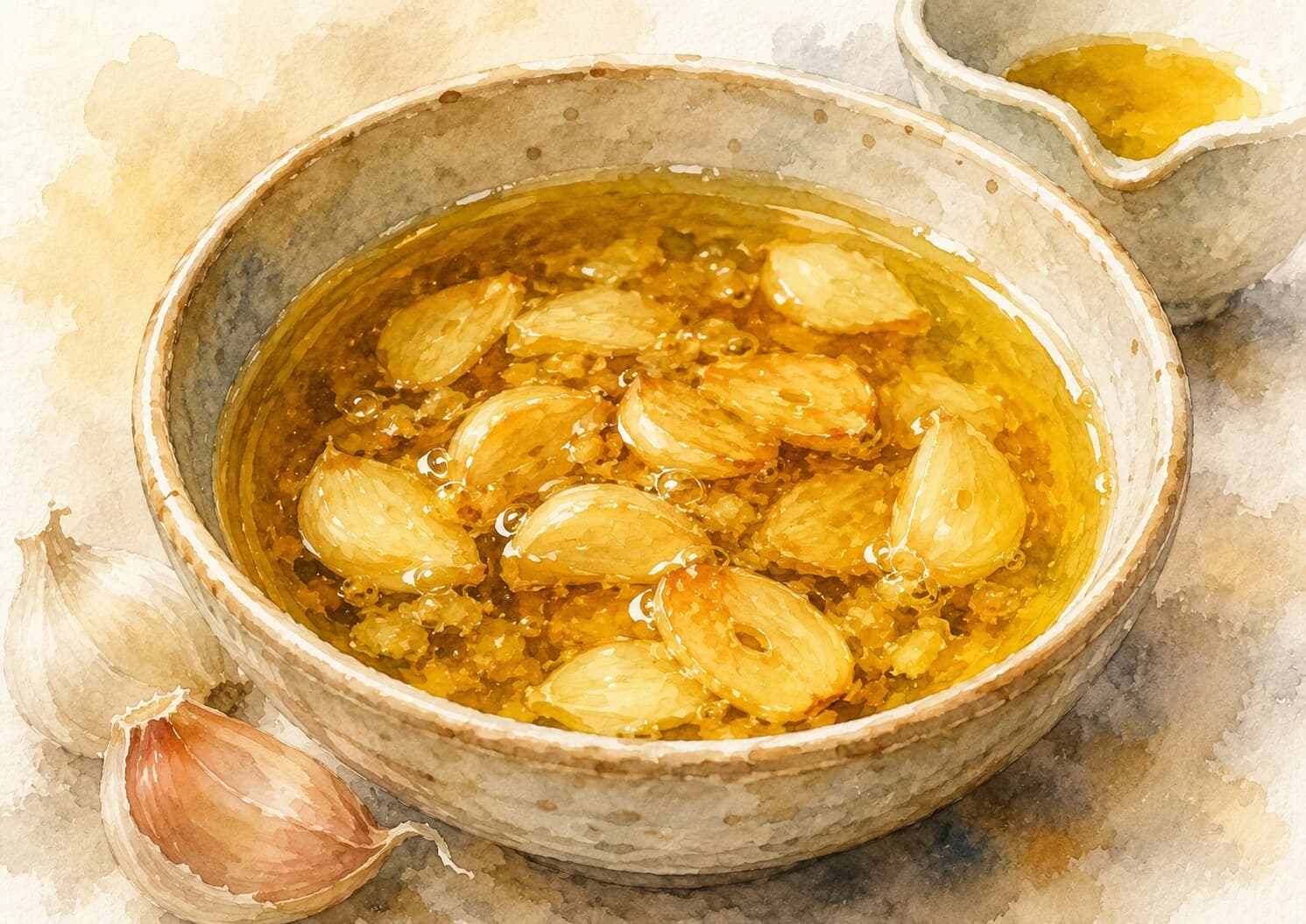
- As the garlic infuses: the cloves shift from white to pale straw to soft gold, never brown. The oil itself becomes lightly tinted and starts to smell sweet and toasted rather than raw.
- When it is done: the cloves are soft enough to crush against the side of the pan with a spoon. The oil should be clear and golden, not cloudy or dark.
- In the jar, after a day: clear oil, no separation, no off smell. A faintly garlicky aroma is right. Sourness, fizziness, or any cloudiness that develops in storage means discard.
A note on history
Garlic (Allium sativum) is one of the oldest cultivated alliums, with origins traced to Central Asia and a recorded culinary and medicinal history of more than 5,000 years across Egypt, Greece, Rome, China, and India (Hyphen, Alibaba — The Origin of Garlic). Steeping garlic in oil to carry its aroma into a dish is not a single national tradition but a technique that appears across the Mediterranean and Asia — most visibly in Neapolitan spaghetti aglio e olio ("garlic and oil"), in Asian stir-fry bases, and in countless modern aglio-oil dressings.
Get the essays in your inbox — free
Weekly notes on flavor, fermentation, and food history — the writing behind the Atlas of Flavor. No spam; unsubscribe anytime.