
Teriyaki Sauce
Create a rich, sweet teriyaki sauce using soy sauce, mirin, sugar, and sake with a simple reduction technique.
Contents (5 sections)▾
Ingredients
- 100 ml soy sauce
- 100 ml mirin
- 100 ml sake
- 50 g sugar
Steps
In a saucepan, combine the soy sauce, mirin, sake, and sugar. Stir well to dissolve the sugar.
Place the saucepan over medium heat and bring the mixture to a gentle simmer.
Allow the sauce to simmer for 10-15 minutes, stirring occasionally, until it thickens to a glaze-like consistency.
Remove from heat and let it cool for 5-10 minutes before using. The sauce will thicken further as it cools.
Why this works
The magic of teriyaki sauce comes from the careful reduction (gently simmering a liquid down so water evaporates and the flavor concentrates) of sugar and soy sauce, which meld together to create a rich glaze (a glossy, slightly syrupy coating that clings to food). The soy sauce provides umami depth (a deep savory taste, the "fifth taste" alongside sweet, salty, sour, and bitter), while mirin (a sweet Japanese rice wine used for cooking) adds a subtle sweetness and complexity through its fermentation process. Sugar acts as a key ingredient that caramelizes during cooking (the sugar browns and turns nutty and toasty as it heats), enhancing the overall flavor. If the sauce seems too thin after cooking, simply return it to the heat for an additional 2-5 minutes to achieve the desired thickness. Conversely, if it becomes too thick, you can add a splash of water to adjust the consistency. This technique ensures a balanced and flavorful sauce that can add to any dish, whether used as a marinade, glaze, or dipping sauce. The precision of time and temperature in this recipe is crucial, as it ensures that the ingredients meld properly, resulting in a well-rounded flavor that is both sweet and savory.
Common mistakes
Boiling it hard to thicken faster.
Target: A gentle simmer, stirred occasionally, for 10–15 minutes.
Why it matters: Sugar and soy sauce scorch easily. A hard boil drives the edges past caramel into burnt, leaving a bitter, acrid sauce — and once it tastes burnt there is no fixing it. The thickening comes from patient evaporation, not high heat.
What to do: Keep it at a lazy simmer. If it isn't reducing, give it time rather than more heat, and stir so nothing sits and catches on the bottom.
Over-reducing into candy.
Target: A loose glaze that still flows and thickens further as it cools.
Why it matters: This is mostly sugar. Take it too far and it sets sticky or hard once cool — closer to a candy than a sauce. The window between glaze and overcooked is narrow at the end.
What to do: Pull it from the heat while it still coats a spoon but runs off — it firms up as it cools. The recipe's rescue applies here: if it does set too thick, stir in a splash of water to loosen it back.
Judging thickness while it's hot.
Target: Account for the fact that the sauce stiffens noticeably as it cools.
Why it matters: Hot teriyaki is always thinner than it will be in the bowl. Reduce until it looks "right" while hot and you'll end up with a paste once it cools.
What to do: Stop a touch earlier than you think. Drip a little onto a cold plate to preview the cooled consistency before deciding it's done.
Not letting the alcohol cook off.
Target: Enough simmering to drive off the raw edge of the sake and mirin.
Why it matters: Sake and mirin both carry alcohol that tastes harsh and boozy if it doesn't have time to evaporate, leaving a sharp note under the sweetness.
What to do: Hold the simmer for the full time so the alcohol cooks away and the flavors round out and meld.
What to look for
- Early simmer: small steady bubbles, sugar fully dissolved, no grains left at the bottom.
- Aroma: the sharp alcohol smell gives way to a rounded, savory-sweet soy fragrance as it reduces.
- Glaze stage: the sauce coats the back of a spoon and a finger drawn through leaves a brief trail, yet still flows.
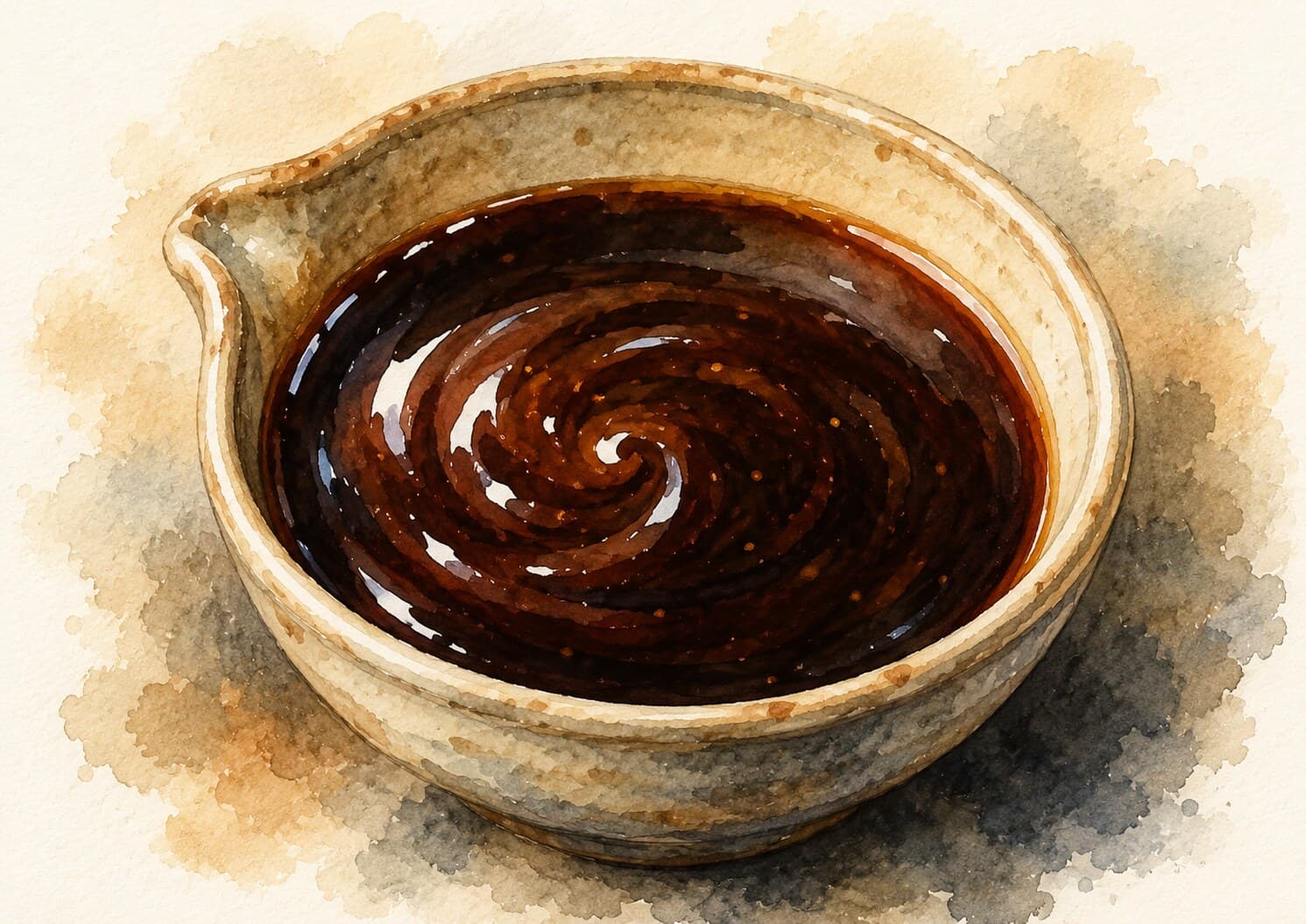
- Cooled and ready: glossy, deep brown, lightly syrupy — thick enough to cling, not set hard.
A note on history
The word teriyaki combines teri (照り), the shine or glaze, with yaki (焼き), to grill or broil — naming the lustrous finish the sauce gives grilled food. The technique of glazing fish with a sweetened soy mixture is associated with Japan's Edo period (1603–1868); the heavily sweet, thick "teriyaki sauce" sold as a bottled condiment today owes much to later popularization abroad, particularly by Japanese immigrants in the United States.
Get the essays in your inbox — free
Weekly notes on flavor, fermentation, and food history — the writing behind the Atlas of Flavor. No spam; unsubscribe anytime.