
Xiaolongbao (Soup Dumplings)
Xiaolongbao, or Soup Dumplings, are delicate pork-filled dumplings that burst with broth when steamed.
Contents (5 sections)▾
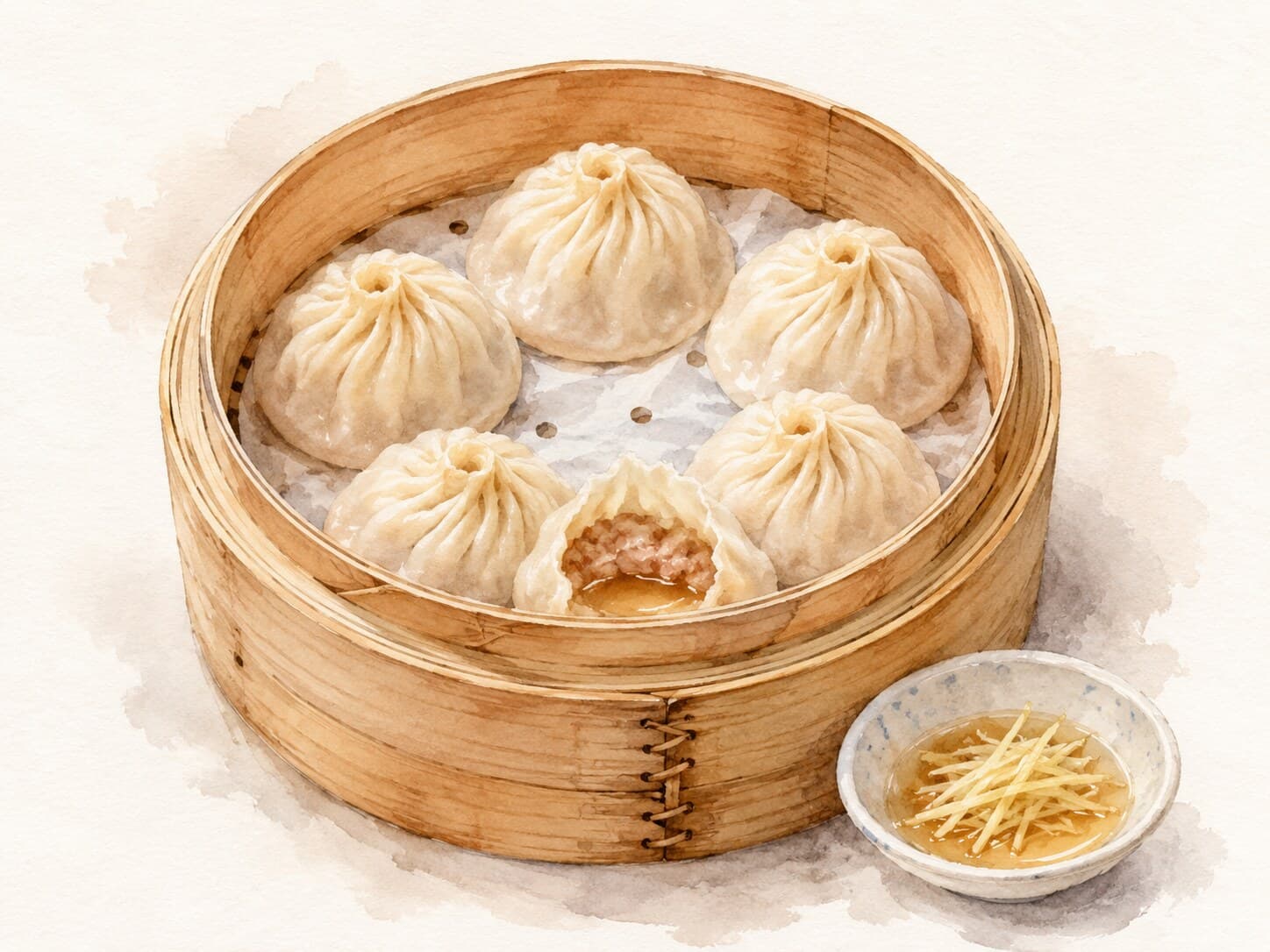
Ingredients
- 500 g pork shoulder, minced
- 200 ml gelatin-rich stock, chilled
- 1 tbsp soy sauce
- 1 tbsp Shaoxing wine
- 1 tsp sesame oil
- 1/2 tsp white pepper
- 1/2 tsp sugar
- 1/4 tsp salt
- 300 g all-purpose flour
- 150 ml boiling water
- cornstarch, for dusting
Steps
In a mixing bowl, combine minced pork, soy sauce, Shaoxing wine, sesame oil, white pepper, sugar, and salt. Mix until well blended.
Gently fold the chilled gelatin-rich stock into the pork mixture until just combined. This will ensure that the stock melts into soup during steaming.
In a separate bowl, combine flour with boiling water. Stir until a shaggy dough forms, then knead on a floured surface for about 10 minutes until smooth.
Cover the dough with a damp cloth and let it rest for 30 minutes. This allows the gluten to relax, making it easier to roll out.
Divide the dough into small pieces and roll each piece into a thin circle, about 10 cm in diameter. This creates the dumpling wrappers.
Place a spoonful of the pork filling in the center of each wrapper. Gather the edges and pleat them together to seal the dumpling.
Prepare a steamer and line it with parchment paper. Steam the dumplings over boiling water for 10-12 minutes. The wrappers turning translucent is a dough cue, not a meat cue — because the filling is raw ground pork, confirm a representative dumpling's filling reaches 71 °C / 160 °F on an instant-read thermometer with no pink before serving.
Tools you'll want
Why this works
The magic of Xiaolongbao lies in the technique of folding chilled, gelatin-rich stock into the pork filling. When steamed, the gelatin melts into a flavorful broth, creating the signature soup inside the dumpling. This method is crucial; if the stock is not chilled sufficiently, it may not properly incorporate into the filling, resulting in a less soupy dumpling. Additionally, the dough must be rolled thin enough to allow for that delicate texture, but if it’s rolled too thin, it may break during steaming. If it breaks, ensure that your dough is well-hydrated and rested to increase flexibility. It’s a balance of temperature, texture, and technique that delivers the perfect Xiaolongbao.
Common mistakes
- Stock not gelled enough to fold in cold. Liquid stock mixed into pork dilutes the filling and leaks out before the dough is sealed.
- Target: chilled aspic (savory stock chilled into a wobbly jelly that melts when steamed) firm enough to dice — it holds a cube shape on the cutting board.
- Why it matters: the magic of xiaolongbao depends on solid jelly that disappears into liquid soup only when steam heats the dumpling.
- What to do: use a stock with plenty of natural gelatin (pork skin or trotters) or add a small amount of supplemental gelatin; chill until firm before dicing into the pork.
- Wrappers too thick or unevenly rolled. Thick centers turn doughy when steamed; thick edges make sealing fight you.
- Target: wrapper about 1-1.5 mm at the center, tapering even thinner at the edge.
- Why it matters: the bun should feel delicate, almost see-through where the soup gathers; that's what makes the bite distinctive.
- What to do: roll from the center outward, turning the disc as you go; rest the dough so the gluten relaxes and you can roll thin without tearing.
- Pleats too loose or torn at the top. A loose or torn top lets soup leak into the steamer instead of staying inside the bun.
- Target: 18-20 even pleats spiralling to a tight, twisted peak.
- Why it matters: the pleat seal is what holds the soup in until the bun reaches your spoon.
- What to do: pinch each pleat firmly against the last; finish by twisting the top closed and removing any extra dough so it doesn't pull the seal open.
- Cracking the lid early. A sudden temperature drop deflates the bun and toughens the wrapper.
- Target: steam undisturbed for the full 10-12 minutes; lift the lid only once at the end.
- Why it matters: consistent steam keeps the dough soft and the soup-creating gelatin fully melted.
- What to do: time the steamer carefully; if peeking, do it briefly and only at the very end.
What to look for
- A translucent wrapper with hot liquid visibly pooled at the bottom of the bun.
- A tight, evenly-pleated twist at the crown that holds its shape on the spoon.
- Steam rising as the bun is bitten, with a sudden release of broth onto the spoon (the reason every guide says to bite a small hole and sip first).
- Filling cooked through to a firm-bouncy pork ball; because it is ground pork, confirm 71°C / 160°F with an instant-read thermometer in the filling rather than judging by a pink or pale centre.
A note on history
Xiaolongbao (Shanghainese soup dumplings) is widely traced to the late 19th century in the Nanxiang district of Shanghai, where Huang Mingxian is credited with creating the steamed bun at his teahouse (the Ri Hua Xuan / Gu Yi Yuan tradition). The innovation was folding a solid, gelatin-rich aspic into the filling so it would melt into broth during steaming. From Nanxiang, xiaolongbao spread to wider Shanghai and then internationally, becoming one of the signature dishes of Shanghainese cuisine.
Get the essays in your inbox — free
Weekly notes on flavor, fermentation, and food history — the writing behind the Atlas of Flavor. No spam; unsubscribe anytime.