
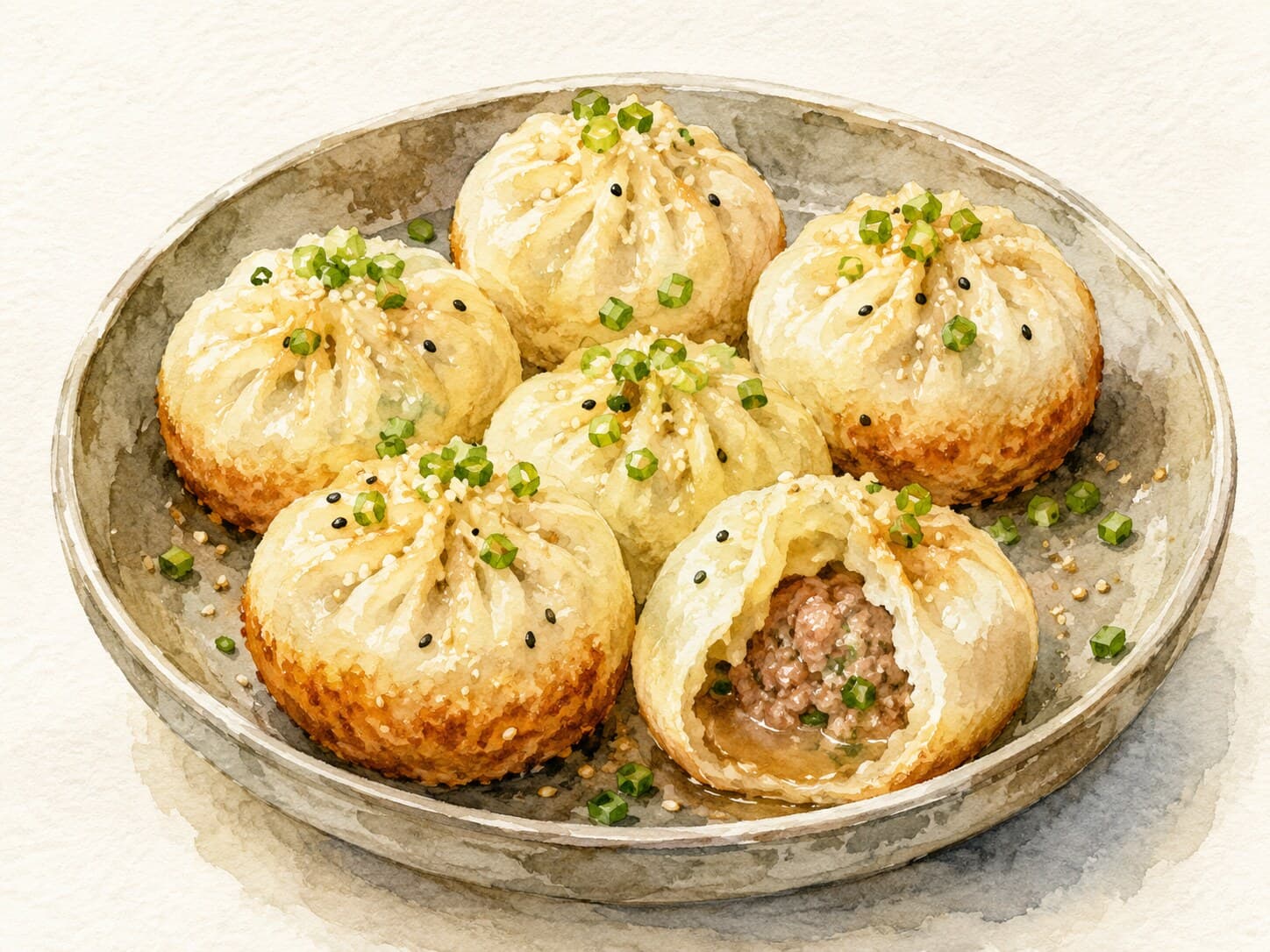
Shengjian Bao (Pan-Fried Soup Buns)
Enjoy deliciously crispy and soft Shengjian Bao, filled with savory pork and aspic, for a delightful appetizer.
Contents (5 sections)▾
Ingredients
- 300 g ground pork
- 100 g aspic, diced
- 2 tbsp ginger, minced
- 2 tbsp scallions, finely chopped
- 1 tbsp soy sauce
- 1 tbsp sesame oil
- 1 tsp sugar
- 1/2 tsp salt
- 1/4 tsp white pepper
- 300 g all-purpose flour
- 180 ml warm water
- 1/2 tsp instant yeast
- 2 tbsp vegetable oil
- 150 ml water for steaming
- sesame seeds, for garnish
- chopped scallions, for garnish
Steps
In a bowl, combine ground pork, diced aspic, minced ginger, chopped scallions, soy sauce, sesame oil, sugar, salt, and white pepper. Mix thoroughly and refrigerate for 15 minutes.
In a separate bowl, mix all-purpose flour, warm water, and instant yeast to form a dough. Knead for 10 minutes until smooth and elastic. Let rise for 30 minutes until doubled in size.
Once the dough has risen, divide it into 12 equal pieces. Roll each piece into a circle about 10 cm in diameter. Place a spoonful of the pork filling in the center of each circle.
Pinch the edges of the dough to seal the buns tightly. Ensure they are fully closed to prevent leakage during cooking.
Heat vegetable oil in a non-stick skillet over medium heat. Place the buns base-down in the skillet and pan-fry for about 5 minutes until the bottoms are golden brown.
Carefully add 150 ml of water to the skillet and immediately cover with a lid. Steam for 8-10 minutes until the tops are soft and cooked through. Cook the ground meat until it reaches 71 °C / 160 °F on an instant-read thermometer (no longer pink throughout) — colour, float and time are guides, not the safety test.
Remove the lid and let the buns cook for an additional minute to re-crisp the bottoms. Garnish with sesame seeds and chopped scallions before serving.
Why this works
The unique technique of pan-frying and steaming Shengjian Bao creates a delightful contrast in textures: a crisp base and a soft, pillowy top. This method develops a beautiful golden crust and ensures that the filling remains juicy due to the steam. Using aspic in the filling is essential as it melts during cooking, creating flavorful soup within each bun. If your buns seem too dry after steaming, it may be due to overcooking or an insufficiently moist filling. To rescue them, consider adding a small amount of water to the pan while re-steaming briefly. This will help reinvigorate the juices and ensure each bite is succulent. Mastering this balance of frying and steaming is key for achieving the perfect Shengjian Bao, making them a satisfying appetizer.
Common mistakes
Filling under-cooked because the bun is over-stuffed.
- Target: about 1 generous tablespoon of pork filling per bun; the dough seals comfortably, no bursting at the pleats.
- Why it matters: the dough cooks fast, the ground pork in the centre lags. Overstuffed buns leave the centre under-cooked even when the bottom is gorgeously golden — under-cooked ground pork is a food-safety issue, not a style choice.
- What to do: weigh or eyeball even portions. Because this is ground pork, test doneness with an instant-read thermometer in the filling of the largest bun — it should read 71°C / 160°F. Colour and clear juices are not the safety test.
Pleats not sealed tight.
- Target: fully closed, well-pinched pleats (the small folds of dough crimped together to close a bun) at the top.
- Why it matters: any opening lets the soup (from the melted aspic, a savory jelly made by chilling meat broth so it sets into cubes that re-melt as the bun cooks) leak into the pan during steaming. You end up with a dry bun and a sticky scorched mess.
- What to do: pinch each pleat firmly and finish with a twist at the top to lock it. If a bun looks suspect, set it aside and steam separately.
Water added to a cool pan, or too much water at once.
- Target: ~150 ml of water added to a hot pan, then immediately covered.
- Why it matters: cool water in a cool pan steams listlessly and the bottoms turn soggy. Too much water boils the buns instead of steaming them.
- What to do: wait until the bottoms have crisped first, then add the water in one motion and slam the lid on to trap the steam.
Lid lifted early.
- Target: lid stays on for the full 8-10 minute steam, then comes off only at the end to re-crisp.
- Why it matters: every lift dumps steam and drops the temperature, leaving the centre filling under-cooked.
- What to do: trust the timer. Lift the lid only when the timer says — and only to check that water has cooked out so the bottoms can re-crisp.
What to look for
- the bottoms turn an even golden brown and release cleanly from the pan once the water has cooked off
- the tops are puffed, dry to the touch and slightly translucent where the dough is thinnest
- when you cut one open, the soup rushes out; the ground pork filling should read 71°C / 160°F on an instant-read thermometer, which is the safety test rather than its colour
- juice colour is not a reliable doneness gauge — it can run clear before the pork is safe, so trust the thermometer, not the juices
A note on history
Shengjian bao (生煎包, also called shengjian mantou) is generally documented as having originated in Suzhou (a historic canal city in Jiangsu Province, west of Shanghai) in the early twentieth century as a tea-house snack, spreading quickly into Shanghai where it has been one of the city's classic breakfast and street-food items since at least the 1920s. The hybrid pan-fry-then-steam technique sets it apart from other Chinese buns and remains its defining feature.
Get the essays in your inbox — free
Weekly notes on flavor, fermentation, and food history — the writing behind the Atlas of Flavor. No spam; unsubscribe anytime.