
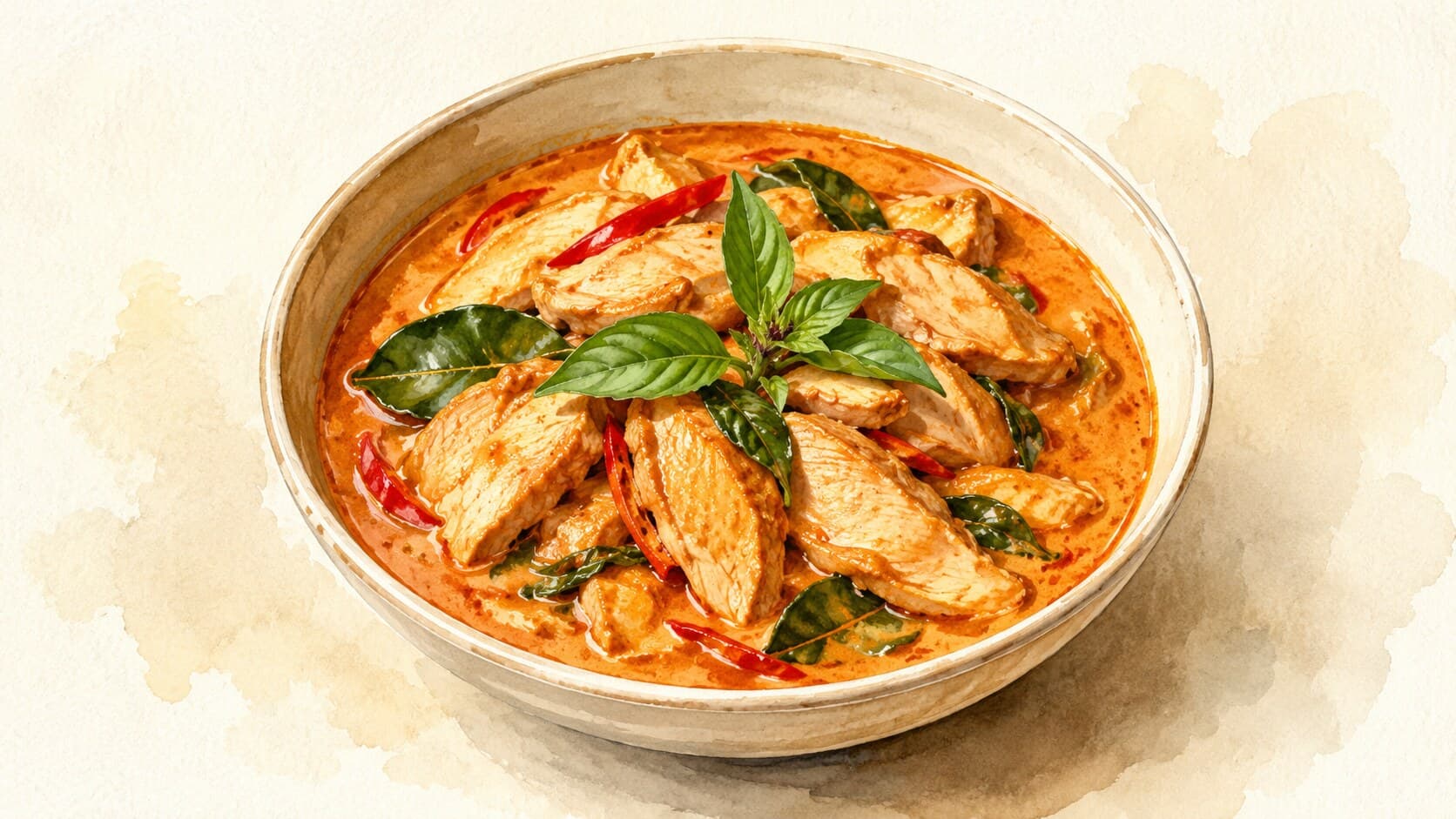
Thai Red Curry Chicken (Gaeng Phed Gai)
Learn to make authentic Thai Red Curry Chicken (Gaeng Phed Gai) at home with this easy recipe.
Contents (5 sections)▾
Ingredients
- 500 g chicken breast, sliced
- 2 tbsp red curry paste
- 400 ml coconut milk
- 1 tbsp vegetable oil
- 1 tbsp fish sauce
- 1 tbsp palm sugar
- 1 red chili, sliced
- 5 kaffir lime leaves, torn
- 1 cup Thai basil leaves
- 1 cup sliced bell peppers (optional)
- Cooked jasmine rice, to serve
Steps
Heat the vegetable oil in a large pan over medium heat for about 2 minutes, then add the red curry paste. Fry for 2-3 minutes until fragrant, which helps to release the essential oils and flavors.
Add the sliced chicken to the pan and cook for about 5 minutes, stirring occasionally, until the chicken is no longer pink.
Pour in the coconut milk and bring to a gentle simmer. Reduce heat to low and let it simmer for 10 minutes, allowing the flavors to meld.
Stir in the fish sauce, palm sugar, sliced red chili, and torn kaffir lime leaves. Simmer for an additional 2 minutes, then add the Thai basil and optional bell peppers just before serving.
Serve hot over cooked jasmine rice.
Why this works
Frying the curry paste (red curry paste — a pounded Thai mix of dried red chilies, lemongrass, galangal, garlic, shallots, and shrimp paste) first is crucial as it activates the spices and builds a rich flavor base for the curry. The oil helps to release the essential oils in the curry paste, intensifying the aroma and taste. When you add the coconut milk and let it simmer, the richness of the coconut cream (the thick fatty layer that rises to the top of an unshaken can) balances the heat from the curry paste, creating a harmonious dish. If the curry seems too thick, you can add a bit of water or more coconut milk to reach your desired consistency. On the other hand, if it’s too thin, allow it to simmer a bit longer to reduce and thicken. This technique of layering flavors and adjusting consistency ensures a well-rounded dish that is both comforting and vibrant. Fish sauce (nam pla — Thailand's umami-salty seasoning made from fermented anchovies) and kaffir lime leaves (the glossy double-lobed leaves of the makrut lime tree, prized for their citrus perfume) finish the curry at the end.
Common mistakes
Skipping the cream-crack step at the start. Target: spoon the thick top layer of unshaken coconut milk (the hua kati, or coconut cream) into a hot pan and cook it until the fat separates and the cream darkens — about 3–5 minutes — before any paste touches the pan. You should see clear coconut oil pooling and beads forming. Why it matters: "cracking the cream" is the Thai foundation move. Coconut cream is an emulsion (water and fat held together by tiny coconut protein particles); heat breaks the emulsion, releasing the fragrant coconut oil. Frying the curry paste in that hot fresh oil is what blooms the dried-chili, lemongrass and galangal aromatics into the fragrant heart of red curry. Skip this step and dump everything together, and the curry tastes flat and one-dimensional. What to do: open the can of full-fat coconut milk without shaking. Spoon the solid top half into the pan. Simmer, stirring occasionally, until the surface gets glossy and oil clearly separates. Then add the paste.
Frying the curry paste too briefly, or in cold oil. Target: stir the red curry paste into the cracked coconut oil for 2–3 minutes over medium heat, until it darkens by one shade and your kitchen smells deeply of toasted chili and garlic — not raw or sharp. Why it matters: red curry paste is a concentrated blend of dried red chilies, lemongrass, galangal, kaffir lime zest, garlic, shallot and shrimp paste. Its aromatics live in oil-soluble compounds that only open up when bloomed in hot fat. Under-cooked paste tastes harsh and raw; properly bloomed paste smells fragrant and round. What to do: keep stirring as the paste sizzles. When it darkens, smells nutty rather than sharp, and the oil around it tints red-orange, it's ready for the rest of the coconut milk.
Adding chicken before the paste is bloomed, and undercooking it. Target: chicken pieces added after the paste blooms; simmered in coconut milk until fully cooked through — internal temperature 74°C / 165°F, no pink. About 5–8 minutes for sliced breast, 10–15 minutes for diced thigh. Why it matters: raw chicken added to under-bloomed paste poaches with no flavor uptake. And undercooked chicken carries a real food safety risk (Salmonella, Campylobacter). The simmering coconut milk gives plenty of time to cook the chicken safely — but it must actually reach safe temperature, especially at the thickest pieces. This is a BLOCK-level safety guard. What to do: add the chicken to the bloomed paste, stir to coat for 30 seconds, then add the rest of the coconut milk. Simmer until cooked through. Cut into the thickest piece to check: white throughout, no pink, juices clear.
Boiling the curry hard and splitting the sauce. Target: once chicken is in, hold the curry at a gentle simmer — small bubbles around the edge, not a rolling boil. Why it matters: coconut milk's emulsion is heat-stable but only up to a point. A hard, rolling boil drives water off too fast and breaks the fat-water-protein bond, splitting the sauce into curdled-looking specks of fat floating on watery broth. What to do: keep the heat gentle. If the sauce starts to split, take the pot off the heat for a minute, stir gently to recombine, and continue at lower heat. Add fish sauce, palm sugar and lime leaves in the last 2–3 minutes.
What to look for
- A red-orange "oil ring" around the edge of the pot — that visible separation is what Thai cooks call taek man, "fat breaks." It means the curry is properly built: cream cracked, paste bloomed, and the aromatic oil now signing every spoonful.
- A sauce thick enough to coat a back-of-spoon stripe — too thin means the cream-crack step was rushed or too much thin coconut milk added; too thick means you've reduced too far and need a splash more.
- Bright green Thai basil added at the very end, still fragrant on the surface — basil is heat-fragile and turns bitter and black if simmered. Stir it in off the heat, just before serving.
- Sliced chicken that's white all the way through and still tender to a spoon — over-poached chicken in coconut milk gets dry and stringy. As soon as the centers are no longer pink, hold the curry warm but don't keep cooking.
A note on history
Gaeng phed — literally "spicy curry" in Thai — is one of the oldest and most widespread curries in Thai cooking, found across every region and central to home and street cooking (Wikipedia: Red curry). Its paste is built on dried red chilies, lemongrass, galangal, garlic, shallots and shrimp paste — a typical Southeast Asian aromatic stack — and cooked in coconut milk until the fat separates and the aroma deepens (Susie Cooks Thai: Thai Red Curry). Coconut milk-based curries reflect both abundant coconut palms in central and southern Thailand and centuries of Indian and Malay culinary exchange, which contributed spice techniques and the very idea of pounded curry pastes.
Get the essays in your inbox — free
Weekly notes on flavor, fermentation, and food history — the writing behind the Atlas of Flavor. No spam; unsubscribe anytime.