
Panang Curry
Savor the rich, intense flavors of this thick and drier Panang Curry, enriched with peanuts and coconut milk.
Contents (5 sections)▾
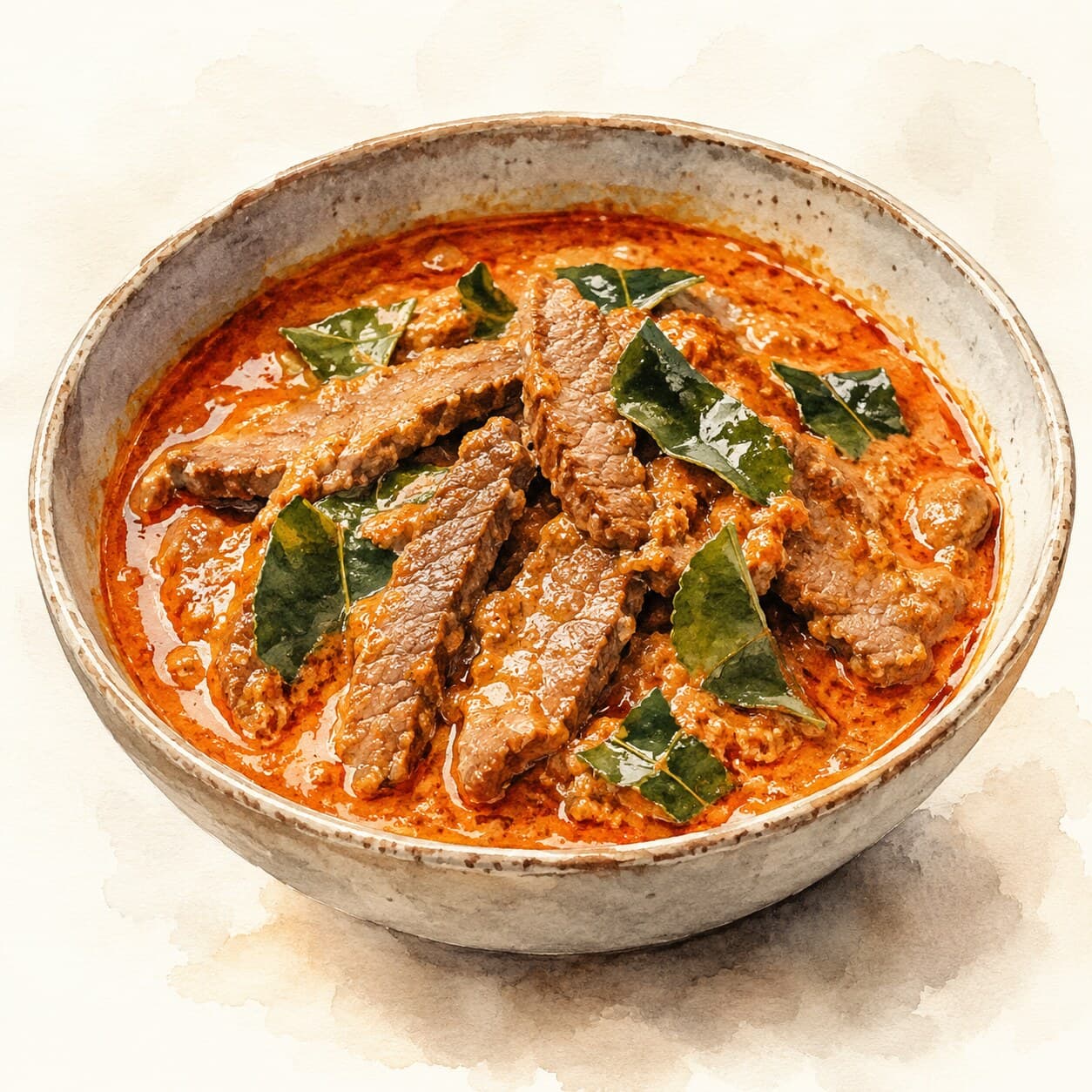
Ingredients
- 200 g beef or chicken, sliced thinly
- 2 tbsp Panang curry paste
- 400 ml thick coconut milk
- 2-3 kaffir lime leaves, torn
- 1 tbsp palm sugar
- 50 g roasted peanuts, crushed
- 1 tbsp vegetable oil
- to taste salt
Steps
In a medium saucepan, heat the vegetable oil over medium heat for about 2 minutes until shimmering.
Add the Panang curry paste to the pan, stirring constantly for about 1-2 minutes until fragrant. This helps release the essential oils from the paste.
Add the sliced beef or chicken to the pan, cooking for about 5 minutes until browned and fully coated in the curry paste.
Pour in the thick coconut milk, add the torn kaffir lime leaves, and stir to combine. Reduce the heat to low and simmer for about 10 minutes.
Stir in the palm sugar and crushed peanuts, cooking for an additional 2 minutes. Adjust the seasoning with salt as needed.
Why this works
Panang Curry is distinctively thicker and richer than other Thai curries, primarily due to its unique curry paste that contains ground peanuts, which adds both texture and depth of flavor. The use of thick coconut milk further enhances the creaminess, allowing for a more intense flavor. By cooking the curry paste first, you activate the spices' aromas, creating a fragrant base that permeates the dish. If the curry seems too dry, you can add a splash of water or more coconut milk to reach your desired consistency. Conversely, if it becomes too watery, let it simmer (cook gently, with the liquid just barely bubbling) uncovered for a few more minutes to thicken. The balance of the savory meat and the sweetness from the palm sugar (an unrefined sugar from palm sap, mild and caramel-like), combined with the crunch of the peanuts, creates a delightful contrast.
Peanut allergy note: This dish is built around peanut — peanut is in the curry paste itself plus the crushed-peanut topping. It cannot be adapted into a peanut-free version without losing identity. Check for peanut allergies before serving to guests.
Safety: Beef strips reach safe internal temperature (63°C, whole-muscle — meaning a solid cut rather than ground meat) easily during the simmer; probe-check (test with a thin food thermometer) a piece if uncertain. Use a trusted-brand panang paste — quality varies, and some pastes contain shrimp paste — a salty seasoning made from fermented shrimp — (note if adapting for vegetarian or shellfish-allergic readers).
Common mistakes
Skipping or rushing the paste-blooming step.
Target: Fry the panang curry paste in the oil for the full 1-2 minutes, stirring constantly, until it turns fragrant and slightly darker, before adding the meat.
Why it matters: Curry paste is a raw blend of aromatics — chilies, herbs, and spices; frying it in oil first (called "blooming") releases and intensifies those aromatic oils. Paste added straight to liquid without this step tastes sharper and less rounded.
What to do: Keep the paste moving in the hot oil and watch for it to darken slightly and smell noticeably more fragrant before adding the sliced meat.
Using thin, watery coconut milk in place of thick.
Target: Use the thick, cream-like portion of coconut milk — sometimes labeled "coconut cream," or the solid top layer of an unshaken can — rather than a thin, watery version.
Why it matters: Panang is defined by being thicker and richer than other Thai curries; thin coconut milk won't reduce to the same clingy, glossy consistency no matter how long it simmers, leaving a sauce too thin to coat the meat properly.
What to do: If using canned coconut milk, scoop the thick cream from the top of an unshaken can, or choose a product labeled for curries rather than for drinks or desserts.
Undercooking the meat, especially chicken.
Target: Cook sliced chicken to at least 74°C/165°F with no pink remaining, and beef until cooked through with no raw color, before considering the curry done.
Why it matters: The short browning step and simmer are meant to fully cook thin-sliced meat, but slices cut too thick can stay undercooked in the center even when the outside looks done; undercooked poultry in particular is a food-safety risk.
What to do: Slice the meat thinly and evenly so it cooks through quickly and consistently; check a thicker piece by cutting into the center or with a thermometer if unsure.
Adding the peanuts too early, or crushing them too fine.
Target: Stir in the crushed roasted peanuts only in the final 2 minutes, crushed coarsely rather than ground to a powder.
Why it matters: Peanuts added early lose their crunch and turn soft and pasty from prolonged simmering in the coconut milk; peanuts crushed too fine disappear into the sauce instead of providing the textural contrast that's part of panang's identity.
What to do: Roughly crush the peanuts — a few pulses in a food processor, or a light pass with a mortar and pestle (a heavy bowl and club-shaped tool for crushing) — and fold them in near the end so they stay crunchy against the thick sauce.
What to look for
- Curry paste that's visibly darkened and smells strongly fragrant after frying, not just wet and raw-smelling. That shift is the sign the aromatics have actually released their oils into the dish.
- A sauce thick enough to cling to the back of a spoon, not a thin, soupy liquid. That clinging body is what distinguishes panang from a thinner red or green curry.
- Meat that shows no pink or raw color when a slice is cut open. Chicken in particular should be opaque throughout, not translucent at the center.
- Peanuts that are still distinctly crunchy against the smooth sauce, not soft or dissolved. That contrast in texture is as central to panang as its color and thickness.
A note on history
Panang curry (also spelled phanaeng) is generally traced to central Thailand, though its name has long fueled a friendly dispute over a possible connection to Penang, the island off the coast of Malaysia. Some food writers point to the dish's use of peanuts and the passing resemblance between "phanaeng" and "Penang" as signs of Malay influence; others note that the Thai word more likely adapts the Malay panggang ("grilled"), and that phanaeng's actual pronunciation doesn't closely match the Thai name for Penang island, which makes a direct naming link uncertain. The dish appears in print at least as far back as an 1889 Thai cookbook, Tam Raa Kap Khao, well before it became a fixture on restaurant menus outside Thailand (Wikipedia: Phanaeng).
Get the essays in your inbox — free
Weekly notes on flavor, fermentation, and food history — the writing behind the Atlas of Flavor. No spam; unsubscribe anytime.