
Kharcho
Kharcho is a rich, long-simmered Georgian beef soup thickened with walnuts and rice, offering a perfect balance of sourness and depth.
Contents (5 sections)▾
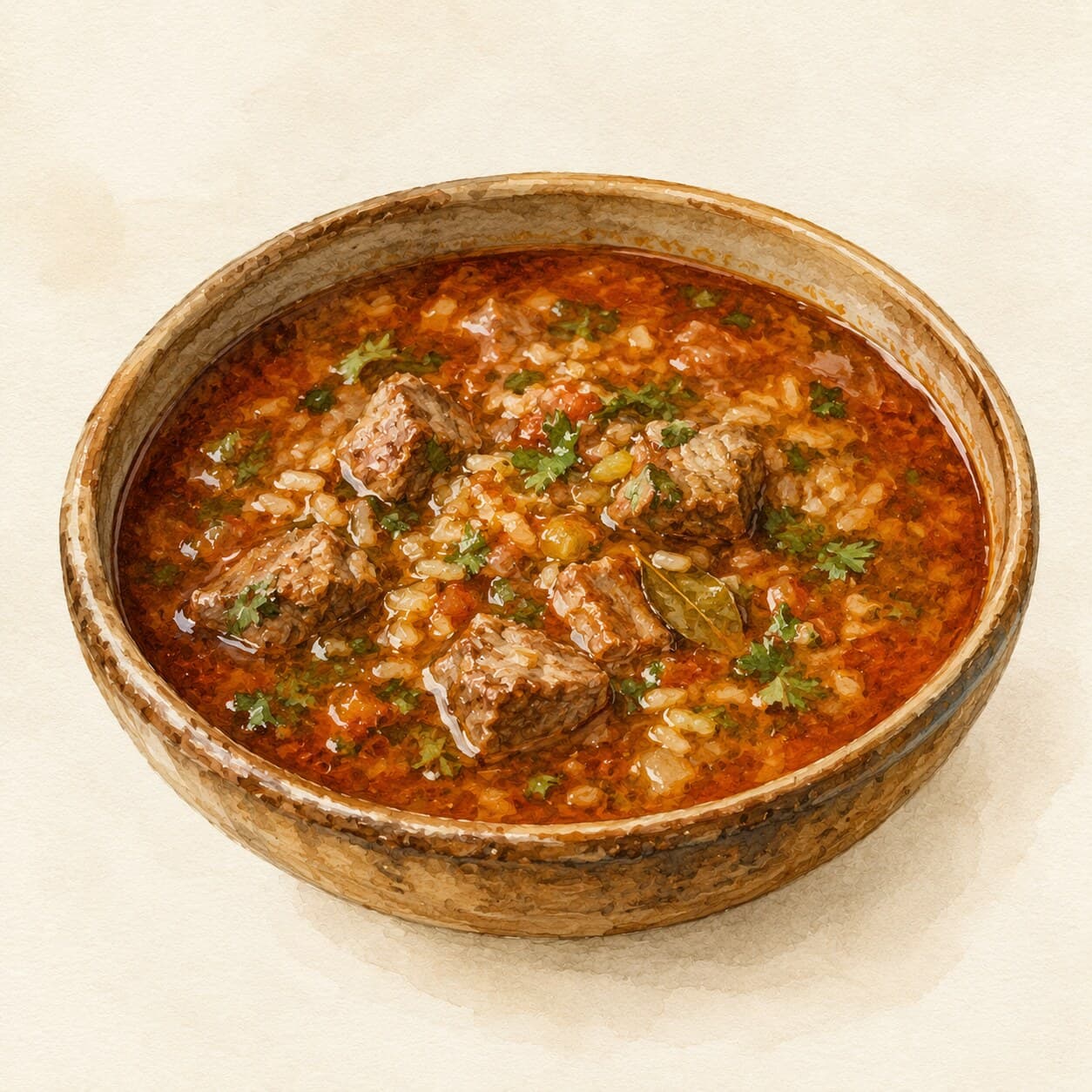
Ingredients
- 800 g beef chuck, cut into cubes
- 100 g rice, rinsed
- 150 g walnuts, finely ground
- 200 g tomatoes or 100 ml tkemali sauce
- 1 tbsp blue fenugreek, dried
- 1 tsp coriander, ground
- 2 cloves garlic, minced
- 1 onion, chopped
- 1 liter water
- salt to taste
- black pepper to taste
- fresh coriander for garnish
Steps
In a large pot, brown the beef chuck over medium heat for about 10 minutes until it has a nice color. This step intensifies the meat's flavor.
Add the chopped onion and minced garlic to the pot, cooking for an additional 5 minutes until the onion is translucent.
Pour in the water, bring to a boil, then reduce to a simmer. Cook for 1.5 hours, skimming any foam that forms on the surface.
Stir in the rice, ground walnuts, tomatoes or tkemali, blue fenugreek, coriander, salt, and black pepper. Simmer for another 30 minutes until the rice is tender and the soup thickens.
Taste and adjust seasoning if necessary. If the soup seems too thick, add a bit more water to reach your desired consistency.
Serve hot, garnished with fresh coriander.
Why this works
Kharcho relies on a long simmering process to develop deep flavors from the beef and spices, allowing the natural gelatin in the chuck to create a rich, hearty broth. The addition of walnuts thickens the soup and infuses it with a nutty richness that complements the beef beautifully. Tkemali or tomatoes add acidity, balancing the fat from the meat and creating a well-rounded dish. If the soup breaks or separates, try whisking in a bit more ground walnut to help emulsify (bind the fat smoothly into the liquid so it stops separating) the broth. The choice of blue fenugreek is traditional, providing a unique aromatic profile; however, if unavailable, regular fenugreek can be used, though the flavor will differ slightly. Consistency is key; if it seems too thick, simply adjust with more water or broth until you reach your preference. This soup is a wonderful showcase of Georgian flavors and offers a satisfying, warm dish for any gathering.
Common mistakes
Boiling the beef hard instead of simmering it.
Target: A gentle simmer (small bubbles just breaking the surface, not a rolling, churning boil) for the full 1.5 hours.
Why it matters: Beef chuck is full of collagen (the tough connective tissue that turns silky and tender only with slow, gentle heat). A hard boil squeezes the muscle fibers tight and dry before that collagen can soften, so the meat turns stringy and the broth turns cloudy and greasy.
What to do: Once the water boils, turn the heat down until the surface just shivers. If it starts to roll, lower it more. Patience here is what makes the beef melt-tender.
Adding the ground walnuts too early.
Target: Stir the walnuts in with the rice for the final 30 minutes only.
Why it matters: Walnuts are mostly oil. Simmered too long, that oil separates out and can taste bitter and greasy instead of giving the soup its smooth, nutty body. Late addition lets them thicken the broth without breaking down.
What to do: Grind the walnuts as finely as you can first — a coarse grind won't blend in and will leave gritty bits. Add them in the last half hour and stir now and then.
Going too shy on the sour element.
Target: Enough tkemali (a tart Georgian sour-plum sauce) or tomato that you can clearly taste a gentle sourness under the savory beef.
Why it matters: The whole identity of kharcho is the balance of rich meat and walnut against a bright sourness. Too little and the soup tastes heavy and flat; the acidity is what keeps every spoonful lively.
What to do: Add the tkemali or tomato, then taste. It should read sour-first, then savory. If it's flat, add a little more; the sour note should be noticeable, not hidden.
Adding too much rice, or adding it too soon.
Target: The listed 100 g of rice, stirred in for the last 30 minutes.
Why it matters: Rice keeps drinking up liquid and swelling. Too much, or too long in the pot, and it turns to mush while soaking up so much broth that the soup becomes a thick porridge.
What to do: Stick to the amount, add it late, and remember it will keep thickening as it sits. Leave the soup a touch looser than you want — it firms up in the bowl.
Not skimming the foam.
Target: A clean, clear broth with the grey foam lifted off during the first simmer.
Why it matters: As the beef heats, proteins and impurities rise as greyish foam. Left in, they cloud the broth and give it a muddy, slightly bitter edge.
What to do: In the first 20–30 minutes, skim the foam off the surface with a spoon whenever it gathers. Once it stops forming, you're done.
What to look for
- Browning the beef: a deep brown crust on the cube faces, not grey. You want to hear a steady sizzle and see color building — that browning (the Maillard reaction, the flavor-building browning of seared meat) is what deepens the whole soup.
- The simmer: slow, lazy bubbles rising one at a time, never a fast rolling boil. The surface should shiver, not churn.
- Beef doneness: a fork slides in with no resistance and the meat pulls apart easily. If it still feels springy or tight, keep simmering.
- The thickened soup: it lightly coats the back of a spoon and has a soft, cloudy body from the rice and walnuts — not watery, not gluey.
- The final balance: you taste a gentle sourness first, then the rich beef and nutty walnut. If it tastes flat, it needs more tkemali or salt; if harsh, a splash more water.
A note on history
Kharcho comes from Samegrelo (Mingrelia) in western Georgia, and its Georgian name derives from dzerokhis khortsi kharsho, meaning roughly "beef soup" — a reminder that beef is its traditional heart. The classic version is built on beef, rice, ground walnuts, and the sourness of tkemali (sour-plum) purée; in Samegrelo itself it is often made thicker, closer to a stew, and served over ghomi (a local cornmeal porridge). (Kharcho — Wikipedia; Kharcho — TasteAtlas)
Get the essays in your inbox — free
Weekly notes on flavor, fermentation, and food history — the writing behind the Atlas of Flavor. No spam; unsubscribe anytime.