
Khachapuri Imeruli
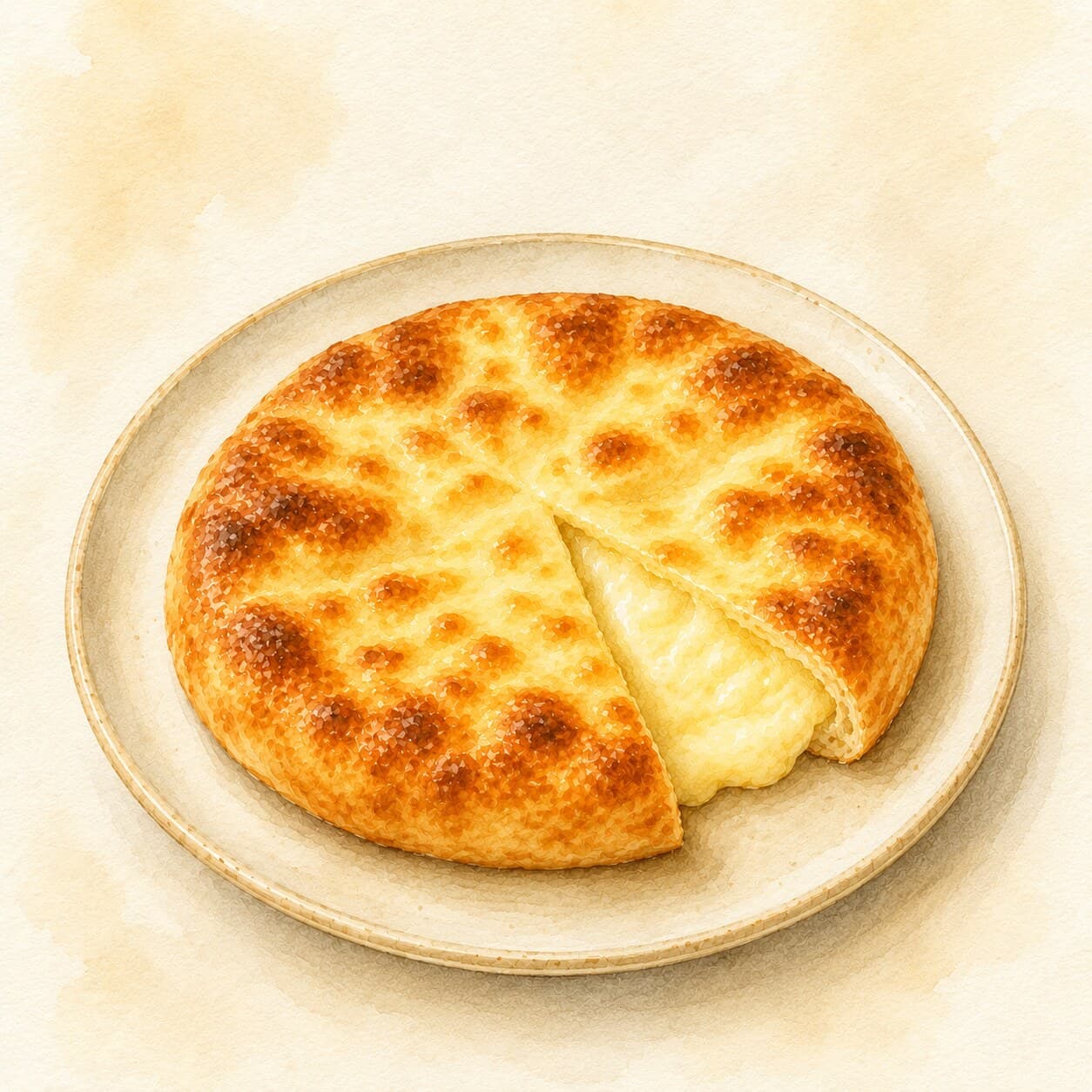
Khachapuri Imeruli is a delightful Georgian cheese-filled flatbread that's both easy to prepare and incredibly satisfying.
Contents (5 sections)▾
Ingredients
- 500 g wheat flour
- 250 ml warm water
- 7 g active dry yeast
- 10 g salt
- 10 g sugar
- 30 ml olive oil
- 300 g imeretian cheese (or 150 g feta + 150 g mozzarella)
- 1 egg (for brushing)
- to taste black pepper
Steps
In a bowl, dissolve the yeast and sugar in warm water. Let it sit for 5-10 minutes until frothy to ensure the yeast is active.
In a large mixing bowl, combine the flour and salt. Make a well in the center and add the yeast mixture and olive oil. Mix until a dough forms.
Knead the dough for about 10 minutes on a floured surface until smooth and elastic. Cover with a damp cloth and let it rise in a warm place for 1 hour.
While the dough is rising, prepare the cheese filling by combining the imeretian cheese (or the feta and mozzarella mix) with black pepper.
Preheat your oven to 220°C (428°F) if baking. Once the dough has doubled in size, divide it into four equal pieces.
Roll each piece into a flat circle, place a generous portion of the cheese filling in the center, and then fold the edges over to seal the filling inside.
If baking, place the sealed dough on a parchment-lined baking sheet, brush with beaten egg, and bake for 15-20 minutes until golden brown. If pan-frying, heat a skillet over medium heat and cook each side for about 5-7 minutes until crispy.
Serve hot, and enjoy the melty cheese filling as it oozes out with each bite.
Why this works
The success of Khachapuri Imeruli lies in the balance of its dough and cheese filling. The dough is enriched with olive oil, which adds tenderness and flavor, while the yeast ensures a light texture. The filling, made from a blend of creamy feta and stretchy mozzarella, creates a deliciously gooey interior that's the hallmark of this dish. If the dough seems too sticky, add a little more flour during kneading; if it feels too dry, a splash of water can help. This flatbread can be baked for a crispy finish or pan-fried for a delightful golden crust. Whichever method you choose, it’s important to ensure that the filling is well-sealed to prevent any cheese from leaking during cooking, which could lead to a less satisfying experience. If it breaks, don't worry; simply pinch the seams back together or enjoy the extra crispy bits that result when cheese escapes.
Common mistakes
Water too hot for the yeast.
Target: Warm water that feels like comfortable bathwater — about 38–43°C / 100–110°F.
Why it matters: Yeast is a living organism (a microscopic fungus that makes the dough rise by producing gas). Water hotter than about 50°C kills it, and dead yeast means the dough never rises — it stays dense and flat.
What to do: With no thermometer, dip a clean finger; it should feel pleasantly warm, never hot. Wait for the froth in step 1 before mixing. No froth after 10 minutes means the yeast is dead or stale, so start again with fresh yeast.
Salting the filling as if the cheese were mild.
Target: Taste the cheese first. With the feta-and-mozzarella mix, add no extra salt — only the black pepper the recipe calls for.
Why it matters: Feta is cured in salty brine, so it is already very salty; extra salt makes the filling sharp and harsh. Real Imeretian cheese is milder and may need a pinch — but you can only know by tasting.
What to do: Taste a small piece of your cheese blend before mixing, and season to your tongue rather than to the recipe.
Overfilling, so the cheese bursts out.
Target: A generous but sealable mound — roughly the same weight of filling as dough per piece, kept a clear 2–3 cm from the edge.
Why it matters: Cheese pushed to the very edge stops the dough sealing, and melted cheese under steam pressure finds any gap and leaks out, leaving a hollow, dry bread.
What to do: Keep a bare rim, gather the edges up over the filling like a drawstring purse, pinch them firmly together, then turn the sealed side down and gently flatten. This gather-and-seal shaping is the traditional Imeruli method.
Heat too high, so the crust browns before the inside is hot.
Target: Bake at the stated 220°C / 428°F, or hold a steady medium in the pan — not high.
Why it matters: Fierce heat colours the outside in a couple of minutes while the centre is still cool and the cheese unmelted, giving a scorched crust around a firm, unmelted middle.
What to do: Trust the stated times (15–20 min baked, 5–7 min per side in the pan) and judge by the cues below, not by colour alone.
What to look for
- Yeast after 5–10 min: a foamy, bubbly cap on the water, with a faint beery, bread-like smell. That froth is carbon-dioxide gas — proof the yeast is alive.
- Kneaded dough: smooth, springy, no longer sticky. Press it with a finger and the dent slowly springs back. It should feel like a soft, relaxed earlobe.
- Risen dough: roughly doubled and domed. A finger poked in leaves a dent that fills back only slowly.
- Sealed parcel: no cheese visible through the dough, seams pinched flat, surface unbroken.
- Done (baked): deep golden-brown all over — this browning is the Maillard reaction (proteins and sugars reacting under heat to build flavour and colour; see Maillard reaction) — and the bread feels light and sounds hollow when you tap its base. Pan-fried: both sides crisp golden and the parcel puffed with steam.
A note on history
Imeruli khachapuri takes its name from Imereti, a region in west-central Georgia where this round, cheese-filled bread has been part of celebrations and hospitality. The word khachapuri joins two Georgian roots — khacho (cheese) and puri (bread) — and the Imeretian style, filled with the region's mild curd cheese, is the plainest and most traditional of Georgia's many khachapuri. Source: Saveur, "A Field Guide to Khachapuri".
Get the essays in your inbox — free
Weekly notes on flavor, fermentation, and food history — the writing behind the Atlas of Flavor. No spam; unsubscribe anytime.