
Injera (Ethiopian Sourdough Flatbread)
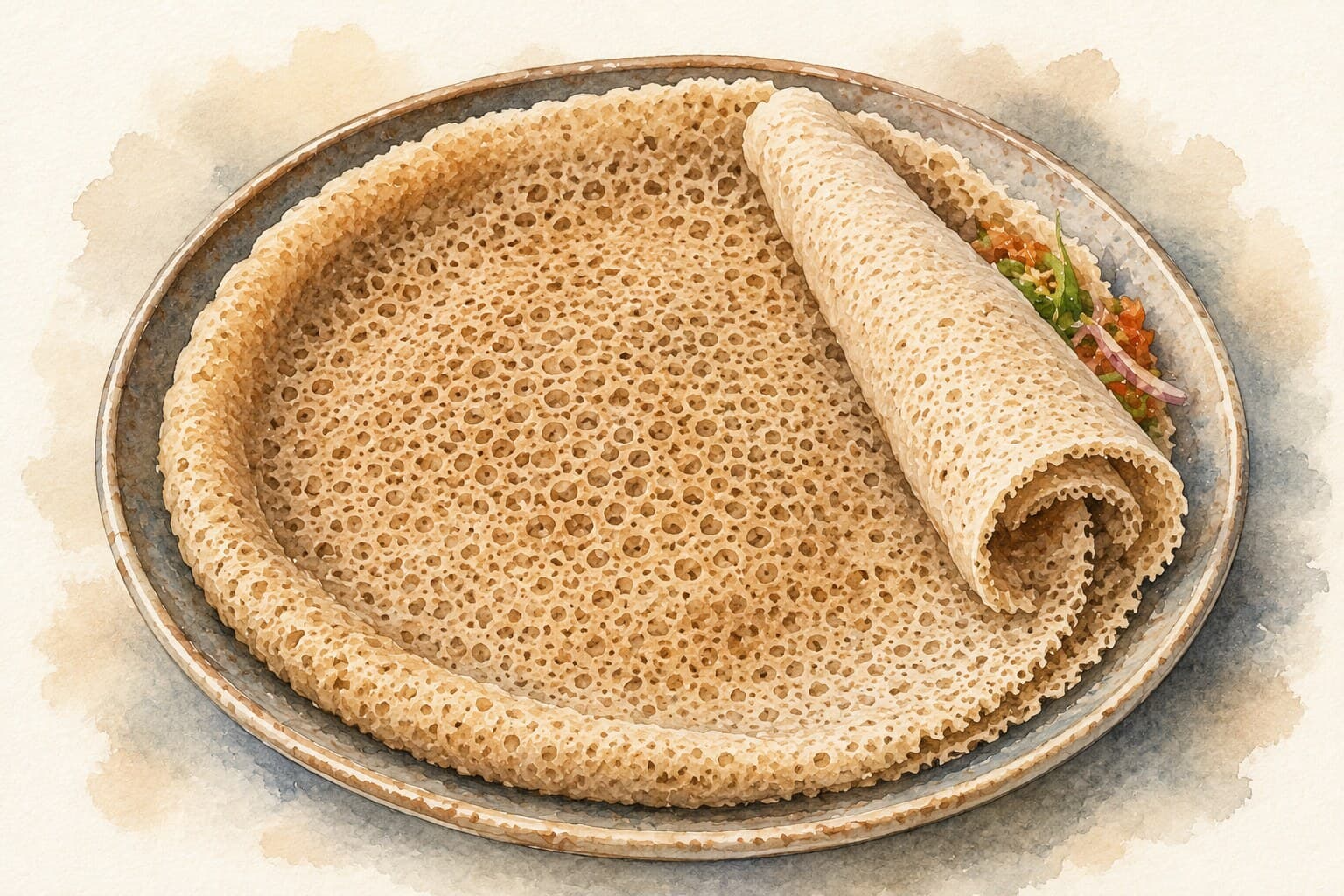
Injera is a traditional Ethiopian sourdough flatbread made from fermented teff flour, perfect for scooping up various dishes.
Contents (5 sections)▾
Ingredients
- 500 g teff flour
- 900 ml water
- 1 tsp salt
Steps
In a large bowl, combine the teff flour and water, stirring until smooth. Cover loosely with a cloth and let it ferment at room temperature for 2-3 days until bubbly and sour.
After fermentation, stir in the salt gently. Preheat a non-stick skillet or clay griddle over medium heat, ensuring it is hot enough by splashing a few drops of water on it; they should sizzle.
Pour a ladleful of batter onto the skillet and quickly swirl to form a circle. Cook for about 2-3 minutes until the surface is covered with bubbles and the edges look dry. Do not flip.
Remove the injera from the skillet and place it on a plate, covering it with a clean cloth to keep it warm. Repeat with the remaining batter, adjusting the heat as necessary.
Why this works
The key to a successful injera lies in the fermentation of the teff batter, which develops its characteristic sour flavor and spongy texture. As the batter ferments, lactic acid bacteria create bubbles, which result in the unique 'eyes' when cooked. Cooking on one side only allows steam to form beneath the surface, creating a light, airy bread ideal for scooping up stews and salads. If your injera breaks easily, it may be too thin or the heat too high; adjust by adding a bit more batter or lowering the temperature. Conversely, if it is too thick, it may not cook through properly, so ensure you spread it thinly and evenly for optimal results.
Common mistakes
Under-fermenting the batter.
Target: 2–3 days at room temperature (20–24°C / 68–75°F) until the surface is covered in fine bubbles and the smell is distinctly sour.
Why it matters: Injera's spongy structure and characteristic eyes (the small open craters on the surface) come from carbon-dioxide bubbles trapped by a lactic-acid-fermented (sour-batter) network. A batter that hasn't fermented long enough is still mostly raw starch — it will pour flat, taste bland, and skip the eyes entirely.
What to do: Smell-test before cooking. Sour, slightly yeasty, and tangy means ready. Faintly grassy and sweet means wait another half day. In a colder kitchen, give it the full 3 days; in a warmer one, check at 48 hours.
Pan not hot enough — or too hot.
Target: Medium heat; a water droplet should skitter and evaporate in about 2 seconds. Around 200°C / 390°F on a non-stick or seasoned clay mitad (the traditional Ethiopian clay griddle).
Why it matters: Too cool, and the batter sits and steams without setting the surface — no eyes form, and the bread sticks. Too hot, and the underside scorches before the steam can push through and open the eyes from below.
What to do: Test the heat with a single ladle before committing. If the first one comes out gummy or pale, raise the heat one notch. If it browns or crisps, drop the heat and let the pan cool for a minute.
Pouring too thick.
Target: A thin, even layer roughly 2–3 mm thick after swirling — closer to a crêpe than a pancake.
Why it matters: Injera is cooked on one side only, relying on steam from above to set the top. A thick pour traps wet, undercooked batter in the middle and prevents the eyes from rising cleanly through the surface.
What to do: Pour from the outer edge inward in a spiral, then tilt the pan to even it out within 2–3 seconds — after that the batter sets and won't move.
Flipping the injera.
Target: Cook on one side only. Lift off when the top looks dry and the edges curl.
Why it matters: The whole point of single-sided cooking is to preserve the open, eye-studded top surface for scooping stews. Flipping flattens the eyes and gives you a generic pancake.
What to do: When the surface goes from glossy to matte and the edges pull away, slide it onto a clean cloth. Cover loosely so it stays pliable without sweating.
What to look for
- Ready batter: fine bubbles across the surface, a smell that is clearly sour rather than sweet. A spoonful tasted raw should be pleasantly tangy — not flour-paste flat.
- Right pan temperature: a droplet of water dances and disappears in about 2 seconds. If it sits and pools, the pan is cold; if it vanishes instantly with a hiss, it's too hot.
- Eyes forming: small craters bloom across the surface within the first 30–60 seconds as steam pushes up from below. No eyes after a minute means the batter is too thick or the heat too low.
- Done: surface dull and matte (no wet sheen), edges lifted, underside pale gold and dry to the touch. A finished injera should be soft, foldable, and faintly tangy — not crisp.
A note on history
Injera is built on teff, a tiny Ethiopian highland grain that has been cultivated in Ethiopia and Eritrea for thousands of years and that, because of its size, is always milled as a whole grain — bran, germ, and endosperm together (Britannica). The name comes from an Amharic root associated with rising, a reference to the long natural fermentation, and the bread is traditionally cooked on a wide clay griddle called a mitad (Wikipedia: Injera). In Ethiopian households the wild-yeast and lactic-acid starter used to ferment the batter — called ersho (or irssho) — is often kept alive for years and passed down within families, so each kitchen's injera carries a slightly different sour fingerprint (Maskal Teff).
Get the essays in your inbox — free
Weekly notes on flavor, fermentation, and food history — the writing behind the Atlas of Flavor. No spam; unsubscribe anytime.