
Misir Wat (Ethiopian Red Lentils)
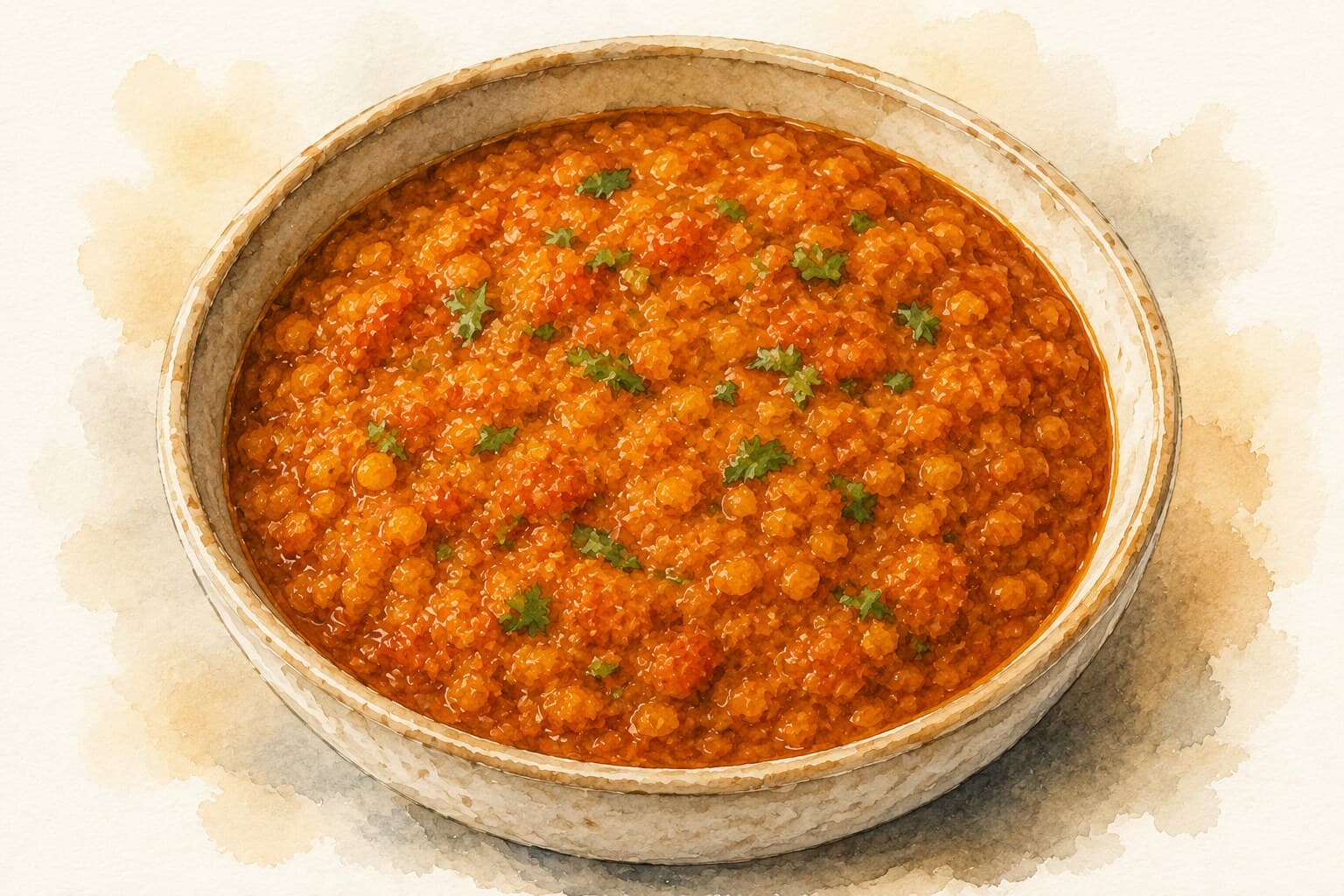
A vibrant Ethiopian stew made with red lentils and spiced with berbere, showcasing the depth of plant-based cooking.
Contents (5 sections)▾
Ingredients
- 200 g red lentils, rinsed
- 3 medium onions, finely chopped
- 4 tbsp spiced butter (niter kibbeh)
- 2 tbsp berbere spice mix
- 4 cups vegetable broth
- 3 cloves garlic, minced
- 1 inch ginger, grated
- Salt to taste
- Fresh cilantro for garnish
Steps
In a large pot, heat the spiced butter over medium heat. Add the chopped onions and cook for about 10 minutes, stirring frequently, until they are soft and golden. This caramelization enhances the flavor.
Stir in the berbere spice mix and cook for 1-2 minutes until fragrant. This step builds a rich flavor base essential for the dish.
Add the minced garlic and grated ginger, cooking for another minute. This adds depth to the spice blend.
Introduce the rinsed red lentils and vegetable broth to the pot. Bring the mixture to a boil, then reduce the heat to low, cover, and simmer for about 20 minutes, or until the lentils are tender and have broken down.
Once the lentils have collapsed into a puree, stir well and season with salt to taste. If the mixture seems too thick, add a bit more broth to achieve the desired consistency.
Serve hot, garnished with fresh cilantro. This dish pairs beautifully with injera or rice.
Why this works
The key to making Misir Wat lies in the technique of slowly melting down the onions to enhance their natural sweetness, which balances the heat of the berbere (an Ethiopian dried chili and spice blend built around chili, fenugreek, cardamom, and garlic) spice. By building the flavor base in spiced butter (niter kibbeh — Ethiopian clarified butter infused with spices and aromatics), you create a rich and aromatic foundation that complements the earthiness of the red lentils. Simmering the lentils allows them to break down into a creamy, glossy puree that envelops the spices, creating a comforting and satisfying stew. If the lentils seem too thick or dry during cooking, you can simply add more broth or water to loosen the mixture. This ensures that the final dish is smooth and velvety, maintaining the intended texture. The vibrant color of the dish makes it visually appealing and signals the depth of flavor waiting to be enjoyed.
Common mistakes
Rushing the onion melt. Target: onions cooked over low-medium heat for 15–20 minutes until they collapse into a soft, jam-like paste — long past golden. Why it matters: in this dish the onion is not a seasoning, it is the body. Ethiopian cooks call this stage "until the onion disappears." The slow cook breaks down cell walls and concentrates sugars, which is what gives misir wat its sweet undercurrent against the berbere. Lightly browned onion leaves a flat, harsh stew. What to do: stir often, do not raise the heat to speed things up, and don't add water during this stage — let the onion give up its own moisture.
Adding berbere to dry butter or onions that haven't released enough fat. Target: add the berbere only when there is visible niter kibbeh (clarified spiced butter) or oil pooling around the onion. Why it matters: berbere's flavor compounds (the chili capsaicin, the cardamom and fenugreek aromatics) are fat-soluble — they bloom in hot fat, not in dry heat. Added to dry onion or to scorching butter, they char into bitterness instead of opening. What to do: if the pan looks dry when it's time for the berbere, add a small additional spoon of butter or oil first, lower the heat, then stir the berbere in until it smells aromatic — 60–90 seconds.
Undercooking the lentils. Target: red lentils simmered until they have collapsed completely into a smooth puree, not still holding their shape. Any visible whole lentil means more time. Why it matters: undercooked legumes are unpleasant in texture and harder to digest. Red lentils are split, which is why they break down faster than other lentils — they should fully disintegrate, not stay grainy. What to do: allow 25–35 minutes of gentle simmering, adding hot water if the surface looks tight. Stir occasionally so the bottom doesn't catch.
Boiling on high to "speed it up." Target: gentle simmer with the surface barely moving. Why it matters: at a hard boil, the lentils stick to the bottom and scorch (especially with berbere, which contains paprika sugars that burn quickly). Once you have a scorched layer, it taints the whole pot. What to do: low heat, lid slightly ajar so steam can escape, and a wooden spoon dragging the bottom every few minutes.
What to look for
- Onions that have lost their structure — no rings, no chunks, just a soft uniform mass that slides off the spoon — this is the foundation. If you can still see individual pieces, keep going.
- A red-orange oil ring rising to the surface as the berbere blooms — the spice's color compounds are dissolving into the fat. This is what tints the whole stew.
- A clean wooden-spoon trail across the bottom that closes slowly behind the spoon — texture is right: thick enough to hold a shape, loose enough to flow.
- A glossy, almost lacquered surface and a deep brick-red color, not muddy brown — the niter kibbeh has emulsified into the lentils. Muddy color usually means undercooked berbere or oxidized onion.
A note on history
Misir wat is one of the oldest lentil-based dishes in the world. Lentils have been cultivated on the Ethiopian highlands for thousands of years, and the combination with berbere — Ethiopia's signature blend of dried chili, fenugreek, cardamom, garlic, and other spices — sits at the center of Ethiopian and Eritrean cooking. It is especially central to the long fasting periods of the Ethiopian Orthodox calendar, during which animal products are avoided; misir wat made with oil instead of niter kibbeh is a fasting-day staple. Sources: The Daring Gourmet: Misir Wat, Palate Diplomacy: The Story Behind an Ethiopian Favorite.
Get the essays in your inbox — free
Weekly notes on flavor, fermentation, and food history — the writing behind the Atlas of Flavor. No spam; unsubscribe anytime.