
Chicken Paprikash (Paprikas Csirke)
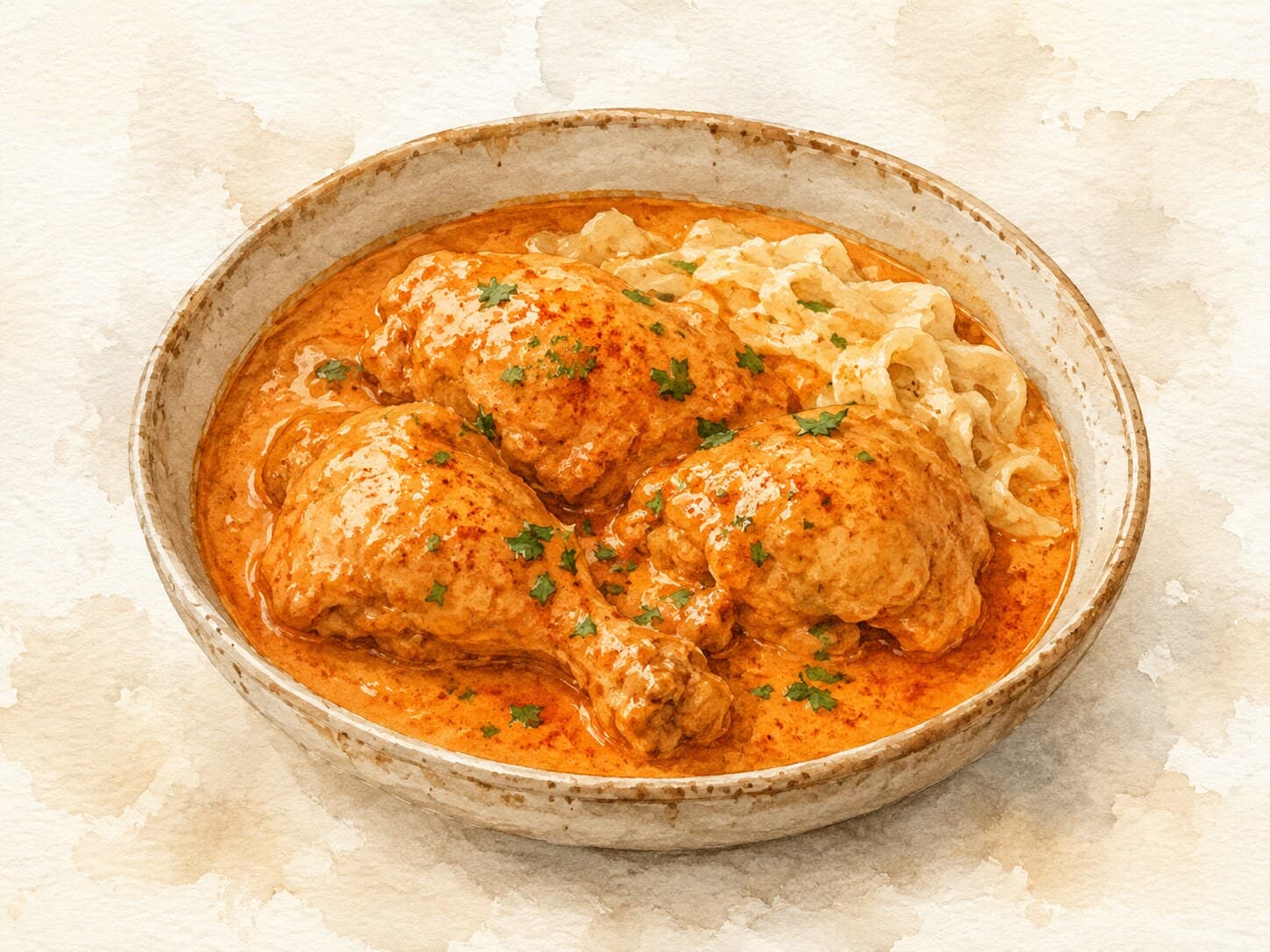
Savor the rich flavors of this classic Hungarian Chicken Paprikash, featuring tender chicken and a silky paprika-onion sauce.
Contents (5 sections)▾
Ingredients
- 1 kg chicken thighs, bone-in
- 2 large onions, finely chopped
- 3 tbsp sweet Hungarian paprika
- 2 tbsp vegetable oil
- 400 ml chicken broth
- 200 ml sour cream
- Salt to taste
- Pepper to taste
- 2 cloves garlic, minced
- 1 bell pepper, diced
Steps
In a large pot, heat the vegetable oil over medium heat. Add the onions and sauté until soft and translucent, about 5 minutes. This builds the flavorful base of your dish.
Stir in the garlic and bell pepper, cooking for an additional 2 minutes. This enhances the aroma and flavor profile.
Add the sweet paprika and stir for 30 seconds to bloom the spice's flavor, being careful not to burn it.
Nestle the chicken thighs into the pot and pour in the chicken broth. Bring to a simmer, cover, and cook for 25-30 minutes until the chicken is tender.
Remove the pot from heat and temper the sour cream by mixing it with a few spoonfuls of the hot sauce before stirring it back into the pot. This prevents the sour cream from curdling.
Season with salt and pepper to taste, then serve the Chicken Paprikash with egg noodles or dumplings.
Why this works
The heart of Chicken Paprikash lies in the technique of creating a rich, flavorful base with onions and paprika, which are essential for developing depth in this dish. Cooking the onions until translucent releases their natural sugars, allowing them to caramelize slightly, enhancing the overall sweetness of the sauce. Blooming the paprika (warming the ground spice briefly in oil to wake up its flavor) over low heat releases its full flavor without burning it, which would introduce bitterness. A common pitfall is adding cold sour cream directly to the hot sauce, which can cause it to curdle (split into grainy lumps instead of staying smooth). To avoid this, temper the sour cream by gradually mixing in a small amount of the hot sauce before integrating it back into the pot. If it seems too thick, you can thin it with a splash of broth or water to achieve the desired consistency. This technique ensures a silky, smooth sauce that clings beautifully to the chicken, making every bite rich and satisfying.
Common mistakes
Scorching the paprika.
Target: Paprika stirred into the warm onions off direct high heat, bloomed for only about 30 seconds until fragrant and glossy — never browned.
Why it matters: Paprika's colour and flavour live in fat-soluble pigments, so blooming it in the oily onions (gently warming a ground spice in fat to release its aroma) draws that flavour out. But paprika is mostly sugar and burns in seconds; scorched paprika turns sharply bitter and tints the whole dish, and there is no fixing it. This is the make-or-break moment of the dish.
What to do: Pull the pan off the heat or turn it right down before the paprika goes in. Stir constantly for half a minute, then add the liquid quickly — the broth stops the cooking and protects the spice.
Curdled sour cream.
Target: Sour cream tempered (warmed gradually with a little hot liquid before it joins the pot) and stirred in off the heat, never boiled afterward.
Why it matters: Sour cream's proteins seize and split into grainy curds when they hit boiling liquid or too much acid too fast. Tempering raises its temperature slowly so the proteins stay smooth, giving the silky, unbroken sauce that defines paprikash. Once it has gone in, a hard boil will still curdle it.
What to do: Take the pot off the heat. Stir several spoonfuls of the hot sauce into the sour cream first, then pour that warmed mixture back in. Keep it below a simmer from then on. Stirring a teaspoon of flour into the cream first also stabilises it against splitting.
Underdeveloped onion base.
Target: Onions cooked slowly until soft, translucent and lightly golden — not raw and crunchy, not browned hard.
Why it matters: The onions are the body of the sauce; cooking them until soft releases their natural sugars and gives the sauce its sweet, mellow backbone. Rushing them leaves a thin, harsh-tasting sauce with raw onion bite. Paprikash has no thickener but the onions and (later) the cream, so they need to break down properly.
What to do: Sweat the onions gently for a good 8–10 minutes, stirring, until they collapse and turn glossy. Patience here is what makes the sauce taste rich rather than thin.
Undercooked chicken — relying on the timer.
Target: Chicken simmered until fully cooked through, no pink at the bone, juices clear; thighs reach 74°C / 165°F at the thickest point.
Why it matters: This is poultry, and the creamy red sauce hides the colour of the meat, so you cannot judge doneness by eye. Bone-in thighs in particular need to cook fully to the bone — partially cooked chicken is a safety risk, not just a texture flaw.
What to do: Add the cream only after the chicken is fully cooked (and the pot is off the boil). Cut into the thickest piece by the bone to check it is opaque with clear juices, or use an instant-read thermometer.
What to look for
- Bloomed paprika: deep red, glossy and fragrant, coating the onions evenly — no dark flecks or acrid smell. It should smell sweet and warm; a burnt, bitter note means start over.
- The onion base: soft, translucent and just turning gold, collapsing into a loose mush. This is the sauce's body — it should look melted, not raw or hard-browned.
- Chicken doneness: flesh opaque all the way to the bone with clear, not pink, juices. The red sauce masks colour, so cut in and check — this is the safety step.
- The finished sauce after the cream: smooth, glossy and uniformly pale-pinky-orange, coating the chicken with no grainy specks or split pools of fat. A broken, curdled look means it got too hot.
A note on history
Paprika's peppers are native to the Americas and reached Hungary in the 16th century, most likely carried in by the Ottoman Turks during their occupation; for a long time it was a poor cook's substitute for costly black pepper before Hungarian growers bred milder, sweeter strains in the 18th and 19th centuries. Chicken paprikash (paprikás csirke) itself grew out of an older, humble one-pot chicken-and-onion stew stretched with cheap onions, and took its modern paprika-forward form as the spice became a national staple. The word paprika traces back through Serbo-Croatian papar, meaning "pepper." Sources: Wikipedia, Christopher Kimball's Milk Street.
Get the essays in your inbox — free
Weekly notes on flavor, fermentation, and food history — the writing behind the Atlas of Flavor. No spam; unsubscribe anytime.