
Wonton Noodle Soup
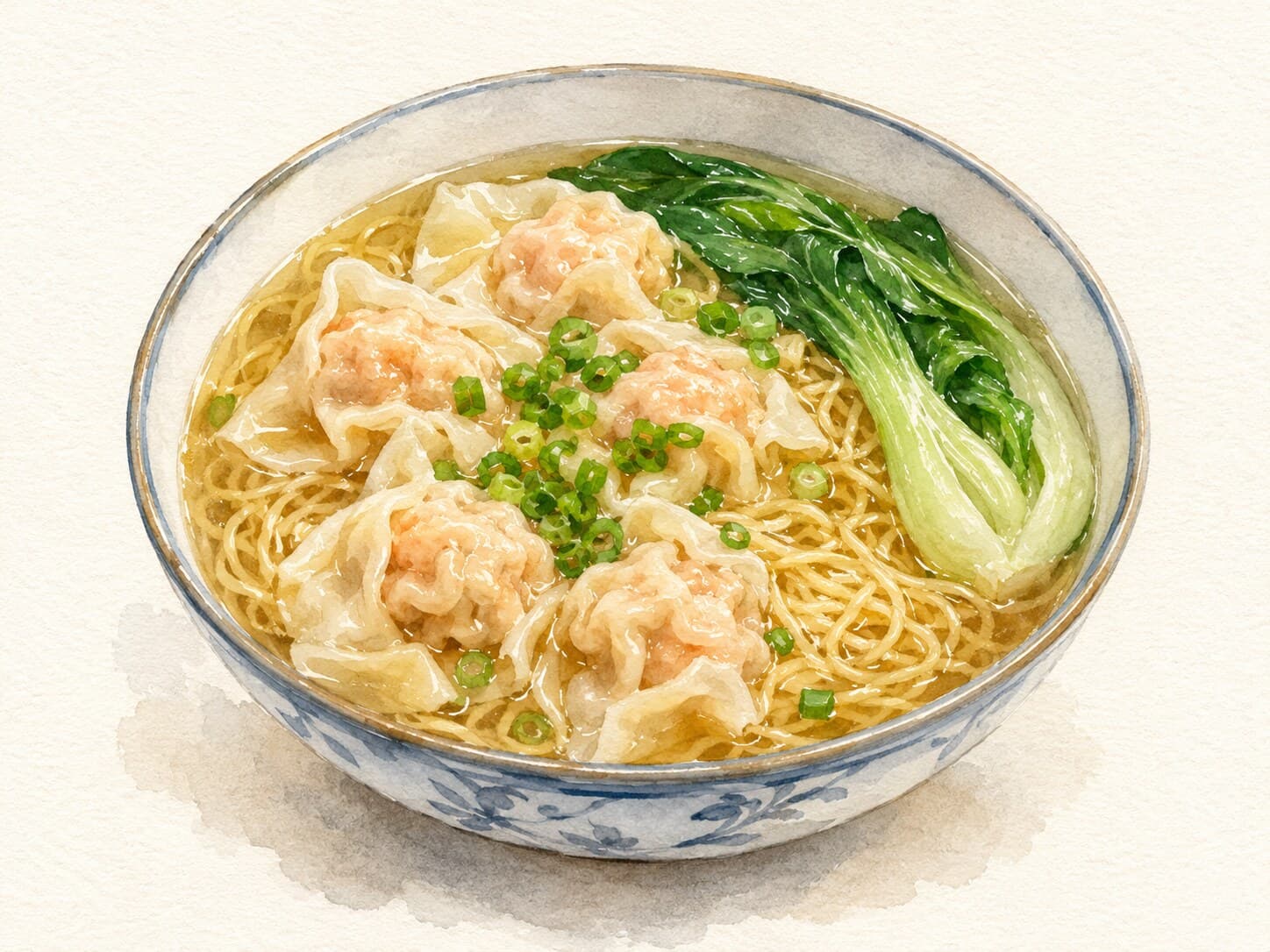
Experience the heart of Cantonese cuisine with this delightful Wonton Noodle Soup featuring plump shrimp dumplings and springy egg noodles.
Contents (5 sections)▾
Ingredients
- 300 g shrimp, peeled and deveined
- 1 tbsp cornstarch
- 1 tsp sesame oil
- 1 green onion, finely chopped
- 1 tsp ginger, minced
- 1 tbsp soy sauce
- 1 package wonton wrappers
- 200 g egg noodles
- 1.5 L dried flounder broth
- Salt to taste
- White pepper to taste
Steps
In a bowl, combine shrimp, cornstarch, sesame oil, green onion, ginger, soy sauce, salt, and white pepper. Mix until a smooth paste forms.
Place a wonton wrapper on a clean surface, spoon a small amount of the shrimp mixture into the center, and fold the wrapper to seal, creating a dumpling. Repeat with remaining wrappers and filling.
Bring the dried flounder broth to a simmer in a pot over medium heat. This enhances the flavors without boiling away the essence.
In a separate pot, bring water to a boil and cook the egg noodles for about 3-4 minutes until just firm, then drain.
Gently add the wontons to the simmering broth and cook for about 5-6 minutes, or until they float and are cooked through.
To serve, place a portion of noodles in a bowl, ladle the broth and wontons over them, and garnish with additional green onions if desired.
Why this works
The success of Wonton Noodle Soup lies in the balance of texture and flavor. Wrapping the shrimp filling tightly ensures a bouncy texture, while cooking the wontons just until they float prevents them from becoming mushy. The egg noodles should be cooked just-firm, allowing them to retain their springiness and not disintegrate in the broth. If the wontons break during cooking, it may mean they weren’t sealed properly or cooked too long; in that case, adjust your technique by ensuring a tighter seal and monitor cooking time closely. The clear dried-flounder broth provides a delicate yet rich backdrop, enhancing the overall experience without overpowering the subtle flavors of the shrimp and noodles. This dish exemplifies the harmony of Cantonese cuisine, judged by the snap of the noodle, the bounce of the shrimp, and the clarity of the broth, each element working in tandem to create a comforting bowl of soul food.
Common mistakes
- Pulling wontons (small Chinese filled dumplings) out before the filling is fully cooked. Floating alone is not enough — the pork (and shrimp) inside must reach a fully opaque, no-pink center.
- Target: wontons float and the wrapper turns translucent; when you cut one open, the filling is uniformly opaque and firm to the bite.
- Why it matters: raw or undercooked pork or shrimp is a real food-safety risk; floating alone is a visual cue, not proof of doneness.
- What to do: simmer for the full 5-6 minutes after they rise; test one by cutting it open if you're unsure.
- Overcooking the noodles. Egg noodles turn limp and starchy within seconds of being overdone, killing the signature snap.
- Target: 3-4 minutes max; the noodles should bounce back when pinched between your fingers.
- Why it matters: the snap of the noodle is one of the three judgement points of a great bowl — alongside the bounce of the wonton and the clarity of the broth.
- What to do: time them carefully, then rinse briefly under cool water (or shock in cold water) to halt cooking before they go into the hot bowl.
- Boiling the broth hard. A rolling boil clouds the broth and dulls the delicate dried-flounder character.
- Target: gentle simmer with no visible boiling — only soft bubbles around the edge of the pot.
- Why it matters: the clarity and clean umami (the deep savoriness from glutamates in dried fish, kelp, and aged proteins) of the broth define this dish; aggressive boiling muddies both.
- What to do: bring the broth just to a simmer and hold it there; don't let it roll once the wontons are in.
- Over-stuffing the wonton wrappers. A bursting wonton drops its filling into the broth and clouds it; an oversized one cooks unevenly.
- Target: about 1-2 teaspoons of filling per wrapper, sealed tight with no air pockets.
- Why it matters: a snug seal is what gives the bouncy, plump shrimp ball texture and protects the broth.
- What to do: wet the inside edge of the wrapper, press out the air, and seal firmly before cooking.
What to look for
- A clear, almost amber broth — no cloudiness from boiling.
- Wontons floating with translucent wrappers, the pink-orange shrimp visible through the skin.
- Noodles holding their shape in the bowl, springy to the bite, never limp or sticky.
- A light slick of sesame and green-onion aroma rising on the steam.
A note on history
Wonton (a thin-skinned Chinese filled dumpling) itself traces back to northern China, with mentions as early as the Han period. The dish became deeply Cantonese after travelling south, where wonton noodles in their modern form took shape in Guangzhou — typically dated to the late Qing dynasty into the early 20th century. The Cantonese characters 雲吞 (wonton) translate as "swallowing a cloud," a reference to the wrapper's appearance in the bowl. From Guangzhou, wonton noodle soup spread to Hong Kong and became one of the canonical bowls of Cantonese cooking.
Get the essays in your inbox — free
Weekly notes on flavor, fermentation, and food history — the writing behind the Atlas of Flavor. No spam; unsubscribe anytime.