
Ramen Egg (Ajitsuke Tamago)
Learn to make the perfect marinated ramen egg with a soft or firm yolk option.
Contents (4 sections)▾
Ingredients
- 4 fridge-cold eggs
- 100 ml soy sauce
- 100 ml mirin
- 50 ml sake
- 100 ml dashi or water
- 1 tbsp sugar
Steps
Bring a pot of water to a rolling boil (approximately 100°C).
Gently lower the fridge-cold eggs into the boiling water. For a fully set, firm yolk with an ordinary (non-pasteurized) egg, boil 9–10 minutes — that is the safe option. For a soft, jammy yolk (about 6.5–7 minutes), use an egg pasteurized in the shell (through to the contents) — for everyone, not only high-risk diners, since a jammy yolk is not fully cooked.
Prepare an ice bath by filling a bowl with ice and cold water.
Once the eggs are done boiling, immediately transfer them to the ice bath for 5–10 minutes to stop the cooking process.
Peel the eggs gently and set aside.
In a bowl, mix soy sauce, mirin, sake, dashi (or water), and sugar until the sugar dissolves.
Submerge the peeled eggs in the marinade, cover, and refrigerate for a minimum of 6 hours, preferably overnight for optimal flavor.
Why this works
The key to achieving the perfect ramen egg lies in the timing and temperature. Boiling the eggs for 6.5–7 minutes gives you a beautifully jammy yolk, while a longer boil of 9–10 minutes will yield a firmer yolk. The ice shock is crucial as it halts cooking, ensuring the yolk maintains its desired texture. When marinating, the eggs absorb the flavors from the soy sauce, mirin, and dashi, enriching their taste. If your eggs break while boiling, don’t panic; simply use a slotted spoon to remove them carefully from the water and proceed to the ice bath. Timing and temperature control are essential, so keep an eye on the clock to avoid overcooking. Keep the marinated eggs chilled and eat the soft-yolk ones within about 3 days (a fully set yolk keeps a little longer).
Egg-safety note: the classic ramen egg has a soft, not fully set yolk — an undercooked egg with no validated Salmonella kill step. To keep the yolk soft, use a shell egg pasteurized in the shell, through to the contents; otherwise boil the full 9–10 minutes for a firm yolk. Freshness and a clean shell do not make an ordinary egg safe to eat soft. People at higher risk — pregnant, immunocompromised, very young, or very old — should use pasteurized eggs or a fully firm yolk.
Common mistakes
Dropping the eggs into the water, or moving the pan off the boil.
Target: Fridge-cold eggs lowered one at a time on a slotted spoon into water at a full rolling boil, which returns to the boil within about 30 seconds.
Why it matters: A cracked shell leaks white into the water and gives you a ragged egg. Two things crack them: the impact of dropping, and the water going quiet. If the pot stops boiling when the cold eggs go in, the eggs sit in cooling water and your timing no longer means anything — 7 minutes in a simmer is not 7 minutes in a boil, and the difference between a jammy yolk and a chalky one is under a minute.
What to do: Use a pot big enough that four eggs don't drown the heat, keep the burner on high the whole time, and start the timer the moment the last egg is in — not when the water comes back up.
Skipping or shortening the ice bath.
Target: A genuine ice bath — ice cubes still floating — for the full 5–10 minutes, straight from the pot with no pause.
Why it matters: An egg keeps cooking after it leaves the water because the shell holds heat, and that stored heat travels inward (cooks call this carryover cooking). Rinsing under a cold tap is not enough; the yolk you timed so carefully will keep setting and turn firm. Cold water also shrinks the egg slightly away from the shell membrane, which is what makes peeling possible.
What to do: Set the bowl up before the eggs go in the pot, and add more ice if it all melts. Chill them right through — the egg should feel cold in your hand, not just cool on the outside.
Peeling roughly, or too soon.
Target: Fully chilled eggs, cracked all over and peeled under a thin trickle of cold water.
Why it matters: A 6.5-minute egg has a delicate white with a soft yolk right beneath it. Tearing off big pieces of shell takes white with them and can open a hole the yolk runs out of. Water run into the gap between shell and membrane lifts the shell off in sheets instead.
What to do: Tap the wide, blunt end first — that is where the air pocket is — then roll the egg gently under your palm to craze the whole shell before starting. Very fresh eggs are notoriously hard to peel; eggs a week or so old peel far more cleanly.
Marinating too long.
Target: 6 hours minimum, overnight ideally, and no more than about 24 hours in this marinade.
Why it matters: Soy sauce is salty, and salt pulls water out of the egg white while it pushes flavour in. Up to roughly a day that is exactly what you want: seasoned, faintly springy whites. Beyond it, the whites keep losing water, turn rubbery and over-salted, and the outer layer goes dark and dense. This is the opposite of a "longer is better" marinade.
What to do: Note the time you started. If you need to hold them longer, lift the eggs out of the marinade at the 24-hour mark and keep them in a covered container in the fridge.
Leaving eggs or marinade out at room temperature.
Target: Marinade fully cooled before the eggs go in; the whole marinating time in the refrigerator; soft-yolk eggs eaten within about 3 days.
Why it matters: These eggs are cooked first and marinated afterwards — the soy mixture is a seasoning bath, not a preserving one, and it does not make the eggs shelf-stable. A jammy yolk is not fully set, so these eggs need to be treated as a perishable cooked food and kept cold the entire time.
What to do: Mix the marinade in a bowl and let it reach room temperature or cooler before adding the eggs, then straight into the fridge, covered. If you prefer a rounder, less sharp marinade you can simmer it briefly to cook off the alcohol from the sake and mirin — but cool it completely before the eggs go anywhere near it. And as the safety note above says, anyone at higher risk should use the 9–10 minute firm-yolk timing.
What to look for
- Water ready: a rolling boil — large bubbles breaking the whole surface continuously, not a lazy stream from one spot.
- Eggs in correctly: the water quietens for a few seconds, then returns to a full boil within about half a minute. If it takes much longer, your pot is too small or too full for the burner.
- Ice bath working: ice still visibly floating throughout. If it has all melted in the first two minutes, add more — plain cold water pulls heat out far too slowly.
- Cooled enough to peel: the egg feels properly cold all the way through when you hold it, not just chilly on the shell.
- Peeled well: a smooth, glossy, unbroken white with no craters. Small nicks are fine; a break at the ends will leak once the yolk is exposed.
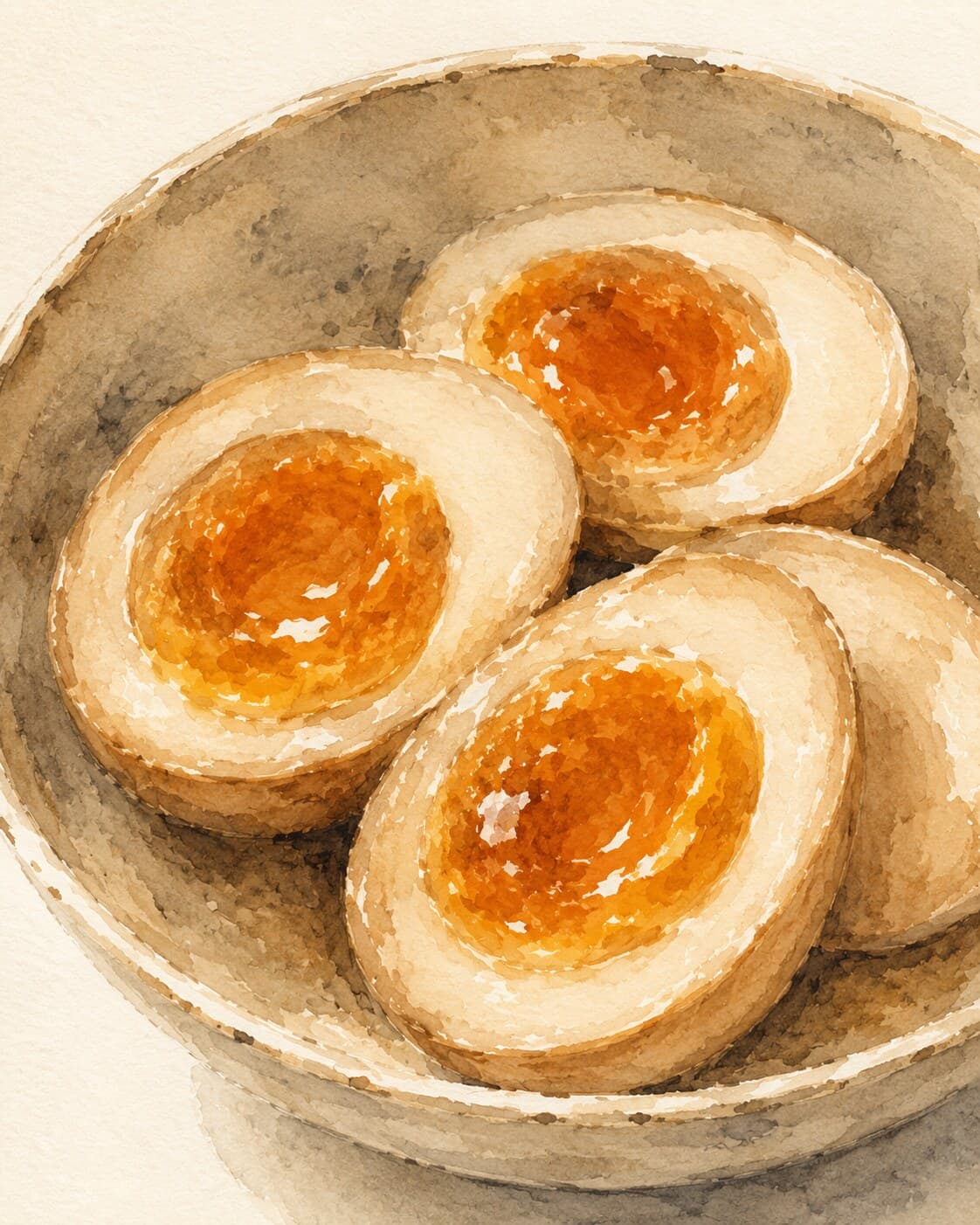
- Jammy yolk (6.5–7 minutes): cut one open and the centre is deep orange, thick and glossy like set honey — it holds a rounded shape and slumps slowly rather than running out.
- Firm yolk (9–10 minutes): pale yellow, matte and crumbly all the way through, with no glossy wet centre. This is the timing to use for anyone at higher risk.
- Marinated enough: the white has turned a light amber, with the colour visible as a band roughly a couple of millimetres deep when you slice one in half. A very dark, leathery-looking surface means it has been in too long.
Get the essays in your inbox — free
Weekly notes on flavor, fermentation, and food history — the writing behind the Atlas of Flavor. No spam; unsubscribe anytime.