
Pho Ga (Vietnamese Chicken Pho)
Experience the delicate flavors of Pho Ga, a Vietnamese chicken noodle soup with a clear broth and aromatic spices.
Contents (5 sections)▾
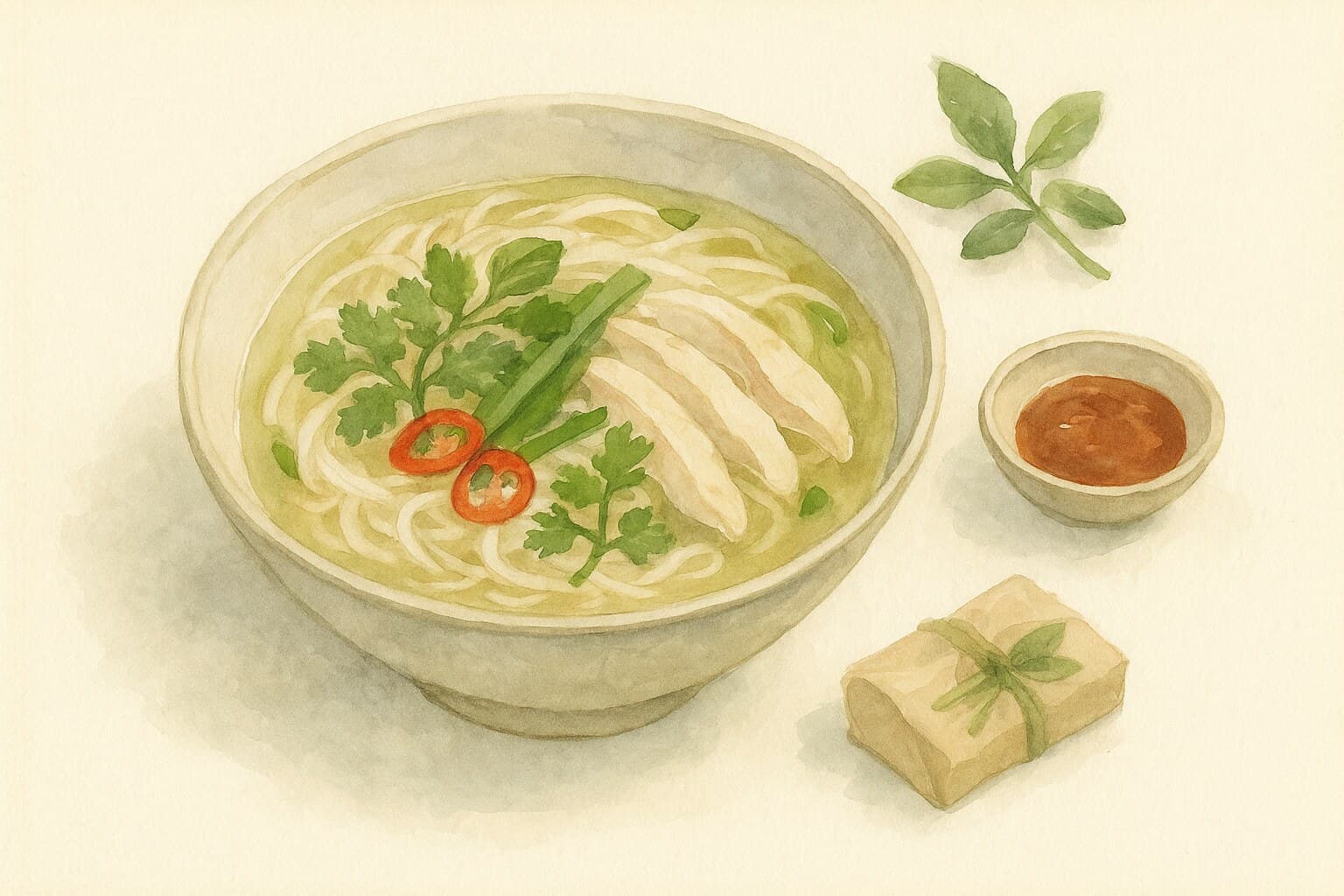
Ingredients
- 1 whole chicken (about 1.5 kg)
- 500 g chicken bones
- 2 medium onions, halved
- 1 large piece of ginger (about 100 g), sliced
- 2 star anise
- 1 cinnamon stick
- 5 cloves
- 1 tbsp fish sauce
- 200 g rice noodles
- Fresh herbs (basil, cilantro) for garnish
- Lime wedges for serving
- Salt to taste
Steps
Char the halved onions and sliced ginger in a dry skillet over medium heat for about 5-7 minutes, until they are browned. This adds depth and sweetness to the broth.
In a large pot, add the whole chicken, chicken bones, charred onions, ginger, star anise, cinnamon stick, and cloves. Cover with cold water and bring to a gentle simmer over low heat.
Allow the broth to simmer gently for 30-40 minutes, maintaining a barely-there tremble. This ensures a clear broth by preventing impurities from clouding it.
Once the chicken is cooked through, carefully remove it from the pot. Let it cool, then shred the meat into bite-sized pieces.
Strain the broth through a fine mesh sieve into a clean pot, discarding solids. Season with fish sauce and salt to taste.
Prepare the rice noodles according to package instructions, soaking them in warm water until tender but not overcooked.
To serve, place a portion of noodles in a bowl, top with shredded chicken, pour hot broth over, and garnish with fresh herbs and lime wedges.
Why this works
The technique of charring the onion and ginger enhances the broth's flavor, introducing a caramelized sweetness that balances the spices. Simmering the chicken and bones at a low temperature allows for a delicate extraction of flavors, leading to a clear broth that is distinct from the richer beef pho. This careful temperature control prevents the broth from becoming cloudy. If your broth seems too oily, use a ladle to skim off some of the fat from the surface. This method ensures a clean taste, allowing the aromatics to shine through. The separately soaked rice noodles prevent overcooking, keeping them perfectly al dente when serving. This approach highlights the umami of the chicken and spices without overwhelming the palate, creating a harmonious bowl of soup.
Common mistakes
Pulling the chicken too early — pink at the bone. Target: the thickest part of the meat (breast and thigh) must reach 74°C / 165°F internal temperature. Cut to the bone to check: juices should run clear, the meat should be opaque all the way through, and no pink should remain along the bone. Why it matters: chicken is a BLOCK-level safety category — undercooked poultry can carry Salmonella or Campylobacter, both of which cause serious foodborne illness. Time-on-the-stove is not a substitute for verifying doneness. What to do: if the broth temperature stays low and the bird is large, allow 35–45 minutes of gentle simmer, then check with a thermometer at the thigh joint. If you don't have a thermometer, slice deeply along the bone — clear juices and uniformly white meat are non-negotiable. If you find any pink, return it to the simmer for another 5–10 minutes and recheck.
Rolling boil instead of barely-there tremble. Target: a gentle simmer, around 85–95°C — small bubbles around the edge of the pot, not a churning surface. Why it matters: a hard boil emulsifies fat and protein particles into the liquid (the same way violent shaking makes vinaigrette cloudy), producing the murky, greasy broth that defines a failed pho ga. Gentle heat lets impurities rise as scum that you can skim. What to do: as soon as the pot reaches a boil, drop the heat. If it's still boiling too hard on the lowest setting, prop the lid slightly ajar or move the pot half off the burner.
Skipping the char on onion and ginger. Target: halved onions and sliced ginger held over an open flame or in a dry skillet until blackened spots cover at least one cut face — about 5–7 minutes; you should smell sweet smoke, not raw allium pungency. Why it matters: the char is the dish's aroma backbone. Heat breaks down sulfur compounds in the onion and converts surface sugars into the Maillard byproducts (browned-aroma chemistry) that give the broth its rounded, sweet-savory base. Skip this and the broth tastes thin no matter how long you simmer. What to do: rinse the blackened skins under cold water before adding to the pot so the surface soot doesn't muddy the broth, but keep the char layer itself intact.
Cooking the rice noodles in the broth pot. Target: cook noodles in a separate pan of plain water (or briefly soak per package directions), drain, then place in the serving bowl. Pour hot broth over at the last second. Why it matters: rice noodles release starch as they cook; cooking them in the broth turns it cloudy, and they go soggy if they sit hot in liquid for more than a minute. What to do: keep noodles slightly underdone — they will continue cooking from the heat of the broth in the bowl.
What to look for
- Crystal-clear, slightly golden broth. Hold a spoonful up to the light — you should be able to see the spoon's bottom through it. Cloudiness almost always traces back to too-hot a boil or unrinsed bones.
- Tiny bubbles around the rim only. A pho ga simmer is so gentle it can look almost still. If the surface is rolling, the heat is too high.
- Aroma that lifts in three layers. Charred-sweet onion first, then warm spice (star anise, cinnamon, clove), then the clean chicken note. If the spice dominates, ease back on time or quantity next time.
- A clean break in the chicken meat. Cooked chicken shreds cleanly along the grain into long, pale, opaque strands — no pink, no rubbery resistance, no chewy outer edges.
A note on history
Phở (a Vietnamese rice-noodle soup) originated in northern Vietnam in the early 20th century, evolving from earlier soup traditions in and around Hanoi; both French and Chinese culinary influences contributed to its development (Wikipedia, Vietnam Tourism). Phở gà — the chicken version — is generally said to have appeared around 1939, particularly during periods when beef was scarce or rationed in mid-20th-century Vietnam, so cooks adapted the beef pho to a more available bird (KimEcopak). Hanoi remains the cultural home of phở, and Hanoi-style phở gà is built on a clear, lightly spiced broth — with star anise (the woody, licorice-toned star-shaped spice pod) and a cinnamon stick (a rolled curl of dried tree bark) as the dominant aromatics — rather than the deeper, sweeter southern style.
Get the essays in your inbox — free
Weekly notes on flavor, fermentation, and food history — the writing behind the Atlas of Flavor. No spam; unsubscribe anytime.