
Pelmeni (Siberian Dumplings)
Discover the art of making authentic Siberian Pelmeni, perfect for a hearty winter meal.
Contents (5 sections)▾
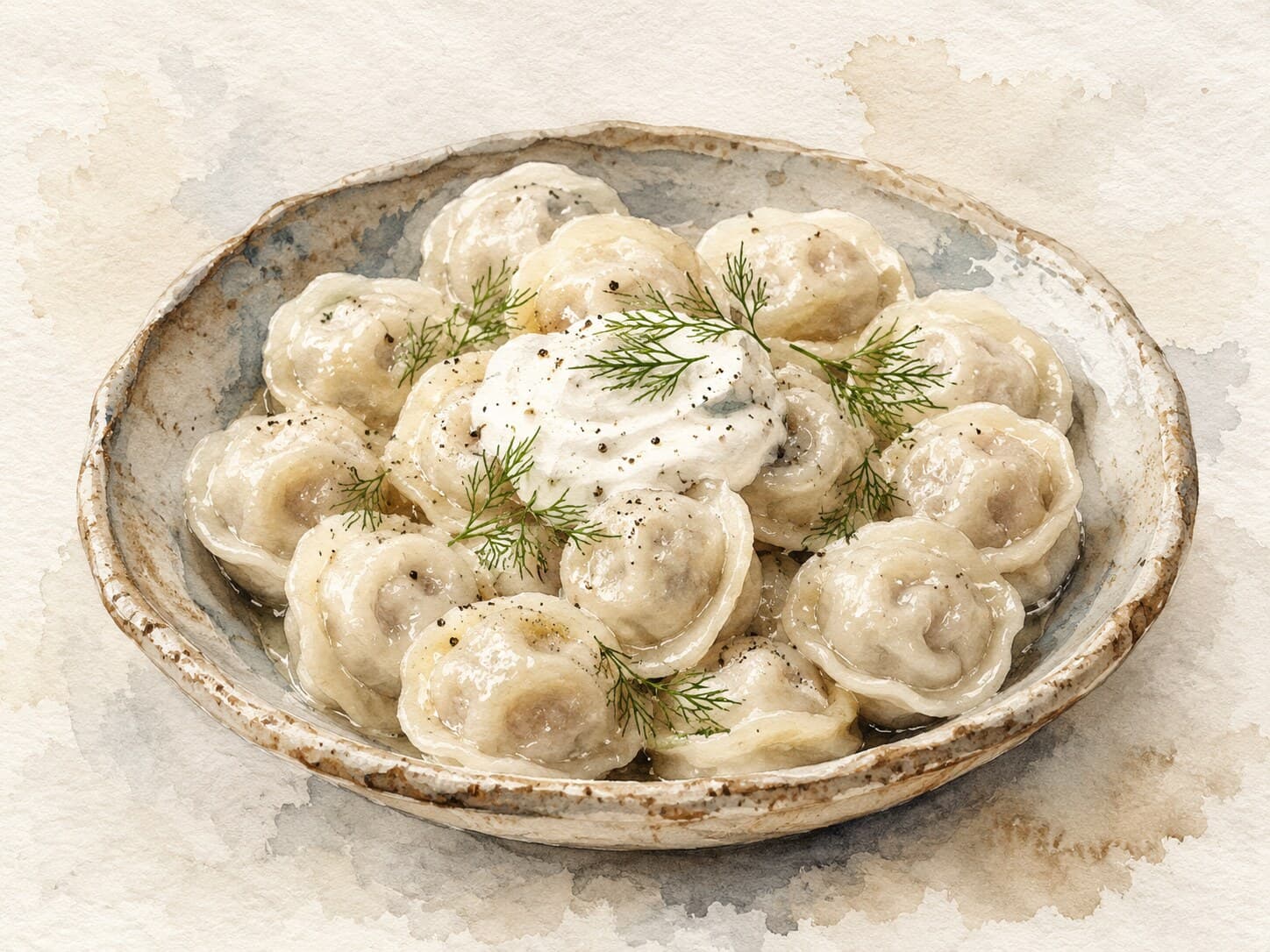
Ingredients
- 500 g all-purpose flour
- 200 ml water
- 1 large egg
- 1 tsp salt
- 300 g ground beef or pork
- 1 small onion, finely chopped
- 2 clove(s) garlic, minced
- black pepper, to taste
- fresh dill, to taste (optional)
Steps
In a bowl, mix the flour and salt. Gradually add water and egg, kneading until a smooth dough forms, about 10 minutes. Cover and let rest for 30 minutes.
In another bowl, combine ground meat, chopped onion, minced garlic, black pepper, and dill. Mix well to create a juicy filling.
Roll out the rested dough on a floured surface to about 2 mm thickness. Cut into 7 cm circles using a glass or cutter.
Place a teaspoon of filling in the center of each circle. Fold the dough over the filling, pressing the edges to seal tightly. Ensure no air pockets remain.
Arrange the pelmeni on a floured tray and freeze for at least 1 hour until solid. Store in bags for long-term freezing.
To cook, bring salted water to a boil. Add frozen pelmeni and boil until they float, about 5-7 minutes. Serve with sour cream or butter. Cook the ground meat until it reaches 71 °C / 160 °F on an instant-read thermometer (no longer pink throughout) — colour, float and time are guides, not the safety test.
Why this works
The technique behind pelmeni is both practical and ingenious, particularly for the harsh Siberian climate. By sealing juicy raw-meat filling in thin dough and freezing them outdoors, you create a durable, long-lasting food source that can be cooked fresh all winter. The key is to ensure the dough is thin enough to cook quickly while retaining moisture but not so thin that it breaks during boiling. If the dough breaks, it could leak the filling, leading to a loss of flavor and texture. To prevent this, ensure to seal the edges thoroughly and avoid overfilling. The freezing process also helps firm up the pelmeni, making them easier to cook without falling apart. This method not only preserves the dumplings but enhances the flavor, as they can be enjoyed straight from the freezer, providing a warm, hearty meal ready in minutes.
Common mistakes
Pulling pelmeni out as soon as they float — meat still pink inside. Target: boil until the filling reaches at least 71 °C / 160 °F (the USDA — the US Department of Agriculture, the federal food-safety regulator — threshold for ground meat) on an instant-read thermometer — typically 1–2 minutes of additional simmering after the dumplings have risen to the surface. That reading is the safety test; a cut showing the filling uniformly cooked with no pink centre is a supporting sign only. Why it matters: pelmeni are stuffed with RAW minced meat (typically pork and beef, or beef alone). Floating only tells you the dough is buoyant — it does not mean the meat at the center has reached a safe temperature. Undercooked ground meat carries real risk of foodborne illness. What to do: treat "floats" as the cue to start the doneness timer, not the doneness signal itself. From frozen, allow 5–7 minutes of gentle boil total, then probe the filling of the first dumpling with an instant-read thermometer — it must read 71 °C / 160 °F before plating the rest. A cut test showing no pink is a supporting check, not a substitute for the reading.
Dough rolled too thick, so the meat under-cooks. Target: about 2 mm thick — when you lift a circle of dough off the board, you should be able to see the outline of your hand through it. Why it matters: thick dough insulates the filling. By the time the outside is tender, the inside meat may still be unsafe. Thin dough lets heat reach the core quickly. What to do: roll in small batches, keep unused dough covered so it doesn't dry, and re-roll scraps once (more than that makes the dough tough from overworked gluten — the wheat-protein network that gives chew).
Edges not sealed; filling leaks into the water. Target: dry, flour-free edges; press firmly with thumb and forefinger to expel any air pocket; reinforce with a fork crimp. Why it matters: flour on the rim acts as a release agent and the seal pops open during boiling. A blown seal not only loses the filling — it floods the pot with raw-meat juices that splash onto already-boiled dumplings. What to do: brush off flour from the edge before sealing; pinch from the filling outward to push air out; if the dough feels dry, dab the rim lightly with a wet finger before pinching.
Boiling too aggressively — wrappers tear and burst. Target: a gentle, steady simmer — small bubbles breaking the surface, not a rolling boil (a violent, full bubbling boil where the surface churns continuously). Why it matters: violent boiling slams the dumplings against each other and the pot wall; thin wrappers split, the filling escapes, and the cooking water turns cloudy. What to do: bring water to a full boil first, slide in the pelmeni, give one gentle stir to keep them off the bottom, then reduce to a calm simmer for the cook time.
What to look for
- Translucent edges, opaque belly. Cooked dough turns slightly glossy and shows the filling shadow through the rim. A chalky, white surface means it still needs time.
- A pelmen' that floats and stays up. Sinks back down briefly? Keep simmering. Floating steadily on the surface is the start of doneness, not the end.
- A cut test that shows no pink at the center. Sacrifice one — split it open on a plate. The filling should be evenly grey-brown, hot to the touch, with the juice running clear.
- Water that stays mostly clear. Cloudy, foamy water with grey scum often means the seals failed or the boil is too rough. Skim, adjust the heat, and proceed.
A note on history
Pelmeni trace to the Ural region — Udmurtia, the Komi Republic, and the Perm area — where the name itself comes from the Permian languages: pel (ear) plus nyan (bread), describing the dumpling's curled ear-like shape (Wikipedia, Russiapedia). They were originally a hunter's and traveler's preservation food: mass-produced in winter, frozen outdoors, then boiled fresh as needed. Pelmeni first appear in Russian cookbooks in the 1820s–1830s and only became known throughout Russia by the mid-19th century, spreading from their Ural-Siberian heartland (Moscow Times).
Get the essays in your inbox — free
Weekly notes on flavor, fermentation, and food history — the writing behind the Atlas of Flavor. No spam; unsubscribe anytime.