
Kottu Roti
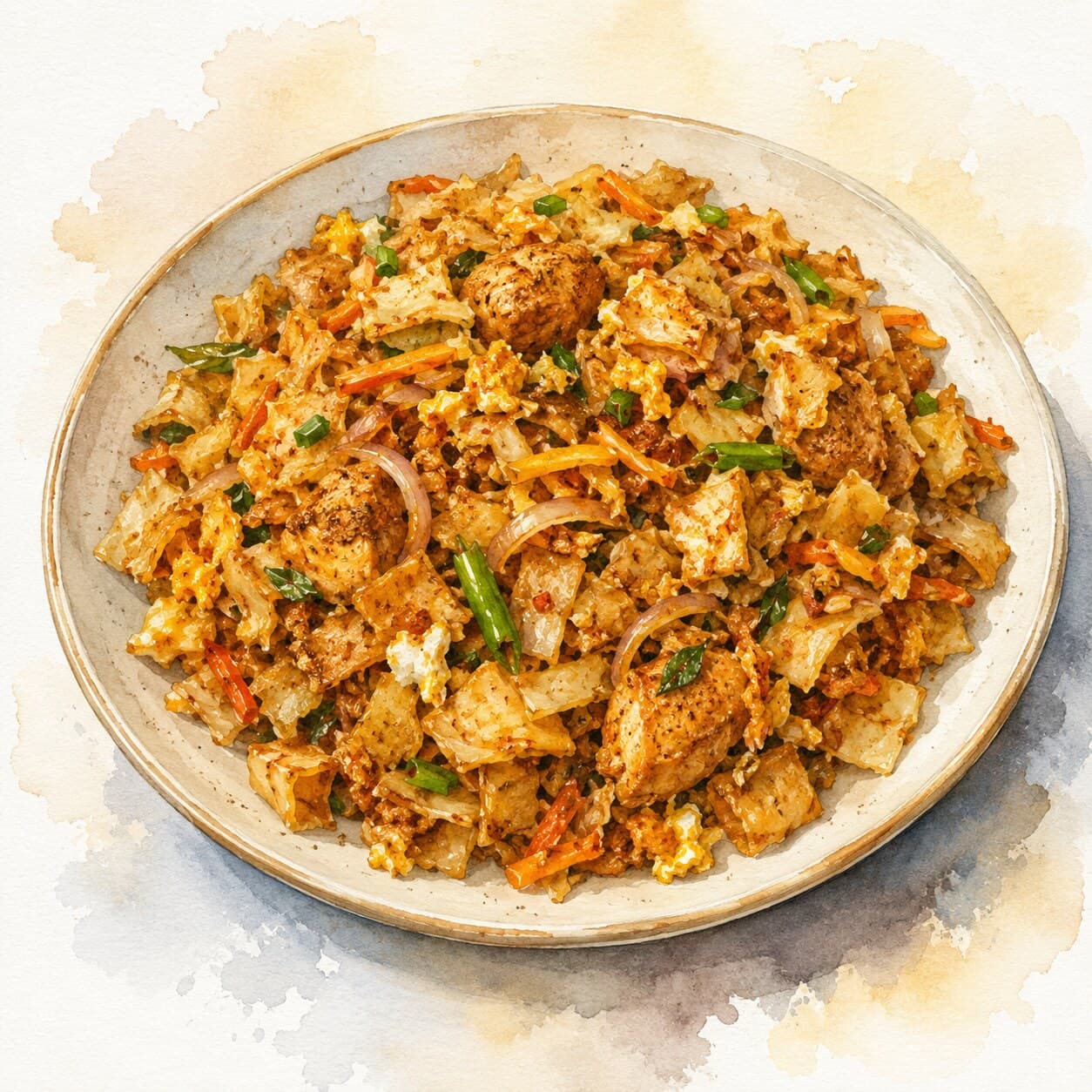
Kottu Roti is a vibrant Sri Lankan street food featuring chopped flatbread stir-fried with chicken or vegetables, egg, and spices.
Contents (5 sections)▾
Ingredients
- 200 g godhamba roti (or shredded flatbread)
- 150 g chicken breast, diced
- 2 large eggs
- 2 tbsp soy sauce
- 1-2 fresh green chili, chopped
- 10 curry leaves
- 2 tbsp cooking oil
- Salt to taste
Steps
Heat a large griddle or wok over medium-high heat and add cooking oil, allowing it to shimmer before adding diced chicken. Cook for about 5-7 minutes until the chicken is cooked through and lightly browned. Cook until the thickest part reaches 74 °C / 165 °F on an instant-read thermometer — colour, juices and time are guides, not the safety test.
Push the chicken to one side and crack the eggs onto the griddle. Scramble them gently for about 2-3 minutes until just set, then mix the eggs with the chicken.
Add the shredded flatbread to the griddle, along with soy sauce, chopped chili, and curry leaves. Stir-fry for about 5 minutes, using rhythmic chopping motions with a cleaver or spatula to combine everything thoroughly.
Season with salt to taste, and stir-fry for an additional 2-3 minutes until the flatbread is slightly crispy and well coated with the mixture.
Why this works
Kottu Roti's charm lies in its unique preparation method, which combines the rhythmic chopping of flatbread with a medley of flavors. The godhamba roti, or flatbread, absorbs the essence of the spices and egg while providing a chewy texture that contrasts beautifully with the tender chicken or vegetables. Cooking the chicken first ensures it's juicy and flavorful, while scrambling the eggs separately helps maintain their texture before mixing them in. If the mixture seems too dry, you can add a splash more soy sauce or a bit of water during stir-frying to create a more cohesive dish. This technique melds the flavors and ensures that each bite is a delightful combination of ingredients, showcasing the vibrant essence of Sri Lankan street food culture.
Common mistakes
Pulling the eggs while they're still glossy or runny in spots.
Target: Scramble the eggs until fully set — opaque throughout with no wet, jelly-like streaks — before mixing them with the chicken.
Why it matters: Eggs cooked directly on a hot griddle can look done at a glance while still holding pockets of raw egg underneath; folding those pockets into the roti mixture leaves streaks of undercooked egg scattered through the finished dish instead of fully cooked curds.
What to do: Break the eggs apart with your spatula as they cook and keep tossing until every part looks matte and set, not shiny, before combining with the chicken.
Cutting the chicken into uneven pieces, so some stay underdone while others overcook.
Target: Dice the chicken breast into small, even pieces and cook until every piece is opaque throughout, with clear juices and no pink at the center — 74°C (165°F) is the safe mark for poultry.
Why it matters: Chicken cut in uneven sizes cooks at different rates; a thin piece can look done while a thicker chunk right next to it is still raw at the core, so an even dice is what makes "cooked for 5-7 minutes" actually mean cooked through for every piece.
What to do: Cut the chicken into uniform, bite-sized pieces before it goes on the griddle, and cut into the largest piece to check for clear juices and no pink before moving on.
Stirring half-heartedly instead of committing to the rhythmic chopping motion.
Target: Use a steady, rhythmic chopping motion with the cleaver (a large, flat-bladed knife or turner used to mince and toss ingredients on the griddle) or a spatula, cutting the flatbread strips smaller as they mix with everything else.
Why it matters: Kottu roti's texture depends on the flatbread being cut into smaller, ragged pieces as it stir-fries, so the shreds pick up the soy sauce and curry leaf flavor evenly on all sides; stirring without chopping leaves long, unevenly seasoned strips that taste bland in the middle.
What to do: Keep both hands moving — one tool chopping down through the pile, the other tossing — so the roti gets cut smaller as it cooks instead of staying in long shreds.
Using fresh, soft flatbread straight off the griddle instead of something slightly firm.
Target: Use flatbread that's cooled and a little firm; if yours is fresh and warm, let it cool a few minutes before shredding it.
Why it matters: Warm, soft roti tears into mush when chopped and stir-fried, turning gluey instead of holding distinct, chewy shreds; slightly firm bread holds its shape under the cleaver and stays pleasantly chewy.
What to do: If the flatbread is fresh and warm, let it cool for a few minutes (or briefly refrigerate it) before cutting it into strips for the griddle.
What to look for
- Chicken that's opaque all the way through, with clear juices and no pink when the largest piece is cut. That's your safety checkpoint before serving.
- Eggs that are fully set, with matte curds and no shiny or wet streaks, mixed evenly through rather than sitting in one clump.
- Flatbread cut down into small, ragged, roughly even pieces rather than long strips. Long shreds mean the chopping motion needs to be more thorough.
- A finished dish that's lightly crisp at the edges and glossy from the soy sauce and oil, with everything roughly the same small size.
A note on history
Kottu roti is generally traced to Sri Lanka's eastern coast, around Batticaloa and Trincomalee, sometime in the 1960s and 1970s, where it began as a way to use up day-old godhamba roti — the thin, layered flatbread — that bakers and food stalls couldn't sell fresh. Cutting the leftover bread into strips and stir-frying it with whatever vegetables, egg, or meat was on hand turned a stale ingredient into a cheap, filling meal for lower-income workers (Wikipedia: Kottu).
The dish takes its name from the Tamil word koththu, meaning "to chop," describing how vendors mince the roti and other ingredients together on a flat griddle using two cleavers or metal spatulas — a technique that produces the sharp, rhythmic clanging sound street stalls are known for. What started as frugal, working-class food is now a well-known part of Sri Lankan street food, especially as a late-night meal (Wikipedia: Kottu).
Get the essays in your inbox — free
Weekly notes on flavor, fermentation, and food history — the writing behind the Atlas of Flavor. No spam; unsubscribe anytime.