
Fesenjan (Pomegranate Walnut Stew)
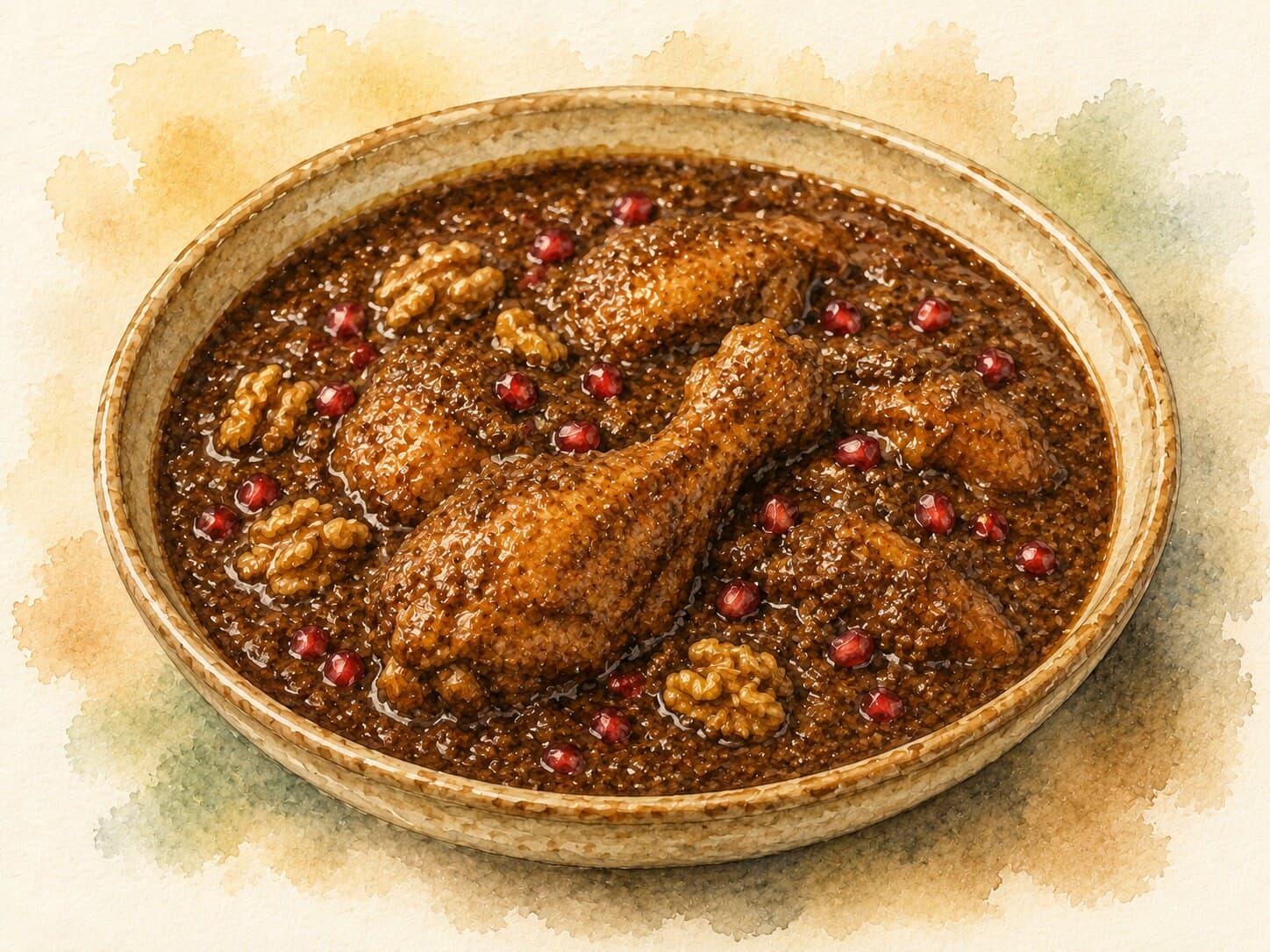
Experience the rich flavors of Persian cuisine with this Fesenjan, a pomegranate walnut stew featuring tender chicken or duck.
Contents (5 sections)▾
Ingredients
- 800 g chicken or duck, cut into pieces
- 200 g walnuts, ground
- 200 ml pomegranate molasses
- 1 large onion, finely chopped
- 2 tbsp vegetable oil
- 2 cups water
- 1 tsp salt, or to taste
- 1/2 tsp black pepper, or to taste
- 1/2 tsp turmeric powder
- 1/2 tsp cinnamon, or to taste
- pomegranate seeds, for garnish
Steps
In a large pot, heat 2 tbsp vegetable oil over medium heat. Add the finely chopped onion and sauté until translucent, about 5 minutes.
Add the chicken or duck pieces to the pot and brown them on all sides for about 10 minutes.
Stir in the ground walnuts, pomegranate molasses, salt, black pepper, turmeric, and cinnamon into the pot.
Pour in 2 cups of water and bring the mixture to a simmer over medium heat.
Reduce the heat to low and cover the pot. Let it simmer gently for 1 hour, stirring occasionally, until the sauce thickens and darkens.
Check the seasoning and adjust with more salt or pomegranate molasses if desired. Serve hot, garnished with pomegranate seeds.
Tools you'll want
Why this works
The key to a successful Fesenjan lies in the careful simmering of ground walnuts and pomegranate molasses (pomegranate juice boiled down to a thick, tangy syrup). When cooked low and slow, the walnuts release their oils, resulting in a richly textured, glossy sauce that balances sweet and sour flavors beautifully. This technique allows the ingredients to meld, enhancing the overall depth of the dish. If the sauce seems too thick during cooking, you can add a little more water to achieve your desired consistency. Conversely, if it feels too thin, continue simmering uncovered for a few more minutes to allow it to reduce. The interplay of the tartness from the pomegranate and the richness of the walnuts creates a distinctive flavor that is the hallmark of Persian cuisine, making this dish a true jewel of a feast.
Common mistakes
Rushing the simmer so the walnuts never release their oil.
Target: A full hour at a bare, lazy simmer (a few bubbles breaking the surface, not a rolling boil), stirring every 10–15 minutes.
Why it matters: Ground walnuts are mostly fat held inside cell walls. Only gentle, sustained heat coaxes that oil out so it can emulsify (disperse the fat into the watery sauce as countless tiny droplets, the way oil and vinegar combine into a creamy dressing when whisked) — this is what turns the sauce from gritty and grey to glossy and deep brown. Boil hard and the walnuts stay chalky while the oil splits out on top.
What to do: Once it reaches a simmer, drop the heat to low, cover, and leave it alone except for periodic stirring. The color shift from beige to mahogany is your clock, not the timer.
Scorching the walnut sauce on the bottom of the pot.
Target: No browning or sticking on the base; the sauce moves freely when you draw a spoon across the bottom.
Why it matters: A walnut purée is thick and fat-rich, so it catches and burns far more easily than a thin stew. A scorched layer turns the whole pot acrid and bitter — bitterness no amount of pomegranate molasses can fix.
What to do: Use a heavy-bottomed pot, keep the heat genuinely low, and stir down to the base each time. If it ever smells toasty, lift it off the heat and pour into a clean pot without scraping the bottom.
Letting the sauce go flat by ignoring the sweet–sour balance.
Target: A finished sauce that tastes both tart and gently sweet at once — neither sharp enough to pucker nor cloying.
Why it matters: Pomegranate molasses (pomegranate juice boiled down to a thick, tangy syrup) varies enormously between brands — some are searingly sour, others almost sweet. The dish lives or dies on this acid–sweet axis, and the only way to land it is to taste and correct near the end.
What to do: Taste in the final 10 minutes. Too sharp, stir in a teaspoon of sugar or honey; too flat or sweet, add more pomegranate molasses a spoonful at a time until it brightens.
Undercooking the chicken or duck.
Target: Poultry cooked fully through — no pink at the bone, juices running clear, 74°C / 165°F at the thickest part.
Why it matters: Chicken and duck must be cooked through for safety; the long braise is built for exactly this, leaving the meat tender rather than dry.
What to do: Keep the pieces submerged in the sauce for the full hour. If they aren't fork-tender and cooked to temperature, simmer longer — this stew only improves with time.
What to look for
- The simmer: slow, lazy bubbles, not a hard boil — a fat-rich walnut sauce needs gentle heat to release oil without scorching or splitting.
- The color: a steady shift from pale beige to deep mahogany-brown — this darkening is the walnut oil emulsifying and the molasses concentrating; it's the truest sign the sauce is ready.
- The surface: glossy, with at most a thin sheen of oil — not a separated oil slick — a little walnut oil rising is normal and can be stirred back; a broken, greasy layer means the heat was too high.
- The taste: tart and sweet in the same spoonful, savory underneath — balance, not dominance by either pole, tells you the seasoning has landed.
A note on history
Fesenjān is one of the oldest dishes in the Persian repertoire — a khoresh (a slow-simmered Iranian stew served over rice) associated with the lush northern province of Gīlān, where walnut and pomegranate trees grow abundantly (Wikipedia). It was historically made with duck, and appeared at royal banquets in the Safavid era, though home cooks had prepared similar walnut-and-pomegranate stews long before (The Mediterranean Dish). Because the pomegranate is a symbol of the winter-solstice festival of Yalda, fesenjān is a traditional dish for that longest night of the year (Unicorns in the Kitchen).
Get the essays in your inbox — free
Weekly notes on flavor, fermentation, and food history — the writing behind the Atlas of Flavor. No spam; unsubscribe anytime.