
Warabimochi (Bracken Starch Jelly)
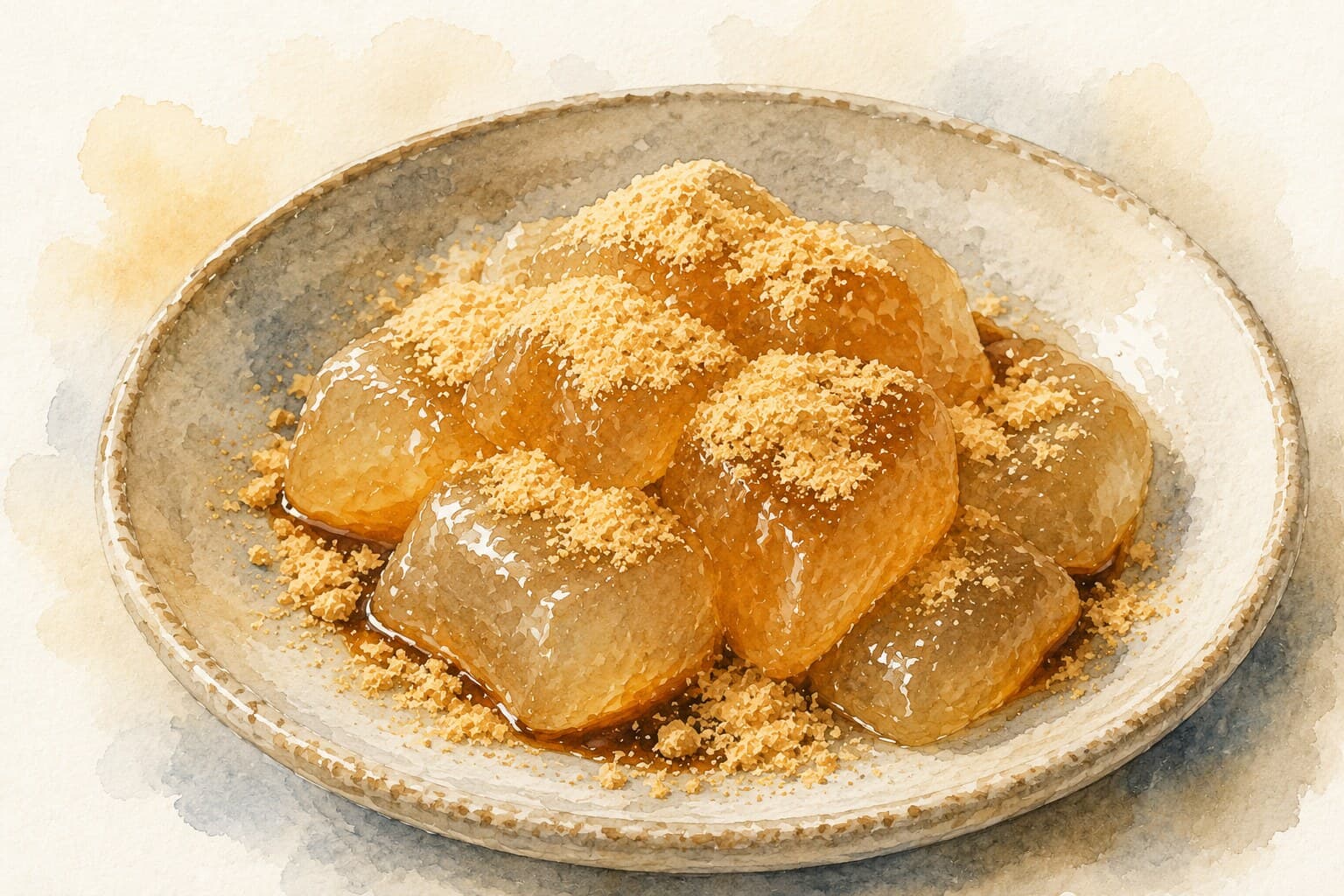
Warabimochi is a delightful Japanese sweet, featuring a smooth, elastic jelly made from bracken starch.
Contents (5 sections)▾
Ingredients
- 100 g bracken starch (or tapioca starch)
- 400 ml water
- 80 g sugar
- roasted soy flour (for dusting, to taste)
Steps
In a saucepan, combine bracken starch, water, and sugar. Whisk over medium heat for about 10 minutes until the mixture thickens and becomes clear.
Once the mixture is clear and elastic, pour it into a mold or a shallow dish. Allow it to cool at room temperature for at least 15 minutes.
Once cooled, refrigerate for 1-2 hours until firm. Cut the jelly into bite-sized pieces.
Dust the pieces generously with roasted soy flour before serving to enhance flavor and texture.
Why this works
The beauty of Warabimochi lies in its unique texture, achieved through careful heating of the bracken starch mixture. As the starch is whisked with water and sugar, the heat causes the starch granules to swell and release amylose, transforming the cloudy mixture into a clear, elastic jelly. This reaction is crucial for achieving the desired springy consistency. If your mixture seems too thick before reaching clarity, simply add a splash of water and continue heating while whisking vigorously. On the other hand, if the mixture breaks and separates instead of becoming smooth, it may have been overheated; reduce the heat and whisk gently until combined again. The final dusting of roasted soy flour adds a nutty flavor and prevents the pieces from sticking together, making it easier to enjoy this refreshing treat.
Common mistakes
- Pulling the mixture off the heat before it's fully translucent. A still-milky center means the starch hasn't gelatinized through, and the jelly will be slack and grainy.
- Target: the entire mass turning glassy-clear, with no white streaks, and pulling away from the sides of the pan as you whisk.
- Why it matters: the springy, slightly rubbery bite that defines warabimochi (Japanese bracken-starch jelly) only forms when starch gelatinization (the heat-driven thickening that turns the cloudy slurry clear) is complete.
- What to do: keep whisking past the first signs of thickening; wait until the entire mass is uniformly translucent before pouring into the mold.
- Whisking too gently and letting the bottom scorch. Bracken starch on the pan bottom can stick and brown, leaving bitter flecks in the jelly.
- Target: constant motion of the whisk reaching the corners of the pan; no visible browning at the bottom.
- Why it matters: scorch is impossible to whisk back in — it stays as dark specks and bitter notes in the finished sweet.
- What to do: use a flat-bottomed pan, medium heat, and a whisk or wooden spoon that reaches the corners; if you smell toasting, drop the heat immediately.
- Refrigerating the jelly too long. Over-chilled starch jellies turn firm and rubbery — far from the soft wobble that is the whole point.
- Target: chilled just enough to be firm to cut, ideally 1-2 hours; serve within a few hours of setting.
- Why it matters: starch retrogradation accelerates in the fridge, and the soft texture is lost.
- What to do: chill to firm-up, then keep at cool room temperature if you're not eating right away; do not freeze.
- Dusting too late or too sparingly. A bare piece of warabimochi sticks to itself and to the plate.
- Target: every cut surface coated in kinako before the pieces touch each other.
- Why it matters: kinako (roasted-soybean flour, a Japanese pantry staple) is also a flavor element — it brings nutty roasted-bean depth that pairs with the cool jelly.
- What to do: dust the mold surface with kinako before cutting, then turn each cut piece to coat all sides.
What to look for
- A clean translucent body with no cloudy patches — light should pass through.
- A soft, springy wobble when the dish is tilted; the surface returns to flat without cracks.
- A clean knife exit when cutting — the jelly should not stick to or drag on the blade.
- A generous, even kinako coat that powders lightly when lifted to the mouth.
A note on history
Warabimochi traces back to the Heian period (794-1185), when it was made from warabi-ko (bracken-fern starch) and was favored by the aristocracy and Buddhist monks. Refinement and spread continued through the Muromachi era under the influence of the tea ceremony, and by the Edo period it had become a popular sweet at teahouses and street stalls. Today it remains a cooling summer wagashi (traditional Japanese confection), typically dusted with kinako and sometimes served with kuromitsu (Japanese dark sugar syrup).
Important safety note. Refined warabi-ko sold for cooking has had the carcinogenic compound ptaquiloside removed through processing. Raw or unrefined bracken root should never be eaten — always use commercial refined warabi-ko (or a tapioca-starch substitute) for this recipe.
Get the essays in your inbox — free
Weekly notes on flavor, fermentation, and food history — the writing behind the Atlas of Flavor. No spam; unsubscribe anytime.