
Taiyaki (Fish-Shaped Filled Cake)
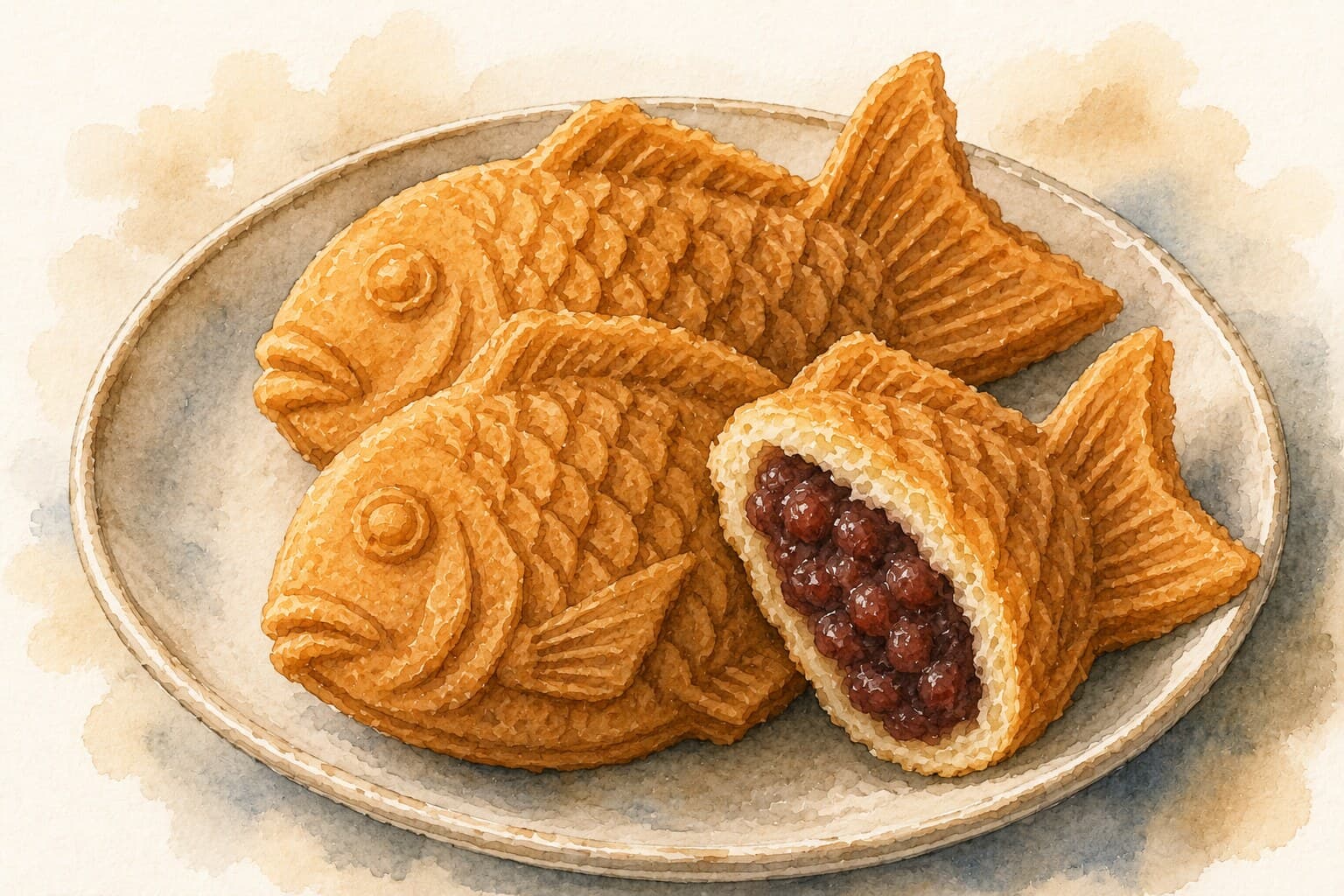
Taiyaki is a delightful fish-shaped cake filled with sweet red bean paste, perfect for dessert lovers.
Contents (5 sections)▾
Ingredients
- 200 g all-purpose flour
- 2 tbsp sugar
- 1 tsp baking powder
- 1/2 tsp salt
- 1 large egg
- 300 ml water
- 1 tbsp vegetable oil
- 200 g red bean paste
Steps
In a bowl, mix flour, sugar, baking powder, and salt. This helps to combine dry ingredients evenly.
In another bowl, whisk together the egg, water, and vegetable oil. Gradually add to the dry mixture, stirring until smooth.
Preheat the taiyaki mold over medium heat for about 5 minutes. Ensure it is hot enough to create a crisp exterior.
Pour a thin layer of batter into one half of the mold, close it, and cook for about 2-3 minutes.
Open the mold and add a spoonful of red bean paste in the center. Pour more batter on top to cover the filling.
Close the mold and cook for another 3-4 minutes until golden brown and crisp. Ensure the inside is fully cooked.
Carefully remove the taiyaki from the mold. If any breaks occur, simply press the edges together gently to seal.
Why this works
The technique of using a fish-shaped mold allows for even cooking and a unique presentation that makes taiyaki visually appealing. The batter must be thin enough to create a crisp shell while being thick enough to hold the filling securely. Preheating the mold is crucial; if it is not hot enough, the batter will stick, resulting in a broken taiyaki. By pouring batter first and then adding the filling, you ensure an even distribution of the red bean paste, balancing the flavors. If the taiyaki seems too thick, try adjusting the batter consistency by adding a little more water. The cooking time allows for the outer layer to crisp up while keeping the inside soft and moist, creating a delightful contrast in texture. This balance is essential to achieve the signature taiyaki experience.
Common mistakes
- Loading a cold or under-oiled mold. A lukewarm mold makes the batter grab, and the tail and fins tear off when you open it.
- Target: mold preheated 4–5 minutes per side over medium heat; oil brushed thinly into every corner of the fish; a drop of batter on the surface should sizzle and set in 2 seconds.
- Why it matters: the Maillard browning (the heat reaction between proteins and sugars that creates golden crusts and toasty flavor) that gives taiyaki its crisp shell and toasty aroma only happens against a properly hot, lightly oiled surface. A cool mold also lets the batter pool unevenly, so the fish comes out pale and flabby.
- What to do: Preheat both halves, brush oil with a folded paper towel into the fins, tail and head, and reheat briefly between batches.
- Over-filling with anko (sweetened azuki-bean paste, the standard taiyaki filling), or putting it in too close to the edges. Filling leaks out, burns on the seam, and pulls the fish apart.
- Target: about 1 tablespoon of anko shaped into a flat oval, placed in the body cavity only — never into the tail or head, and 5 mm clear of the rim.
- Why it matters: the seam between the two halves needs a thin batter weld to seal; anko at the seam scorches and breaks the closure. The tail is supposed to be all crisp shell — that's the part connoisseurs eat first.
- What to do: Shape the anko in advance into small flat ovals on a sheet of parchment. Pipe or spoon the first batter layer thin, drop the anko centered on the belly, then ladle the top layer so it spreads to the edges before closing.
- Closing the mold and walking away. Each side wants its own active phase.
- Target: flip the closed mold every 60–90 seconds for 3–4 minutes total, until both faces are evenly golden brown.
- Why it matters: the side touching the heat browns fast and the upper side stalls. Flipping keeps both faces in the same color, and the rotation also helps the batter creep into the fin detail.
- What to do: Set a timer. Listen — a properly cooking taiyaki goes quiet when steam stops escaping at the seam; that's when you flip, not when you peek.
- Eating the next day without re-crisping. Taiyaki goes leathery once it cools and the steam softens the shell.
- Target: eat hot, ideally within 30 minutes; if reheating, 3–4 minutes in a toaster oven at 180°C / 350°F, not the microwave.
- Why it matters: the textural contrast — crisp shell, tender crumb, warm anko — is the whole point. Microwaves drive water into the shell and turn it tough; dry heat drives water back out.
- What to do: Wrap leftover taiyaki in foil, freeze, and reheat from frozen in the toaster oven; that's better than fridge-stored.
What to look for
- A clean, almost amber-edged outline of the fish when you open the mold — the fin tips and tail should be slightly darker than the body.
- A hollow, dry-sounding tap when you flick the shell — that's a properly set crust, not raw batter beneath.
- Anko visible only as a thin dark stripe when you split a taiyaki in half — not bulging out, not absent, just centered in the belly.
- Steam, not liquid, escaping when you bite in — wet steam means the anko was over-loose or too cold going in.
A note on history
Taiyaki was invented in Tokyo in the Meiji period, generally credited to Kanbe Seijiro, who opened Naniwaya Sohonten in the Azabu/Kanda area of Tokyo around 1909. The shop was making imagawa-yaki — a round filled cake (the disc-shaped Edo-era pancake that pre-dates taiyaki) — when Kanbe experimented with different mold shapes. The sea bream (tai) form caught on because tai was an expensive celebration fish that ordinary people could rarely afford; the bean-paste cake let everyone have a "tai" for the price of a snack. Naniwaya is still in business today, and the lineage of single-mold "tennen" (literally "natural", referring to shops that bake one taiyaki at a time in a hand-held iron mold rather than on a multi-cavity griddle) taiyaki shops traces back to that early-twentieth-century origin.
Get the essays in your inbox — free
Weekly notes on flavor, fermentation, and food history — the writing behind the Atlas of Flavor. No spam; unsubscribe anytime.