
Veloute De Volaille
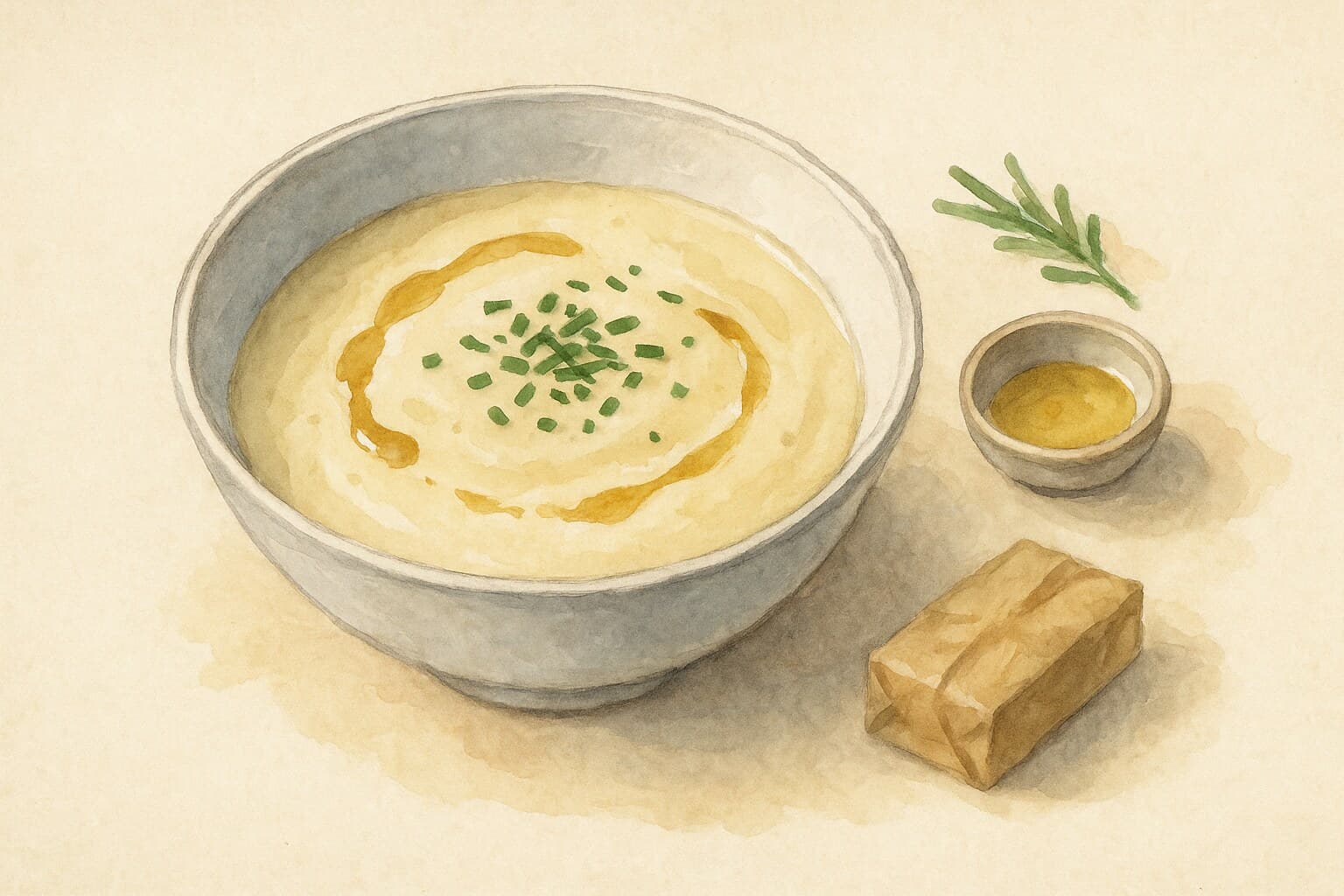
Veloute De Volaille is a creamy and elegant chicken velouté sauce, perfect as a base for various dishes.
Contents (5 sections)▾
Ingredients
- 150 g of chicken breast, diced
- 50 g of butter
- 50 g of all-purpose flour
- 1 liter of chicken stock
- 1 onion, finely chopped
- 1 carrot, finely chopped
- 1 celery stalk, finely chopped
- Salt to taste
- White pepper to taste
- Fresh parsley, for garnish
Steps
1. In a large saucepan, melt the butter over medium heat. Add the mirepoix (onion, carrot, and celery) and sauté for exactly 5 minutes until softened. This creates a flavor base.
2. Add the diced chicken breast to the saucepan. Cook for another 5 minutes until the chicken is lightly browned and reaches an internal temperature of 75°C. This step ensures the chicken infuses its flavor into the sauce.
3. Sprinkle the flour over the chicken and vegetables, stirring constantly for 2 minutes to cook the flour and remove its raw taste.
4. Gradually add the chicken stock while continuously whisking to prevent lumps. Bring the mixture to a gentle simmer (around 90°C) and cook for an additional 10 minutes, allowing it to thicken.
5. Season with salt and white pepper to taste. If the velouté seems too thick, add a bit more chicken stock to achieve the desired consistency.
6. Strain the sauce through a fine sieve for an ultra-smooth finish, if desired. Serve hot, garnished with fresh parsley.
Why this works
Veloute de volaille employs the classic French technique of making a velouté sauce, one of the five mother sauces, which is crucial for many culinary applications. The process starts with a roux, where flour is cooked with butter, creating a thickening agent that gives the sauce its desired consistency. The mirepoix layer builds a complex flavor foundation that complements the chicken. If the sauce seems too thick after cooking, you can add more chicken stock to adjust the consistency, ensuring it remains smooth and pourable. This delicate balance is essential; if it breaks or separates, whisking in a bit of cold stock can help bring it back together. The key lies in patience and attention, as the velouté should simmer gently at approximately 90°C to develop its flavor without burning or over-reducing. Utilizing precise temperatures and times contributes to the sauce's refinement and consistency, making it a reliable base for numerous dishes. The importance of maintaining the right simmer ensures that the flavors meld harmoniously while avoiding any undesirable texture changes.
Common mistakes
-
Undercooking the roux. A white roux still needs proper cooking, or the finished sauce tastes of raw flour.
- Target: Equal weight butter and flour, cooked over medium heat for at least 2-3 minutes, until it smells nutty and the pale yellow paste no longer tastes raw.
- Why it matters: A velouté with undercooked roux carries a chalky, library-paste note no amount of stock will hide.
- What to do: Stir constantly with a wooden spoon and let the roux loosen and bubble. It should still be pale — this is a blond roux, not a brown one — but it must be cooked.
-
Dumping cold stock onto hot roux. A sudden flood of cold liquid seizes the starch and pulls it into lumps.
- Target: Stock warmed in a separate pan, added in three or four additions, whisking smooth between each.
- Why it matters: Velouté's velvety body comes from a controlled gelatinisation of the starch. Lumps mean uneven thickening and a grainy mouthfeel that's hard to recover from.
- What to do: Have stock simmering on the side. Pour a ladle into the roux while whisking constantly. Once smooth, add the next ladle. Continue until incorporated.
-
Boiling the velouté hard. A rolling boil splits the sauce and dulls its colour.
- Target: A bare simmer of around 85-90 °C, with only the gentlest motion at the surface, for at least 20-30 minutes.
- Why it matters: Long, slow simmering is what cooks out the floury edge and concentrates flavour. Hard boiling overworks the starch into gluiness and risks scorching the bottom of the pan.
- What to do: Drop the heat once it thickens, set the pan slightly off-centre on the burner so impurities collect to one side, and skim foam as it rises.
-
Forgetting to strain. A velouté is supposed to be glassy-smooth.
- Target: Final pass through a fine-mesh sieve (chinois if you have one), with the back of a ladle pressing the solids gently.
- Why it matters: Even a perfect simmer leaves tiny mirepoix fibres and bits of coagulated stock that mar the texture. The strain is what separates "soup" from "sauce."
- What to do: Strain into a clean pan, return to the heat, taste, and finish with a knob of cold butter swirled in off the heat for shine.
What to look for
- A roux that smells faintly of toasted almonds and looks like wet sand — cooked through but still pale.
- Stock disappearing smoothly into the roux at each addition, with no white islands of starch left behind.
- A velouté that coats the back of a spoon and holds a clean line when a finger is drawn through it — the nappé point (the consistency where a sauce clings to a spoon in an even, slightly viscous film) classical kitchens look for.
- A finished pour that looks ivory and glossy, not chalky or oil-broken — colour and shine intact.
A note on history
Velouté (a smooth white sauce of light stock thickened with a butter-and-flour roux) is one of the foundational sauces of the French classical kitchen. The framework of "mother sauces" (the small handful of base sauces from which most classic French sauces are derived) was first codified by Marie-Antoine Carême in the early 19th century, who grouped Espagnole, Velouté, Allemande and Béchamel as the grandes sauces from which all others were built. About a century later, Auguste Escoffier rationalised the system in "Le Guide Culinaire" (1903): he reclassified Allemande as a derivative of velouté and added Tomate and Hollandaise, leaving the five-mother-sauce hierarchy we still teach today. Velouté de volaille — chicken velouté — is the canonical example, and the parent of derivative sauces such as suprême, allemande and ivoire.
Get the essays in your inbox — free
Weekly notes on flavor, fermentation, and food history — the writing behind the Atlas of Flavor. No spam; unsubscribe anytime.