
Vada Pav
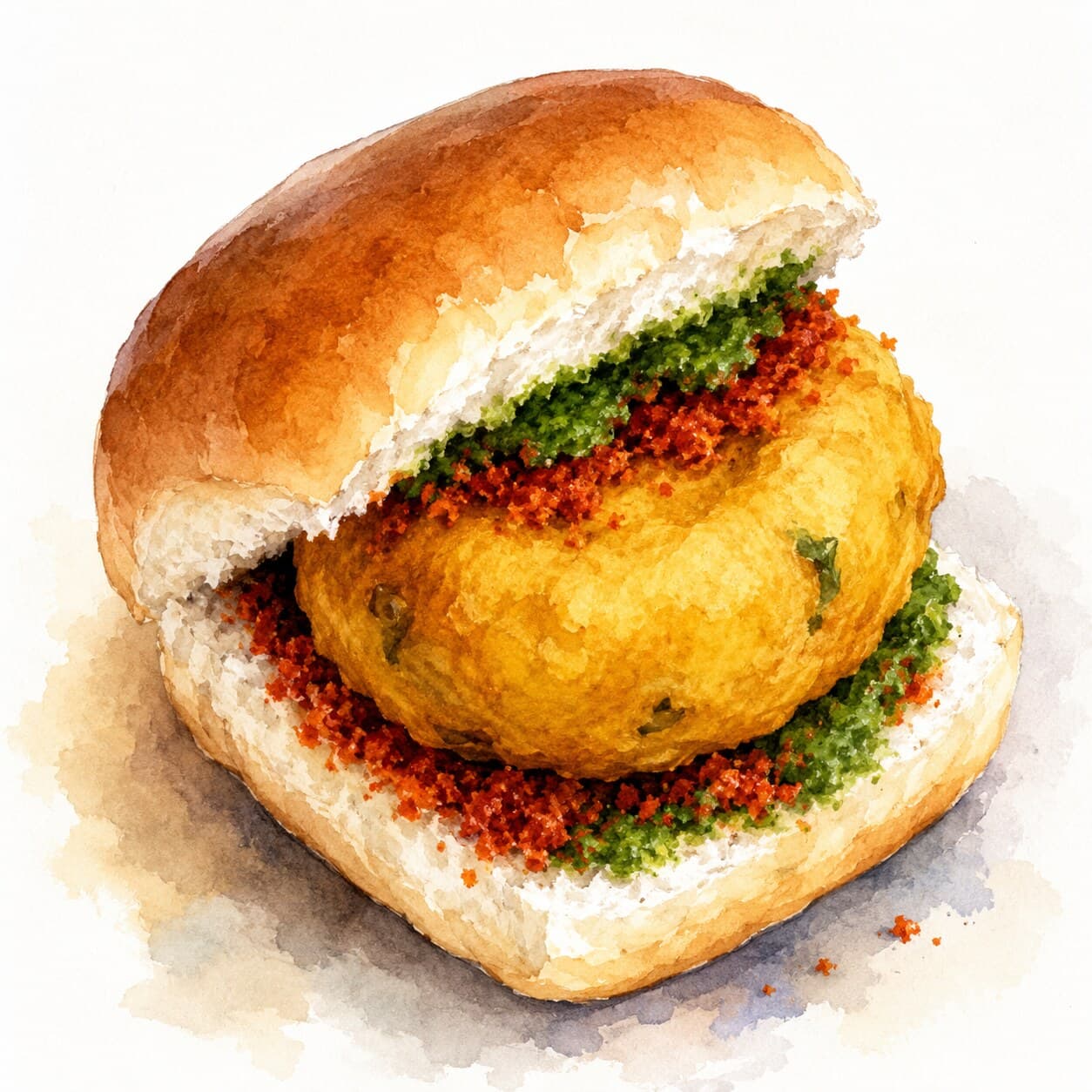
Vada Pav is a popular Mumbai street food featuring a spiced potato ball in a soft bread roll with flavorful chutneys.
Contents (5 sections)▾
Ingredients
- 200 g boiled potatoes, mashed
- 1 tsp mustard seeds
- 1 tsp cumin seeds
- 2 green chilies, finely chopped
- 1/2 tsp turmeric powder
- 1 tsp garam masala
- 2 tbsp chopped fresh cilantro
- Salt to taste
- 100 g chickpea flour (besan)
- Water, as needed for batter
- Oil for deep frying
- 2 pav (soft bread rolls)
- 2 tbsp green chutney
- 2 tbsp dry garlic chutney
- 2 fried green chilies
Steps
In a pan, heat a tablespoon of oil over medium heat, add mustard seeds, and let them splutter. Then, add cumin seeds, chopped green chilies, turmeric, and mashed potatoes. Mix well and cook for 5 minutes.
Stir in garam masala, cilantro, and salt to taste. Allow the mixture to cool, then shape it into golf ball-sized vadas.
In a bowl, mix chickpea flour with water to create a smooth batter. The consistency should be thick enough to coat the back of a spoon.
Heat oil in a deep frying pan to 180°C (350°F). Dip each potato ball in the batter and carefully place them in the hot oil. Fry until golden brown, about 4-5 minutes.
Remove vadas with a slotted spoon and drain on paper towels. Cut pav rolls in half without slicing all the way through.
Assemble the Vada Pav by placing a vada inside the pav, topping it with green chutney, dry garlic chutney, and a fried green chili. Serve immediately.
Tools you'll want
Why this works
The technique of deep frying the spiced potato vadas in chickpea batter creates a crispy outer layer while keeping the inside moist and flavorful. The use of chickpea flour is essential as it adheres well to the potato filling, ensuring a uniform coating that crisps up beautifully when fried. The combination of spices, including mustard seeds and cumin, infuses the potato with layered flavors that are characteristic of Mumbai street food. If the batter seems too thin, add a bit more chickpea flour to achieve the desired consistency; if too thick, a splash of water can help. The balance of chutneys adds a tangy and spicy contrast.
Common mistakes
Shaping the vadas while the potato mixture is still hot, in uneven sizes.
Target: Let the potato mixture cool to warm or room temperature before shaping it, and form uniform, golf-ball-sized portions.
Why it matters: A mixture that's still hot is hard to shape neatly and can make the batter slip rather than cling. Uneven sizes also fry at different rates, so smaller balls can scorch on the outside while larger ones finish with a raw-tasting, starchy batter layer that hasn't cooked through.
What to do: Spread the mixture out to cool for a few minutes, then shape even portions with lightly oiled hands.
Guessing at the oil temperature instead of checking it.
Target: Bring the oil to the full 180°C (350°F) before frying and hold it there, checking with a thermometer or a small test drop of batter rather than judging by eye.
Why it matters: Oil that's too cool lets the vadas soak up excess oil and turn greasy before the batter crisps. Oil that's too hot browns the outside within seconds while the potato filling stays cool inside and the batter underneath stays raw and pasty. Hot oil also spatters, so holding a steady, moderate-high temperature rather than the highest possible heat matters for safety in the kitchen as much as for texture.
What to do: Use a thermometer if you have one, or drop in a bit of batter first — it should sizzle and rise steadily rather than sit still or blacken instantly — and let the oil recover its temperature between batches.
Crowding too many vadas into the pot at once.
Target: Fry in small batches, leaving each vada room to float freely rather than packing the pot.
Why it matters: Adding too many at once drops the oil's temperature sharply, which slows the crisping and lets the vadas soak up more oil while the temperature climbs back up. Crowded pieces can also stick together, tearing the batter coating.
What to do: Fry two or three at a time depending on the size of your pot, and let the oil come back up to temperature between batches.
Leaving bare, thin patches in the batter coating.
Target: Coat each potato ball completely in the batter, checking that no patch of bare potato shows through before it goes into the oil.
Why it matters: The chickpea flour batter is what seals in the potato filling and turns crisp in the fryer. A thin spot lets hot oil hit the potato directly, drying out that patch while the rest stays tender, and can let the ball crack apart in the oil.
What to do: Turn the ball fully in the batter, letting the excess drip off before frying, so the coating is even all the way around.
What to look for
- A batter coating that turns a deep, even golden-brown all over, with no pale or translucent patches. That even color means the oil temperature stayed steady and every side cooked fully.
- Vadas that sizzle steadily and rise toward the surface of the oil rather than sitting on the bottom. Rising is a sign the crust has crisped and set; one that stays submerged and pale needs more time or hotter oil.
- A crust that shatters slightly when bitten, giving way to a soft, well-mixed potato filling underneath. A soggy, oil-soaked crust means the oil was too cool; a hard, dark crust over a barely warm center means it was too hot or the pot was crowded.
- Pav that is warmed and lightly toasted rather than cold or doughy in the center. Warming the bread through, even briefly in a dry pan, makes it easier to tear and gives the cut edge a light crispness.
A note on history
Vada pav is widely credited to a specific Mumbai vendor, Ashok Vaidya, who is said to have started selling it from a stall outside Dadar railway station in 1966, pairing an already-familiar spiced, deep-fried potato fritter (vada) with pav, the soft bread roll that entered the region under earlier colonial influence. Other accounts point to different vendors from the same neighborhood and era with a similar idea around the same time, so — as with many street foods with devoted local followings — the exact "first" version is hard to pin down with certainty, even though the Vaidya family's stall is the most frequently cited starting point.
Whoever served it first, vada pav caught on quickly as cheap, filling food for Mumbai's mill workers and commuters, and its rise was closely tied to the city's mid-20th-century economic pressures, when street vending became an important source of self-employment. In the decades since, the snack has become entangled with regional pride and identity politics in Mumbai, and it is now treated as something close to the city's unofficial signature food.
Get the essays in your inbox — free
Weekly notes on flavor, fermentation, and food history — the writing behind the Atlas of Flavor. No spam; unsubscribe anytime.