
Tod Mun Pla
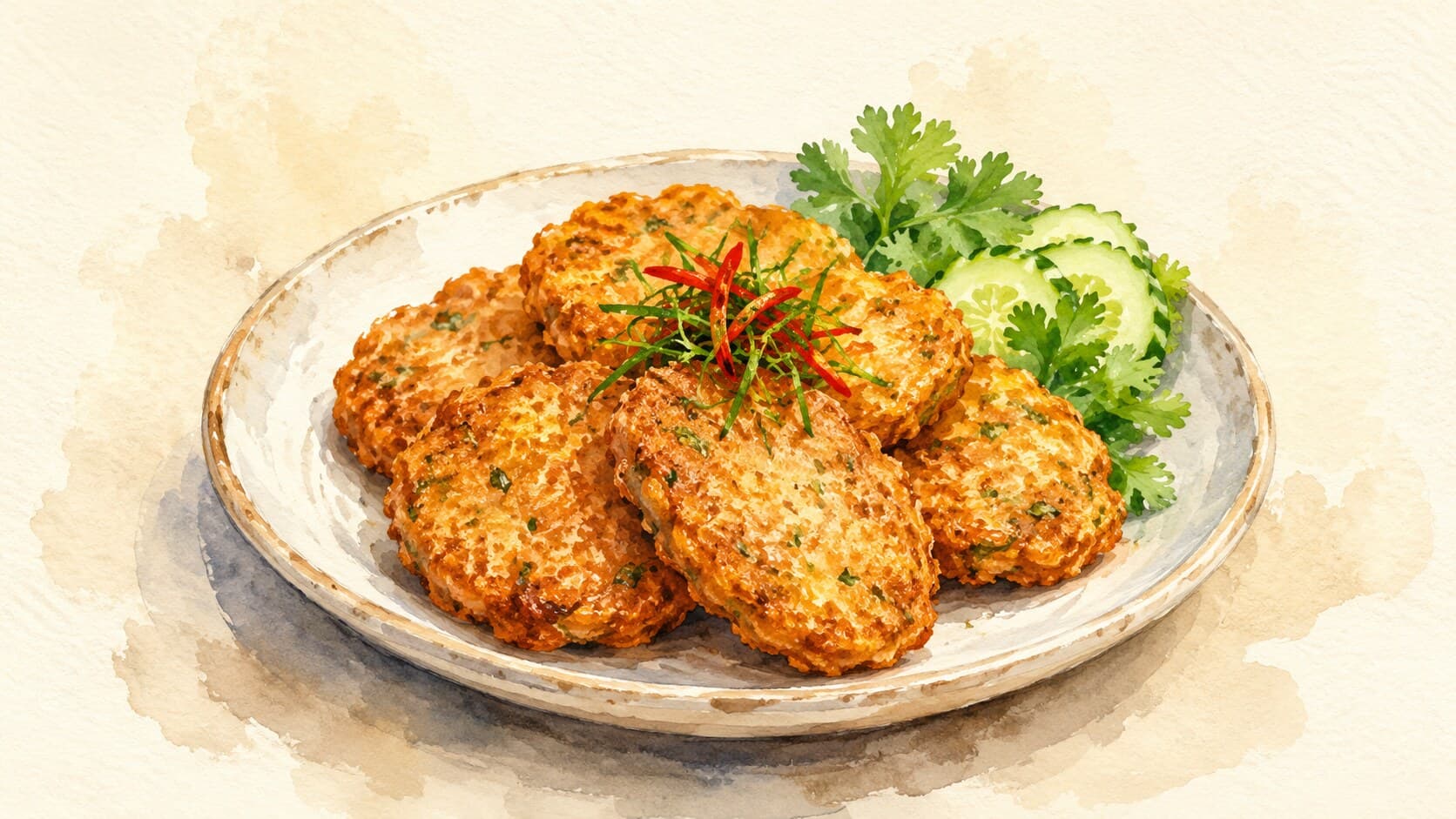
Tod Mun Pla are flavorful Thai fish cakes made with white fish, red curry paste, and kaffir lime leaves, perfect as a party starter.
Contents (5 sections)▾
Ingredients
- 500 g white fish fillet, skinless
- 2 tbsp red curry paste
- 4 kaffir lime leaves, finely chopped
- 1 tbsp fish sauce
- 1 egg, beaten
- 2 tbsp tapioca flour
- 1/2 tsp sugar
- Oil for deep frying
- Cucumber relish, for serving
Steps
In a food processor, combine the white fish, red curry paste, kaffir lime leaves, fish sauce, beaten egg, tapioca flour, and sugar. Blend until a smooth paste forms, about 1-2 minutes.
Transfer the mixture to a bowl and refrigerate for 15 minutes. This helps the flavors meld and ensures the cakes hold together during frying.
Heat oil in a deep frying pan to 180°C (350°F). Use a thermometer to check the temperature for optimal frying.
Using wet hands, form the fish mixture into small, thin patties, about 5 cm in diameter, to achieve even cooking and a delightful chew.
Carefully lower the patties into the hot oil, frying in batches to avoid overcrowding. Fry for 3-4 minutes on each side, or until they reach a golden brown color and are cooked through.
Remove the patties and drain on paper towels to absorb excess oil. Serve hot with cucumber relish.
Why this works
The technique of pounding white fish into a paste is crucial for achieving the desired bouncy texture that characterizes authentic Tod Mun Pla. By using a food processor, the fish and spices are blended evenly, allowing the flavors to meld. The addition of tapioca flour helps bind the mixture while contributing to that signature chewiness. Frying at the correct oil temperature of 180°C (350°F) ensures that the patties cook through without becoming greasy. If the oil temperature drops below this range, the patties may absorb excess oil, resulting in a greasy texture; if this occurs, increase the heat slightly to restore the temperature. Conversely, if the patties are too thick, flatten them slightly before frying to achieve an even cook. This method also allows for an enhanced surface crispiness, bringing balance to the soft interior. The key to successful frying is to maintain consistent oil temperature; if it drops too low, the patties may absorb excess oil and lose their desired texture, while too high of a temperature may burn the outside before the inside is thoroughly cooked. Thus, precise control over both time and temperature is essential for achieving the perfect Tod Mun Pla.
Common mistakes
- Under-processing the fish paste (the smooth, sticky mince of fish, curry paste and binders that gives the cakes their springy texture) so the patties don't bounce.
- Target: A sticky, cohesive paste that pulls back on itself when you lift the spatula.
- Why it matters: The signature bounce comes from working the fish proteins enough to form a network; under-worked paste fries up soft and crumbly.
- What to do: Pulse and scrape down the bowl a few times; the mixture should clearly tighten and turn glossy before you stop.
- Skipping the rest in the fridge after blending.
- Target: At least 15 minutes chilled, longer if the kitchen is warm.
- Why it matters: Cold paste holds its shape on the way into the oil and gives the surface a head start on crisping before the inside heats through.
- What to do: Cover and rest the bowl in the fridge; shape patties straight from cold with wet hands.
- Forming the patties too thick.
- Target: Around 1 cm thick, roughly 5 cm across.
- Why it matters: Thicker disks brown on the outside before the centre cooks through, and you lose the chewy-soft interior contrast.
- What to do: Flatten between wet palms; if a test patty comes out pale inside, thin the next batch.
- Dropping the oil temperature by frying too many at once.
- Target: Steady 180°C; the oil should sizzle vigorously when a patty hits it.
- Why it matters: Cold oil soaks into the patties and they come out greasy instead of crisp; very hot oil burns the surface before the centre is opaque.
- What to do: Fry in small batches, let the oil recover between rounds, and check with a thermometer.
What to look for
- a paste that tightens visibly and pulls back from the bowl wall after pulsing
- flecks of red curry paste (the Thai aromatic paste of chillies, lemongrass, galangal and shrimp paste pounded together) and bright-green kaffir lime leaf (the deeply aromatic, double-lobed leaf used as a fresh herb in Thai cooking) evenly distributed
- a vigorous, even sizzle the moment a patty enters the oil
- a deep, uniform golden-brown surface with a firm, opaque centre
A note on history
Tod mun pla belongs to a long Thai tradition of pounded-fish preparations (a family of dishes built by mashing or processing fish flesh into a sticky, springy paste before forming and cooking) that turn cheap river and coastal fish into snacks and ready-to-fry meals. The technique — minced or pounded fish bound with curry paste and aromatics, then fried — appears across Southeast Asia and reflects Thailand's position as a culinary crossroads. Specific origin stories are not well-documented, so I'll stop short of attributing it to a particular era or person.
Get the essays in your inbox — free
Weekly notes on flavor, fermentation, and food history — the writing behind the Atlas of Flavor. No spam; unsubscribe anytime.