
Sake Nanban-zuke
Sake Nanban-zuke is a Japanese home dish of crisp fried salmon briefly marinated in a sweet-tart vinegar sauce. Refrigerate and eat within 2–3 days.
Contents (5 sections)▾
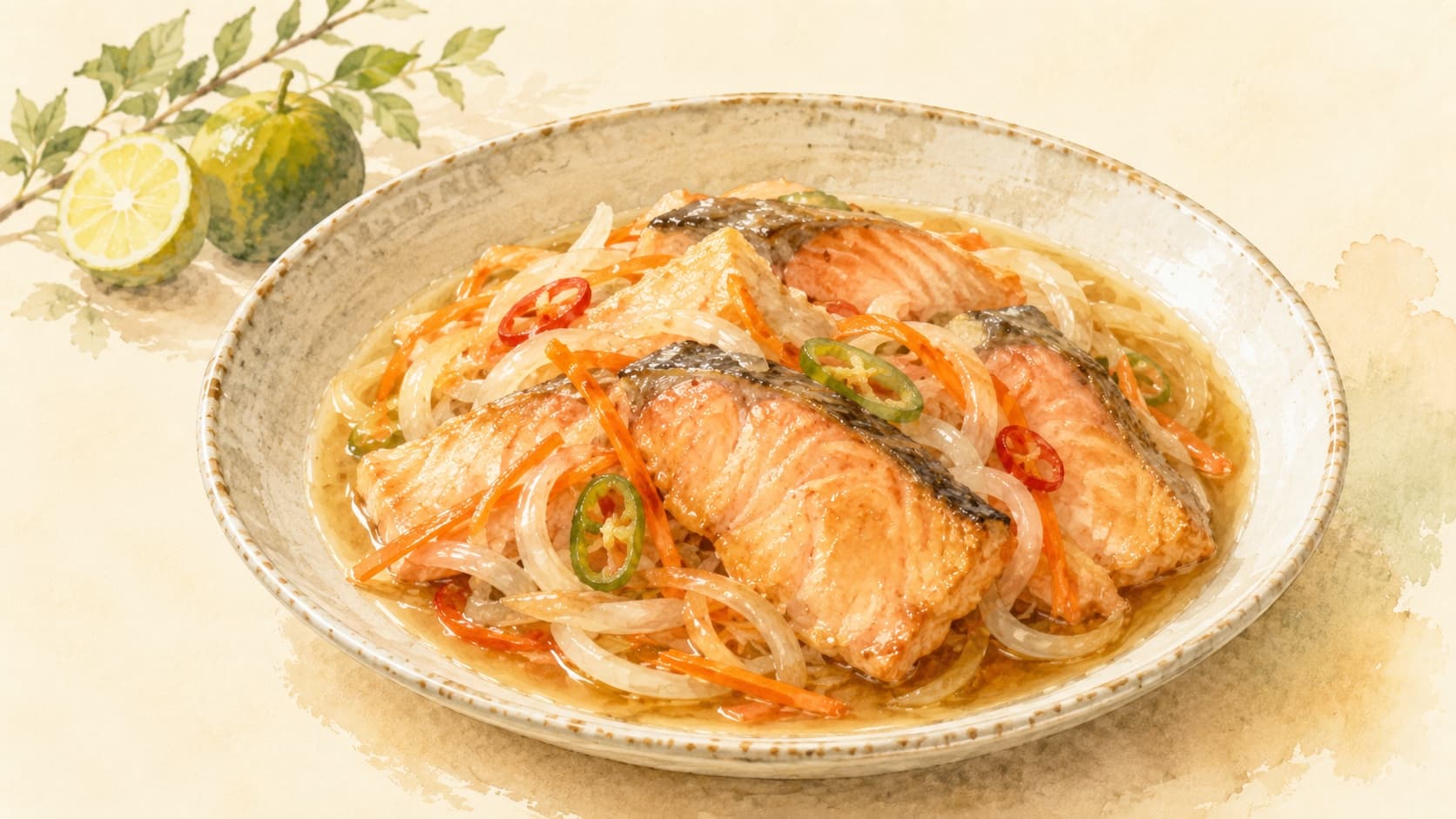
Ingredients
- 500 g salmon fillet
- 1/2 cup all-purpose flour
- 2 large eggs
- 1 cup panko breadcrumbs
- 1/2 cup rice vinegar
- 1/4 cup soy sauce
- 1/4 cup mirin
- 1 tablespoon sugar
- 1 red bell pepper, sliced
- 1 carrot, julienned
- 1 small onion, sliced
- 2 tablespoons sesame oil
- Salt and pepper to taste
- Oil for frying
Steps
Cut the salmon fillet into bite-sized pieces and season with salt and pepper. Let sit for 10 minutes to absorb the flavors.
Prepare a breading station: Place flour in one bowl, beaten eggs in another, and panko breadcrumbs in a third bowl.
Dredge each piece of salmon in flour, dip in egg, and coat with panko breadcrumbs.
Heat oil in a frying pan over medium heat (about 180°C/350°F) and fry the salmon pieces until golden brown, approximately 3-4 minutes per side.
While the salmon is frying, mix rice vinegar, soy sauce, mirin, and sugar in a bowl until the sugar dissolves.
Remove the fried salmon and drain on paper towels. In a separate pan, sauté the sliced bell pepper, carrot, and onion in sesame oil for about 3 minutes until slightly softened.
Combine the sautéed vegetables with the vinegar mixture and add the fried salmon pieces. Once the contents have cooled to room temperature, transfer to a clean covered container and refrigerate for at least 30 minutes before serving. Do not leave the marinating salmon at room temperature.
Use fresh salmon and chill the dish promptly after cooking. Store only in the refrigerator and finish within 2–3 days. The vinegar marinade adds flavor but does not make the fish safe at room temperature. Do not rely on smell, color, or taste alone to judge whether leftovers are still safe — when in doubt, discard.
Why this works
The technique of marinating fried salmon in a vinegar mixture pairs the crisp panko (Japanese coarse breadcrumbs that fry up especially light and crispy) crust against bright, sweet-tart acid — the contrast is what makes nanban-zuke (a Japanese "southern-barbarian-style pickle" of fried protein soaked briefly in a sweet-tart vinegar marinade) memorable. The vinegar tempers the richness of the fried crust while the panko keeps the salmon moist inside. If the coating seems too thick after frying, lightly press it down with a spatula while cooking so it adheres properly. To keep the texture crisp, avoid overcrowding the pan during frying, which lowers the oil temperature and turns the crust soggy. A note on storage: while flavors do continue to develop overnight in the marinade, this is a fresh-cooked everyday dish, not a long-keeping preserve. Use fresh salmon, cool the dish promptly after cooking, refrigerate in a clean covered container, and eat within 2–3 days. Do not leave at room temperature; the vinegar does not make the fish safe outside the fridge. Do not judge spoilage by smell, color, or taste alone — when in doubt, discard.
Common mistakes
Pulling the salmon out of the oil before it's cooked through.
- Target: Each piece fried until the panko is deep golden brown and the salmon inside is uniformly opaque from edge to centre — the marinade is for flavour only, not for cooking.
- Why it matters: A vinegar marinade does not cook fish; it only acidifies the surface. If the salmon goes into the marinade under-cooked, it stays raw inside while the crust softens, and that's both a food-safety problem and a texture failure.
- What to do: Cut salmon into uniform bite-sized pieces, fry at around 175–180°C until the largest piece tests opaque through, and only then move them onto kitchen paper.
Frying in oil that's too cool or too crowded.
- Target: Oil holding around 175–180°C, with no more than a single layer of pieces in the pan and breathing room between them.
- Why it matters: Cool or crowded oil drops below frying temperature on contact, the crust soaks oil instead of crisping, and you end up with greasy salmon that the marinade promptly turns soggy.
- What to do: Heat the oil and test with a single panko crumb (it should sizzle immediately), fry in 2–3 batches, and let the oil come back up to temperature between batches.
Pouring vinegar marinade over hot salmon and leaving it on the counter.
- Target: The salmon and vegetables cooled enough to handle, then transferred into a clean covered container with the marinade and moved straight into the fridge for at least 30 minutes.
- Why it matters: Long room-temperature rests in an acidic, low-temperature window are exactly where bacteria multiply — the vinegar adds tang but does not make the fish shelf-stable. The marinade is also better absorbed by warm-not-hot fish than by steaming-hot fish, which sweats and dilutes the sauce.
- What to do: Let the fried salmon rest briefly to stop steaming, combine with the sautéed vegetables and marinade in a clean container, cool to lukewarm, then refrigerate. Eat within 2–3 days; if in doubt, discard.
Skipping the vegetable sauté.
- Target: Bell pepper, carrot and onion lightly softened in sesame oil for 2–3 minutes, just past raw, before they meet the marinade.
- Why it matters: Raw, cold vegetables stay crunchy and watery in the marinade, and the marinade itself never absorbs into them. A short sauté breaks down the cell walls just enough to let the vinegar in without turning them limp.
- What to do: Cut all vegetables to a similar fine size for even cooking, sauté on medium heat until just translucent at the edges, and slide them straight into the marinade while still hot.
What to look for
- A piece of test panko bread dropped into the oil sizzles immediately, surrounded by an even ring of small bubbles.
- Cut into the largest fried piece, the salmon is uniformly opaque pink-orange and flakes apart — no glassy, translucent centre.
- Just after marinating, the panko is glossy and slightly softened but the bites still have a faint crisp pull rather than a wet, falling-apart crust.
- The marinade itself smells brightly sweet-tart with a savoury underline from the soy — sharp without being eye-watering.
A note on history
Nanban-zuke — literally "southern-barbarian pickle" — is the Japanese adaptation of escabeche, a fried-then-marinated seafood dish brought to Japan by Portuguese traders and missionaries arriving in the southern ports in the late 16th century. The European newcomers, approaching Japan from the south, were called nanban ("southern barbarians"), and the dishes that arrived with them — fried fish bathed in a vinegar-and-spice marinade — picked up the same name when Japanese cooks made the technique their own.
Get the essays in your inbox — free
Weekly notes on flavor, fermentation, and food history — the writing behind the Atlas of Flavor. No spam; unsubscribe anytime.