
Pimientos de Padrón
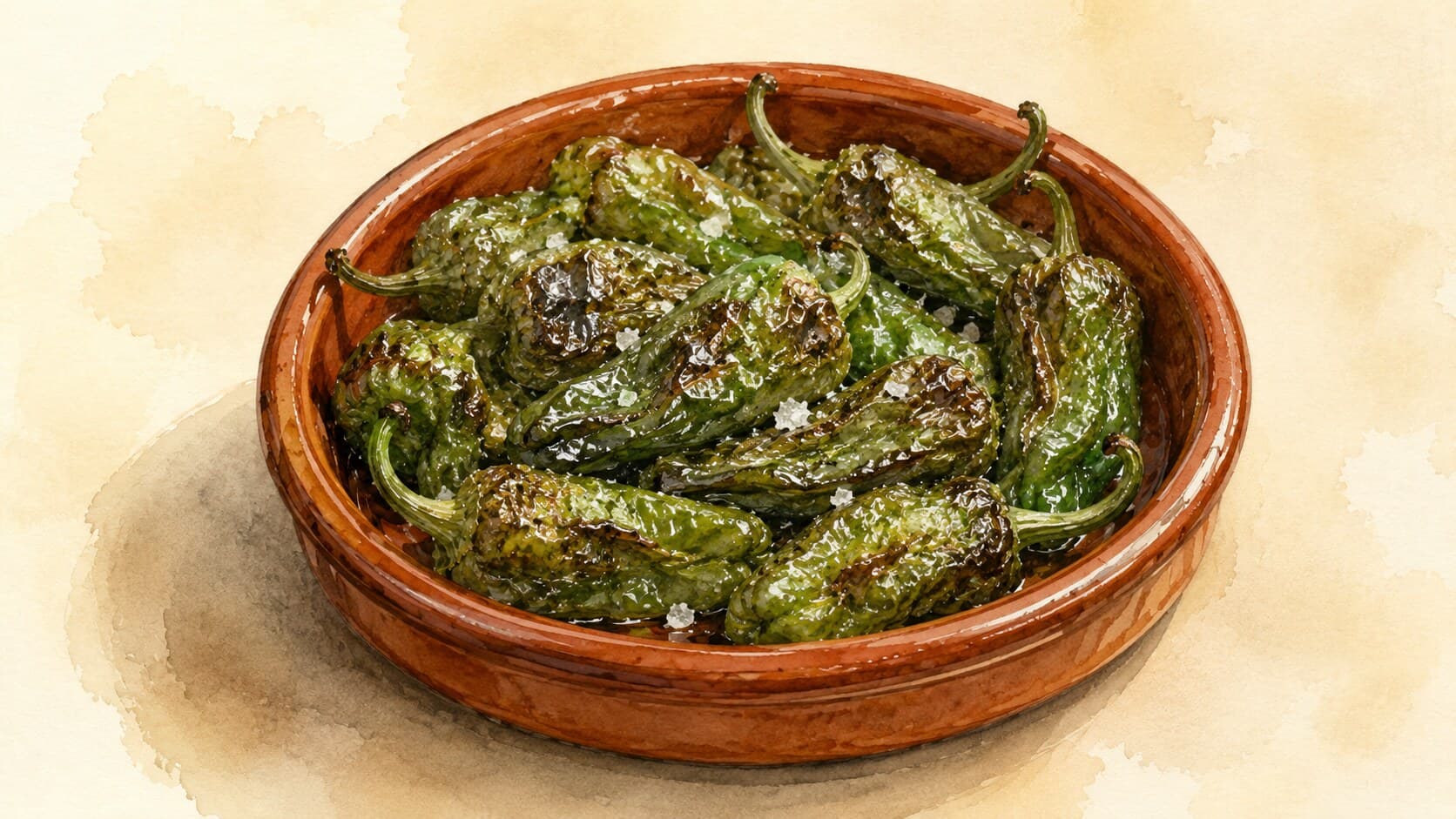
Blistered Padrón peppers make a quick and flavorful Spanish tapa that's perfect for any occasion.
Contents (5 sections)▾
Ingredients
- 200 g Padrón peppers
- 30 ml olive oil
- Flaky sea salt to taste
Steps
Heat a large skillet over high heat until it is very hot, around 200°C (400°F). This high temperature is crucial for blistering.
Add the olive oil to the skillet, ensuring it coats the bottom. You need very little oil to achieve the right blistering effect.
Quickly add the Padrón peppers in a single layer, without crowding the pan. Cook for about 5-7 minutes, shaking the pan occasionally, until the peppers are blistered and slightly charred.
Remove the peppers from the heat and transfer them to a serving dish. Sprinkle generously with flaky sea salt right before serving.
Why this works
Blistering Padrón peppers is a technique that relies on high heat and minimal oil, which creates a delightful contrast between the tender interior and the crispy skin. The high temperature causes the moisture in the peppers to evaporate quickly, leading to blistering without overcooking them. It's essential not to overcrowd the pan; otherwise, the peppers will steam instead of blister. If you notice that the peppers are not blistering after the first few minutes, increase the heat slightly. Conversely, if the oil begins to smoke, reduce the heat to avoid burning. The addition of flaky sea salt enhances the natural flavors of the peppers, making this a simple yet addictive tapa.
Common mistakes
Adding wet peppers to hot oil — dangerous spatter. Target: peppers thoroughly dried with a clean kitchen towel before they hit the pan. The pan should be shimmering hot (oil moves easily and just begins to thin); the peppers should sizzle on contact, not crack or pop. Why it matters: water droplets meeting hot oil flash to steam instantly and eject the oil from the pan in droplets — burn risk to hands and face. The shimmering-but-not-smoking visual cue helps you avoid both spatter and oil breakdown. What to do: if you've washed the peppers, dry them in a single layer on a towel for 10 minutes; pat dry with another towel just before cooking. Have a lid ready in case spatter starts.
Overcrowding the pan — peppers steam instead of blister. Target: a single uncrowded layer; if your pan is full, cook in two batches. The peppers should sit with space between them, not piled. Why it matters: a crowded pan releases too much moisture at once, drops the pan temperature, and the peppers boil in their own steam. Blistering — those golden-brown bubbles on the skin — requires direct, dry skin-to-hot-pan contact and fast moisture evaporation. What to do: if you hear steaming hissing instead of frying sizzle, lift some peppers out to a plate, raise the heat, and add them back once the pan recovers.
Too much oil — peppers fry instead of blister, become greasy. Target: just enough oil to gloss the pan (about 1 tablespoon per 200 g of peppers). Peppers should look glossy but not swim. Why it matters: Padrón blistering is closer to dry-roasting in a film of oil than to deep frying. Extra oil pools, lowers contact heat, and the peppers turn limp and slick rather than charred and crisp. What to do: if too much pooled at the bottom, tilt the pan and spoon some off into a heatproof bowl before continuing.
Salting before cooking, or salting while still hot off the pan. Target: finish with flaky sea salt right before serving — not in the marinade, and not while the peppers are still steaming hot enough to dissolve the salt completely. Why it matters: salt added in advance draws water out of the peppers via osmosis (water-pulling chemistry) and undermines the blister. Flaky salt that lands on a slightly cooled, blistered surface stays as visible crystals — the textural pop that makes this tapa. What to do: transfer the peppers to a warm serving dish and let them rest 30 seconds before sprinkling the salt. A wedge of lemon is optional but classic.
What to look for
- A pan that shimmers, not smokes. Tilt the pan and watch the oil — when it moves quickly and the surface looks rippled but not hazy, you're at the right temperature.
- Blisters appearing within 60 seconds. Within a minute of adding the peppers, you should start seeing golden-brown bubbles forming on the skin. If nothing happens, the heat is too low or the peppers were wet.
- A skin that crackles, flesh that gives. A finished pepper has a thin, crisp blistered skin and yields to gentle pressure — a sign the flesh inside has softened in the burst of trapped steam.
- Two-tone color: deep blistered patches against bright green. Uniform color across the whole pepper usually means either undercooked (all green) or overcooked (all browned and bitter). You want the mottled pattern.
A note on history
Pimientos de Padrón (small green Spanish peppers blistered in hot oil and eaten whole as a tapa) were brought from the Americas to Galicia in northwestern Spain in the early 1600s by Franciscan monks (a Catholic mendicant order founded by St. Francis of Assisi in 1209), who cultivated the seeds at the Convent of San Antonio in Herbón, near the town of Padrón (Atlas Obscura, La Tienda). Galicia's cool, rainy climate and the monks' seed selection over generations produced the distinctive Padrón variety, which differs from its Latin American ancestors. The annual Festa do Pemento de Padrón has been held in Herbón since 1979, on the first Sunday in August. The local saying — uns pican e outros non, "some are spicy, some are not" — captures the variety's signature unpredictability: most are mild, but the occasional one delivers a real kick.
Get the essays in your inbox — free
Weekly notes on flavor, fermentation, and food history — the writing behind the Atlas of Flavor. No spam; unsubscribe anytime.