
Pasta e Fagioli
A hearty Italian bean and pasta soup, rich in flavor and perfect for weeknight dinners.
Contents (5 sections)▾
Ingredients
- 200 g cannellini or borlotti beans, cooked
- 2 tbsp olive oil
- 1 medium onion, finely chopped
- 1 medium carrot, finely chopped
- 1 celery stalk, finely chopped
- 2 cloves garlic, minced
- 400 g canned diced tomatoes
- 1 liter vegetable or chicken stock
- 150 g short pasta (like ditalini or elbow)
- Salt to taste
- Freshly ground black pepper to taste
- Grated Parmesan cheese for serving
- Chopped flat-leaf parsley for garnish
Steps
In a large pot, heat the olive oil over medium heat. Add the onion, carrot, and celery (this is your soffritto) and cook, stirring occasionally, for about 5-7 minutes until softened.
Add the minced garlic and cook for another 1-2 minutes until fragrant, being careful not to let it burn.
Stir in the diced tomatoes and cooked beans, and pour in the stock. Bring to a gentle simmer over medium heat.
After about 10 minutes of simmering, use an immersion blender to purée about half of the soup. This will give the soup a creamy texture while retaining some whole beans.
Add the short pasta directly to the pot and cook according to package instructions, usually about 8-10 minutes, until al dente. Stir occasionally to prevent sticking.
Season with salt and black pepper to taste. Serve hot, drizzling with olive oil and garnishing with grated Parmesan and parsley.
Why this works
This Pasta e Fagioli recipe is a comforting favorite and a practical lesson in Italian cooking techniques, focusing on soffritto and bean preparation. The soffritto, a base of finely chopped onions, carrots, and celery, is the aromatic foundation that builds flavor in this dish. As the beans simmer with tomatoes and stock, they impart their creaminess to the broth. By partially puréeing the soup, you create a richer texture, while the short pasta absorbs the flavors directly from the broth. If the pasta seems too soft, turn off the heat immediately to prevent overcooking. This dish balances the heartiness of beans with the comforting nature of pasta, making it a perfect one-pot meal for busy weeknights.
Common mistakes
- Using beans that aren't fully tender (food-safety BLOCK). Beans that go into the pot still firm in the centre won't soften enough during the short simmer, and undercooked beans of the cannellini/borlotti family contain lectins (phytohaemagglutinin in particular for kidney beans) that can cause significant digestive upset. Target: beans that crush easily between two fingers — fully tender all the way through — BEFORE they go into the soup. Why it matters: lectins are heat-sensitive proteins; they only fully break down at a true boil sustained for at least 10 minutes (a quick simmer is NOT enough). Most home pasta e fagioli recipes assume you start from cooked beans, so this matters most when you boil dry beans yourself. What to do: if cooking dry beans, soak overnight, drain, cover with fresh water and bring to a rolling boil for at least 10 minutes before reducing to a simmer until completely tender. If using canned beans, you can skip this — they're already cooked.
- Burning the soffritto. The soffritto (a slowly-cooked onion, carrot, celery base) is supposed to soften and sweeten, not brown sharply. If it goes brown before the garlic, you've shifted the flavour register entirely. Target: vegetables that turn translucent and smell sweet, slack and golden — never crisp or browned. Why it matters: soffritto sweetness comes from slow Maillard reactions and caramelisation in the vegetables' own sugars. Too much heat pushes past sweet into bitter, and the soup never recovers. What to do: keep the heat at medium-LOW, give it the full 5–7 minutes, and stir often. If it browns too fast, add a splash of water and lower the heat.
- Adding the pasta too early and letting it get mushy. Short pasta cooks fast in soup — it keeps cooking on residual heat once you turn off the stove, and an overcooked pasta e fagioli has a porridge texture. Target: al dente pasta (Italian for "to the tooth" — cooked just to firm-tender, with a slight bite at the centre) when you pull the pot off the heat, NOT when you serve. Why it matters: pasta starch continues to gelatinise as long as the soup is hot. Five extra minutes of "resting" can turn al dente into mush. What to do: check the pasta a minute before package time. The moment it's al dente, kill the heat. If you're serving in 10+ minutes, undercook by 2 minutes — the soup will finish it.
- Forgetting any meat ingredient (pancetta, guanciale) needs proper cooking. If you add pancetta (Italian salt-cured pork belly, similar to bacon but unsmoked) to render the fat at the start, render it slowly until the fat is clear and the meat is crispy — not still pink and limp. Target: pancetta fully cooked, fat fully rendered, meat crisp at the edges. Why it matters: undercooked cured pork carries food-safety risk even though it's salted; properly rendered, it also flavours the soffritto fat that builds the whole soup. What to do: cook pancetta in the oil over medium heat for 4–5 minutes BEFORE adding the soffritto vegetables, until the fat is clear and the meat is browning. If you skipped meat, this doesn't apply — vegetable broth alone is perfectly traditional in many regions.
What to look for
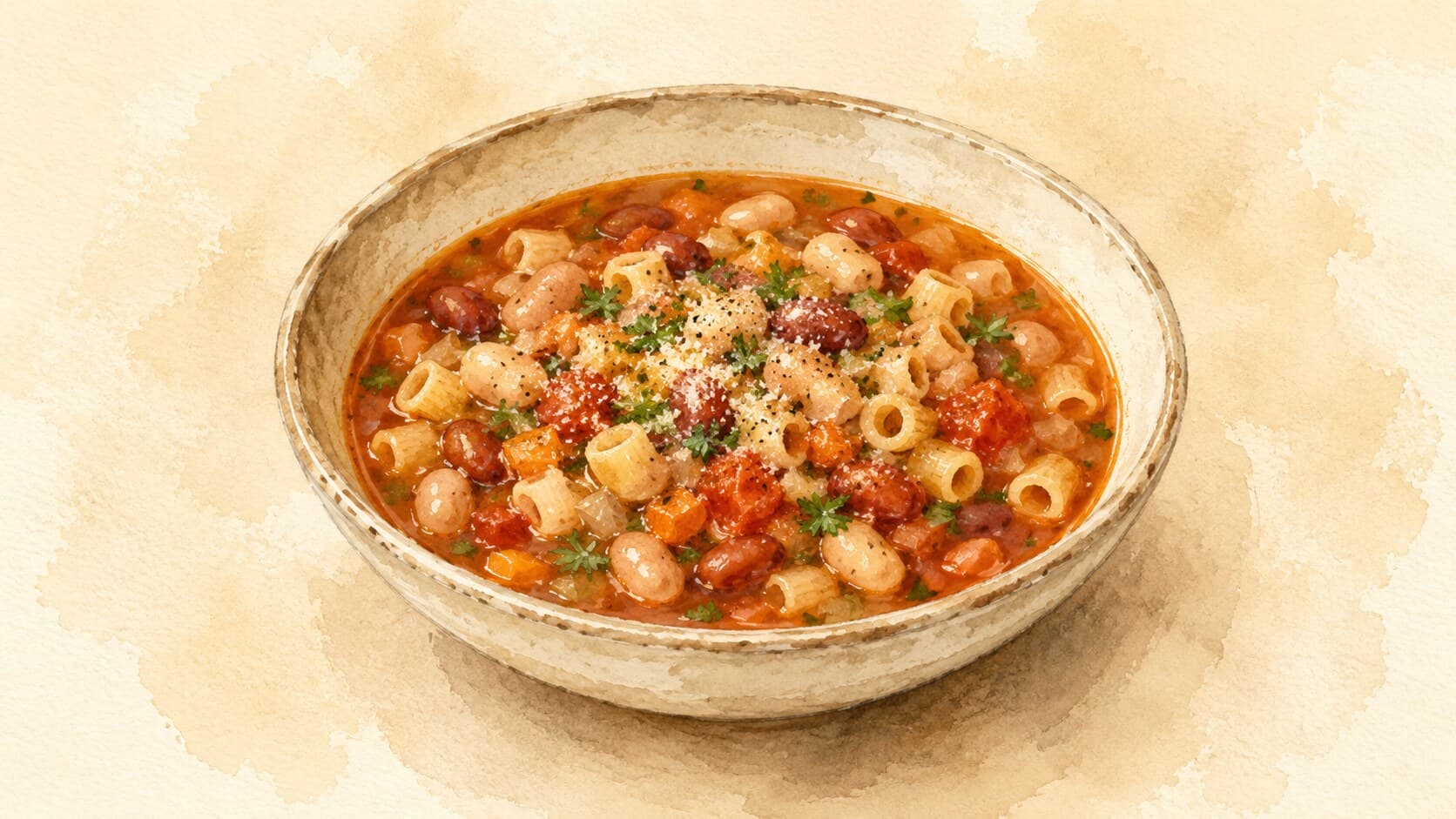
- A creamy, cloudy broth, not a clear one — proper pasta e fagioli should look slightly thickened from the puréed beans and released pasta starch, with the consistency of pourable porridge.
- Whole beans visible alongside the purée — half-blending gives you the best of both: creaminess from the puréed portion, texture from the whole beans.
- A glossy droplet of olive oil on the surface — a finishing drizzle of extra virgin olive oil sits in tiny pools that catch the light. This isn't garnish; it's a flavour layer.
- Pasta that holds its shape — short tubes (ditalini, the tiny thimble-shaped tubes traditional to this soup; elbow macaroni works as a substitute) should still be discrete in the bowl, not collapsed into mush.
A note on history
Pasta e fagioli is a true cucina povera (peasant kitchen) dish whose roots are commonly traced back to Roman and pre-Roman peasant cooking — a cheap, filling combination of legumes and grain that fed agricultural and labouring populations across Italy (Wikipedia). Regional variations diverge sharply: the Neapolitan tradition cooks the pasta directly in the bean broth and applies a "mantecatura" finish for creaminess, while the Veneto version (around Venice and Verona) leans more soupy and often uses borlotti beans. The dish's Italian-American nickname "pasta fazool" derives from the Neapolitan dialect rendering "pasta e fasule" (Philosokitchen).
Get the essays in your inbox — free
Weekly notes on flavor, fermentation, and food history — the writing behind the Atlas of Flavor. No spam; unsubscribe anytime.