
Ohitashi
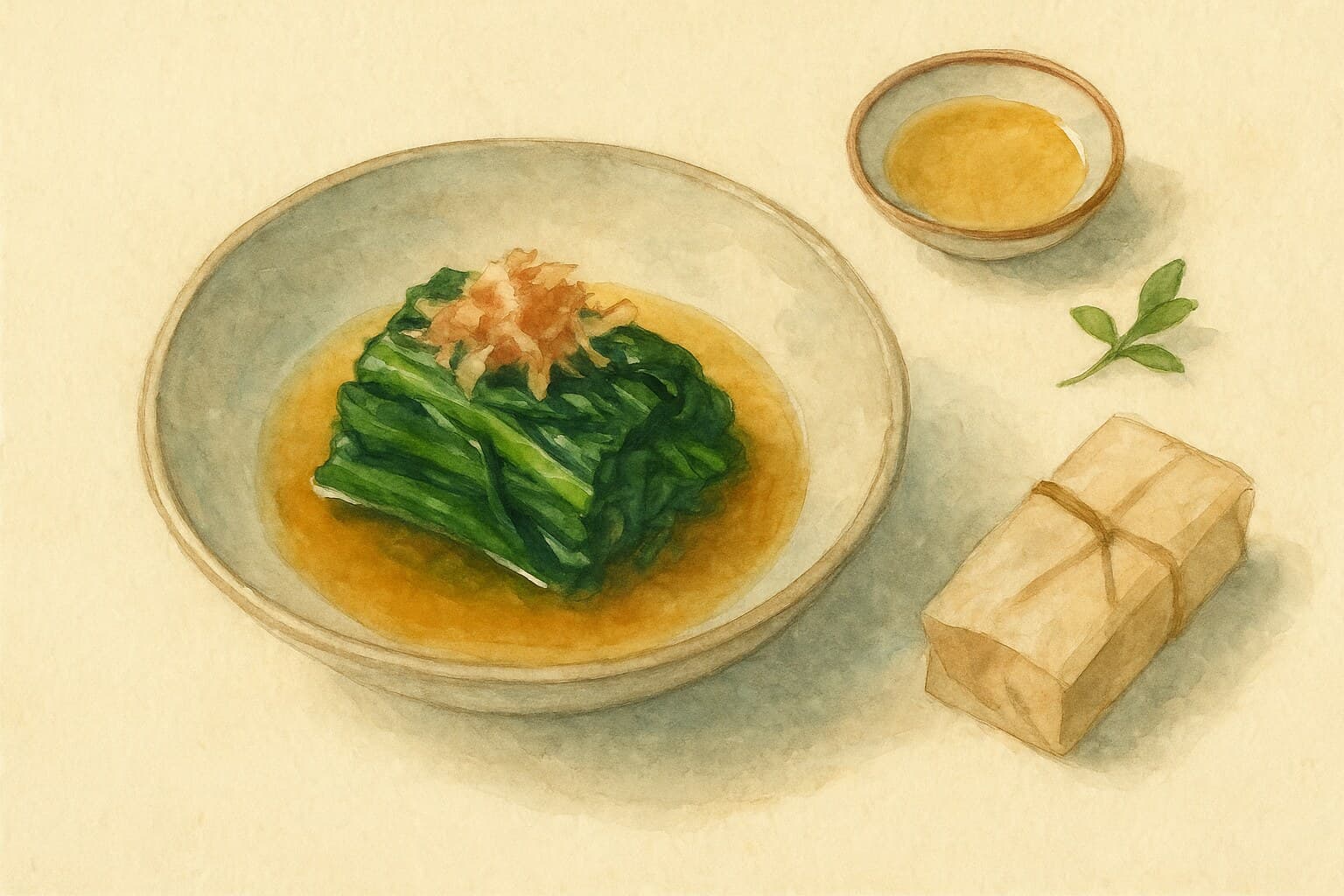
Ohitashi is a classic Japanese side dish featuring blanched greens soaked in umami-rich dashi.
Contents (5 sections)▾
Ingredients
- 200 g spinach or other leafy greens
- 500 ml dashi stock
- 1 tbsp soy sauce
- 1 tsp mirin
- 1 tsp sesame seeds, toasted
- to taste salt
Steps
Bring a large pot of water to a boil over high heat.
Add the greens to the boiling water and blanch for 1-2 minutes until bright and tender, then quickly transfer to an ice bath to stop cooking.
In a separate bowl, combine dashi stock, soy sauce, mirin, and a pinch of salt.
Once cooled, drain the greens and gently squeeze to remove excess water, then place them in the dashi mixture.
Let the greens soak in the dashi for at least 10 minutes to absorb the flavors before serving.
Before serving, garnish with toasted sesame seeds for added flavor and texture.
Why this works
The blanch-and-soak technique used in Ohitashi is essential for maximizing both texture and flavor. Blanching (briefly dunking in heavily salted boiling water, then plunging into ice water to lock in color and stop cooking) the greens for a brief moment brightens their color and softens them while preserving their nutrients. The immediate transfer to an ice bath halts the cooking process, ensuring they remain vibrant and crisp. Soaking the blanched greens in dashi (the foundational Japanese broth, drawn from kelp and dried bonito flakes) allows them to absorb the umami flavors, creating a harmonious balance. If the greens seem too salty after soaking, simply rinse them briefly under cold water before serving to mellow the flavor. This method enhances the dish's appeal, making it a staple in Japanese cuisine. The result is a refreshing side dish that complements various meals, showcasing the beauty of simplicity in Japanese cooking.
Common mistakes
-
Pulling the greens out before they're cooked through. Target: 1-2 minutes in heavily-salted, fully boiling water (a generous tablespoon of salt per liter), thick stems in 10-20 seconds before the leaves, until everything bends without snapping. Why it matters: Ohitashi's greens are intended to be fully cooked — chilled, but cooked — not raw and crunchy. Underblanched spinach is unpleasant raw at the stem, and harder leafy greens like komatsuna hold a grassy bitterness if pulled too early. The salted water also acts as a brief seasoning bath; unsalted water leaches color and leaves a flat, watery flavor. What to do: Salt the water like seawater. Hold thick stems under first, leaves second, fish everything out the moment the color deepens to a bright glowing green.
-
Skipping the ice bath, or skipping the squeeze. Target: Immediate plunge into ice water until cold to the touch (about 30 seconds), then gather and squeeze gently but firmly to remove as much water as possible. Why it matters: Without the ice bath, residual heat keeps cooking the greens — what looked perfect in the pot becomes olive-gray and slumped on the plate. Without the squeeze, the dashi can't get in: the cells are already saturated with cooking water and the dish ends up watery and underseasoned (dashi-osmosis — the seasoned broth migrating into the cells of the cooked greens — only works if there's room to absorb). What to do: Have an ice bath ready before you blanch. Squeeze the cooled greens in your hand into a tight log, then cut into bite-sized pieces.
-
Soaking in dashi that's still hot. Target: Dashi cooled to room temperature (or chilled) before the greens go in; soak 10-30 minutes in the refrigerator before serving. Why it matters: Hot dashi continues to cook the greens and drives off the lighter aromatic compounds in the broth (kombu's glutamates persist, but katsuobushi's nuance does not). Cold soaking preserves the texture you just locked in with the ice bath and gives time for full flavor penetration. What to do: Make the seasoned dashi first, let it cool, then add the squeezed greens. If in a hurry, set the dashi bowl in cold water.
-
Holding leftovers too long. Target: Refrigerate covered at or below 5°C / 41°F; consume within 24 hours, ideally the same day. Why it matters: Cooked greens in a lightly-salted broth are a hospitable bacterial environment if left at room temperature; there's no acid, sugar, or alcohol to act as a preservative. What to do: Refrigerate as soon as the dish is assembled if you're not eating right away, and don't leave it on the counter while you eat.
What to look for
- A bright glowing green color in the leaves that has actually deepened, not faded — a brief enough blanch holds in the chlorophyll and brightens it; an overlong blanch turns it olive.
- Stems that bend in a soft curve without breaking, but still have a slight chew at the base — fully cooked, not collapsed. If the stem snaps when you bend it, blanch slightly longer next time; if it flops like wet paper, slightly less.
- Dashi that's clear and faintly amber, with the greens slowly drinking it — a cloudy broth means residual blanching water leaked in (didn't squeeze hard enough). Clear means the squeeze worked.
- A clean balance on the tongue: dashi's umami first, then a soft salt edge, then the green vegetable last — if salt comes first, the soy was too much; if vegetable comes first and dashi is barely there, more soaking time needed.
A note on history
Ohitashi takes its name from the verb hitasu (浸す, "to soak"), and the soak-in-broth technique is far older than the modern dish. Hitashimono appears in Japanese records as early as 1517 (Sengoku period), and in the Edo period the soaking liquid was sometimes built on reduced sake or vinegar rather than soy, with abalone, sea cucumber, or jellyfish among the things being soaked. The modern vegetable version — leafy greens soaked in soy-seasoned dashi — became the mainstream form after the Meiji period as soy sauce displaced older bases (Japanese Wiki Corpus, Kikkoman). What looks like the simplest of dishes is, in fact, one of Japan's oldest documented techniques.
Get the essays in your inbox — free
Weekly notes on flavor, fermentation, and food history — the writing behind the Atlas of Flavor. No spam; unsubscribe anytime.