
Namtok Moo
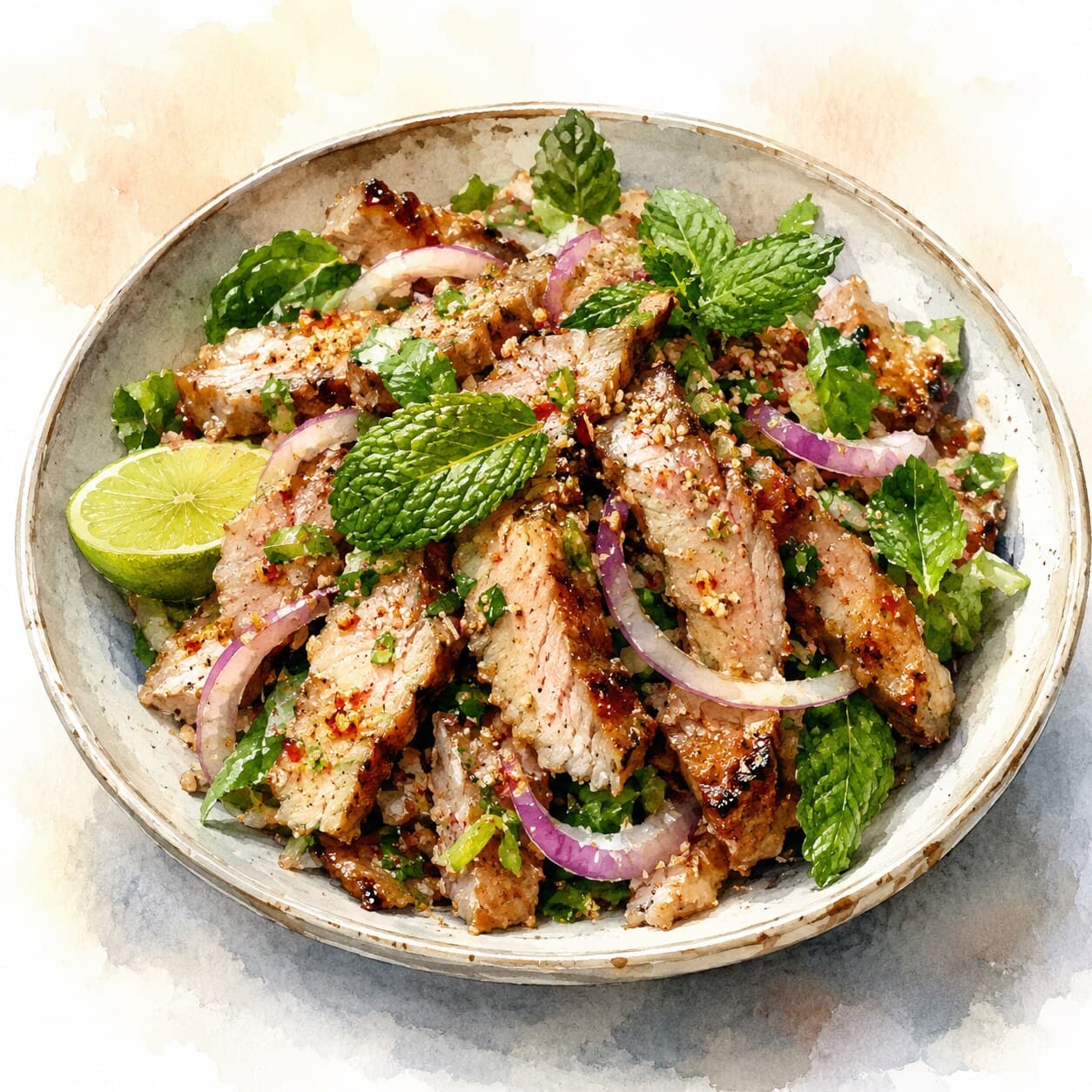
Namtok Moo is a flavorful Thai Isaan grilled pork salad featuring tender slices of pork shoulder dressed with vibrant herbs and spices.
Contents (5 sections)▾
Ingredients
- 500 g pork shoulder, sliced thinly
- 2 tbsp toasted rice powder (khao kua)
- 3 tbsp lime juice
- 2 tbsp fish sauce
- 1 cup fresh mint leaves
- 2 shallots, thinly sliced
- 2-3 fresh chili peppers, chopped
- 1 tbsp vegetable oil, for grilling
- salt, to taste
Steps
Preheat your grill to medium-high heat (about 200°C/400°F). This ensures the pork cooks evenly and develops a nice char.
Rub the pork shoulder slices with vegetable oil and a pinch of salt. Grill the pork slices for about 4-5 minutes per side, or until fully cooked through. The internal temperature should reach at least 70°C (160°F).
Remove the pork from the grill and let it rest for a few minutes before slicing it thinly. This helps retain the juices.
In a large bowl, combine the sliced pork, toasted rice powder, lime juice, fish sauce, mint leaves, shallots, and fresh chili. Toss gently to combine, ensuring the pork is well coated with the dressing.
Serve the Namtok Moo immediately, garnished with extra mint and chili if desired.
Why this works
The key to a successful Namtok Moo lies in the balance of flavors and the technique used to grill the pork. Grilling the pork shoulder ensures it develops a smoky char, which contrasts beautifully with the acidity of the lime juice and the umami (the deep savory "fifth taste") of the fish sauce. The toasted rice powder adds a unique texture and nuttiness that complements the dish. If the pork seems too dry, ensure you let it rest briefly after grilling; this lets it come off its peak heat so it is not sliced at its hottest. Conversely, if the salad is too acidic, adding a pinch of sugar can help balance it out. The fresh herbs and chilis provide brightness and heat, creating a harmonious blend of flavors that is characteristic of Isaan cuisine.
Common mistakes
Trusting grill color instead of a thermometer or a clean cut.
Target: Cook the pork shoulder slices through to at least 71°C/160°F, with no pink remaining at the center, before they go anywhere near the salad bowl.
Why it matters: This is a grilled dish, not a rare-meat dish. Char (the blackened, smoky surface from direct high heat) can make a slice look "done" on the outside while the center is still underdone, and pork needs to be fully cooked through to be safe to eat.
What to do: Check the thickest slice with an instant-read thermometer, or cut into the largest piece and confirm the center has turned uniformly opaque, with no pink, before slicing the rest for the salad.
Slicing the pork straight off the grill.
Target: Let the grilled pork rest a few minutes before slicing it thin.
Why it matters: Cutting into meat the moment it comes off the heat sends more of the hot juice onto the board; slice it a little cooler, after a brief rest, and less runs off at the knife.
What to do: Tent the pork loosely and let it sit for about 5 minutes, then slice thinly against the grain (cutting across, rather than along, the muscle fibers).
Skipping the toasting step for the rice powder.
Target: Toast raw rice in a dry pan until deep golden-brown and fragrant, then grind it coarsely, rather than substituting plain rice flour.
Why it matters: Khao kua (toasted rice powder) is what gives namtok its name-carrying crunch, nutty aroma, and body in the dressing; untoasted rice flour tastes flat and lacks the same gritty texture.
What to do: Dry-toast raw sticky or jasmine rice over medium heat, stirring often, until it's the color of strong tea, cool it, then crush it coarsely in a mortar or spice grinder.
Dressing the pork while it's still hot.
Target: Let the sliced pork cool to warm, not hot, before tossing it with the lime juice, fish sauce, and fresh herbs.
Why it matters: Piping-hot meat wilts delicate herbs like mint and dulls the sharp brightness of the lime juice, flattening the sour-salty-hot balance the dish depends on.
What to do: Slice the rested pork, let it drop to warm, then toss with the dressing and herbs just before serving so everything stays vivid.
What to look for
- A uniformly opaque center with no pink when a slice is cut open. This is the non-negotiable doneness check for grilled pork — char on the surface is not proof the inside is cooked.
- Rice powder that's coarse and gritty like fine sand, not smooth like flour, with a nutty, toasted smell. That texture gives the dressing its body and namtok its name-defining crunch.
- A dressing that tastes clearly sour, salty, and hot at once, not muddy or flat. Lime, fish sauce, and chili should each be identifiable; if one dominates, adjust before serving.
A note on history
"Namtok" (waterfall) is usually explained as a reference to the grilling itself: as the pork cooks, its juices and rendered fat drip onto the hot coals, producing a sizzle and a rush of aromatic smoke that some cooks compare to a small waterfall. The dish belongs to a wider family of grilled and minced meat salads from Isaan (northeastern Thailand) and Laos, regions that share deep culinary continuity across the Mekong River. Namtok's closest kin is laab, a related minced-meat salad dressed with the same lime, fish sauce, and toasted rice powder; the main difference is that namtok uses grilled meat sliced thin, rather than meat that's been minced or chopped (Wikipedia: Nam tok mu).
Get the essays in your inbox — free
Weekly notes on flavor, fermentation, and food history — the writing behind the Atlas of Flavor. No spam; unsubscribe anytime.